
• Skip to primary navigation
  • Skip to content
  • Skip to primary sidebar
  • Skip to footer

SkinTrack

  • Lightest Gear
    • Skis
    • Boots
    • Bindings
    • Skins
    • Packs
  • Skimo Training
    • Training Plans + Skimo Manual
    • Transitions Videos
  • Facebook
  • Instagram

Dynafit

Is Your Skimo Helmet Legal for Racing? New ISMF Rule and the EN 12492, EN 1077 and UIAA 106 certifications

October 24, 2016 By Stano Faban 23 Comments

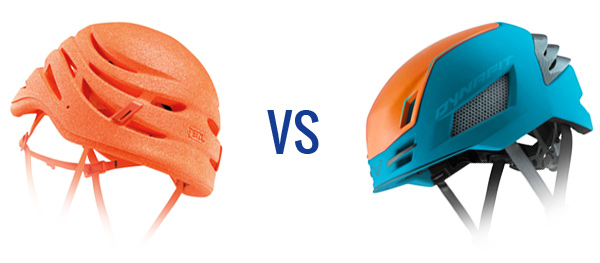
skimo-helmets-matchup
Several weeks ago, we hinted that some new ISMF rule changes will affect the gear skimo athletes will need to use at ISMF sanctioned races starting in the 2016/17 season. Since then one of the most debated topics among athletes revolves around helmets.
Here, we are taking a deeper look at:

  • the new ISMF helmet rule and how it will affect the use of your (and our) current helmets,
  • what the certifications/standards mean,
  • what you should pay attention to in a store,
  • which helmets currently on the market have both of these certifications.

* ISMF stands for International Ski Mountaineering Federation and is the world governing body for skimo racing.

The new ISMF rule and required helmet certifications

For years, ISMF required our skimo racing helmets to meet only the UIAA 106 or EN 12492 standards. Both are basically the same and saying a helmet has been certified for mountaineering.
However, with the beginning of the new racing season our helmets will also require the EN 1077 classB standard – effectively meaning, a helmet has been certified for alpine skiing.
This is the helmet rule to the letter as of last update in early October 2016:

A helmet conforming to:
– UIAA 106 (For season 2016-2017 : UIAA 106 and EN 1077 classB standards)
– or EN 12492 (For season 2016-2017 : or EN 12492 and EN 1077 classB standards).
Helmets must be used (chin-strap has to be fastened) during the whole race (from the start to the finish line). CE/UIAA: Yes.

What do these certifications and standards mean?

In a nutshell, this is the difference between the two certifications/standards:

  • UIAA 106 and EN 12492 standards test and approve helmets mainly for impact from above such as rockfall, hence, the standard was designed for climbing and mountaineering helmets.
  • EN 1077 standard tests and approves helmets for alpine skiing where a lot of impact is happening on collision or when a skier falls. Statistically, in such situations the impact is coming from the sides or the back of the head.
    This standard further divides into class A and class B, which essentially only differentiates the amount of head’s side and back areas covered up by the helmet. Class A helmets cover the head more while class B helmets less, however, both meet the same minimal impact force requirement protection from directions defined in the standard.

Do you really need a new helmet?

The answer is not black and white. First check your old helmet for certification tags to see whether or not it is compliant with both standards. Beyond this:

  • You will need a new helmet if you are planning on racing in World Cups, World Championships or any races that fully comply with ISMF rules.
  • You may not need a new helmet right away for racing in smaller events in the US, Canada and other countries depending whether their federations and organizers follow ISMF rules to the letter or are a bit more “accommodating” for the sake of growing the local skimo scene.

As for US and Canadian races, we received confirmation from both federations that they won’t be enforcing this rule in the current season, and will only start to do so from 2017/18. This is because many of the new helmets won’t even make it to North American market this year.

Buying your new certified skimo racing helmet

When buying your new lid you want to make absolutely sure that it has the above specified double-certification. Check for those little “EN” stickers or tags inside the helmet or on manufacturer’s website as not all store employees will know the correct answer.

Ventilation

We are curious to see how the new helmets will ventilate. While safety is a priority, in skimo we spend majority of time climbing, with the surface of our heads being one of the most important areas through which the body cools. On most ski-rated helmets, vents are conspicuously absent – likely because they are primarily designed for descending, and therefore warmth.
Road cycling also went through this “ventilation” debate but the speeds reached on a bicycle while climbing are much higher than while skinning and the helmets don’t need to meet the mountaineering standard; therefore, cooling is much easier. It will probably take a few years before a happy medium is found and a manufacturer can develop a new skim0-specific design.

Currently compliant helmets on the market under 500g
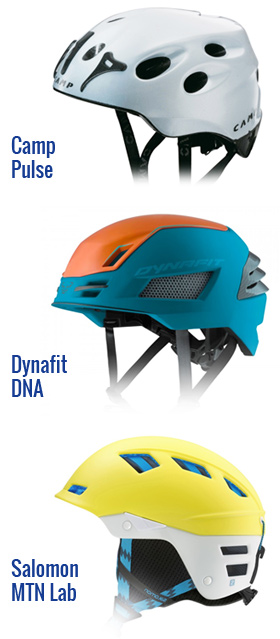
skimo-helmets-comply-ismfAccording to our own research (mainly based on manufacturers’ websites) here is a list of helmets that comply with the new ISMF rule and are currently on the market.
However,many of these won’t be available in North American stores just yet.
Alpina Snow Tour – 330g
Camp Pulse – around 360g (must be used with winter kit for double certification)
Cebe Trilogy – around 360g
Dynafit Daymaker – 320g
Dynafit DNA – 290g
Dynafit ST – 320g
Kong Kosmos – 390g (also certified for cycling)
Mammut Alpine Rider – 430g
Salewa Vert FSM – 400g
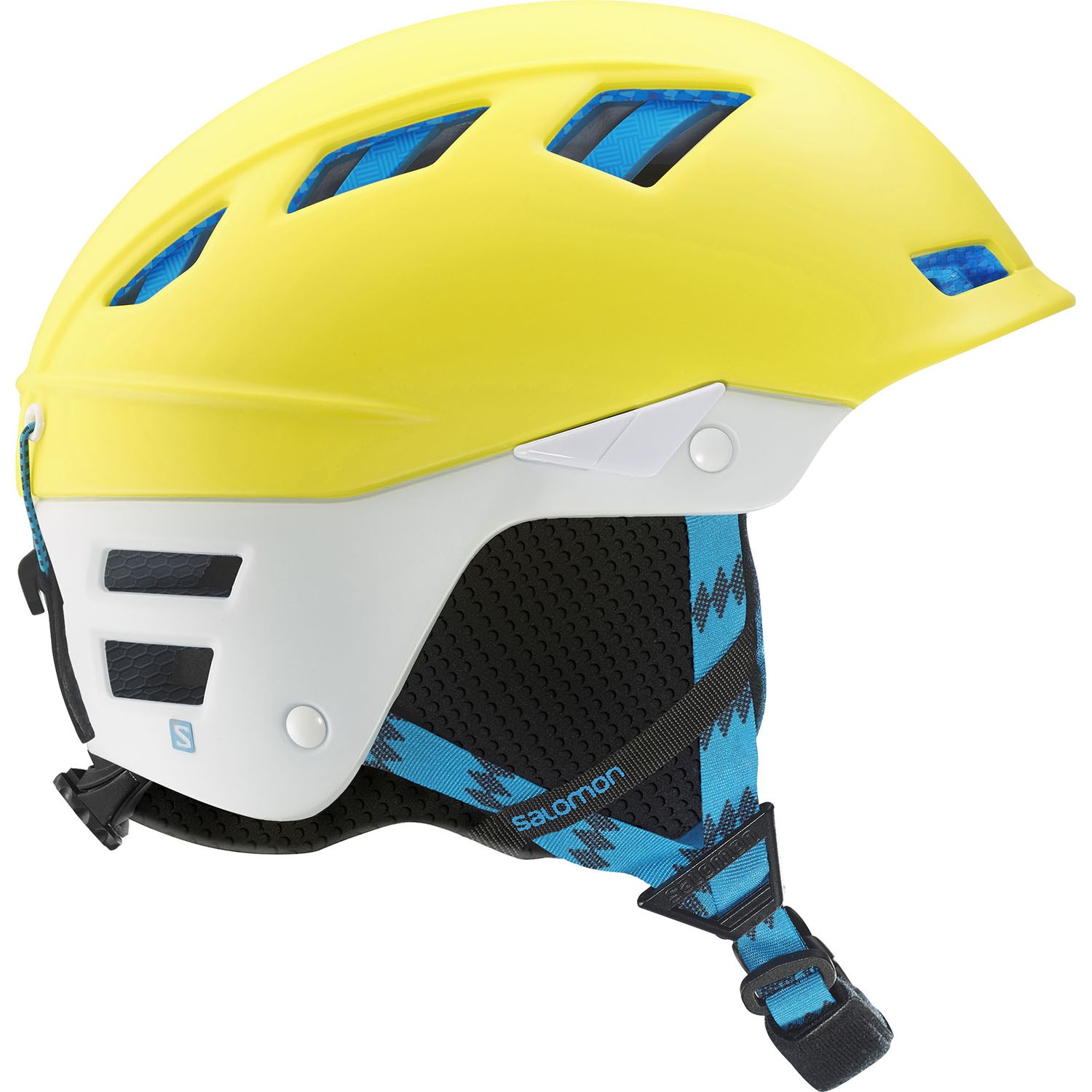
Salomon MTN Lab – 300g – Read our review!
Ski Trab Casco Gara/Race – 280g
Ski Trab Casco Maximo – 280g
Uvex P.8000 Tour – 310g

Non-compliant but popular “ski mountaineering” helmets

Note that some of these helmets might meet the EN 1077 standard for skiing in the future but they first need to be tested for it, thus, as of now they don’t comply:
Black Diamond Vapor
Black Diamond Vector
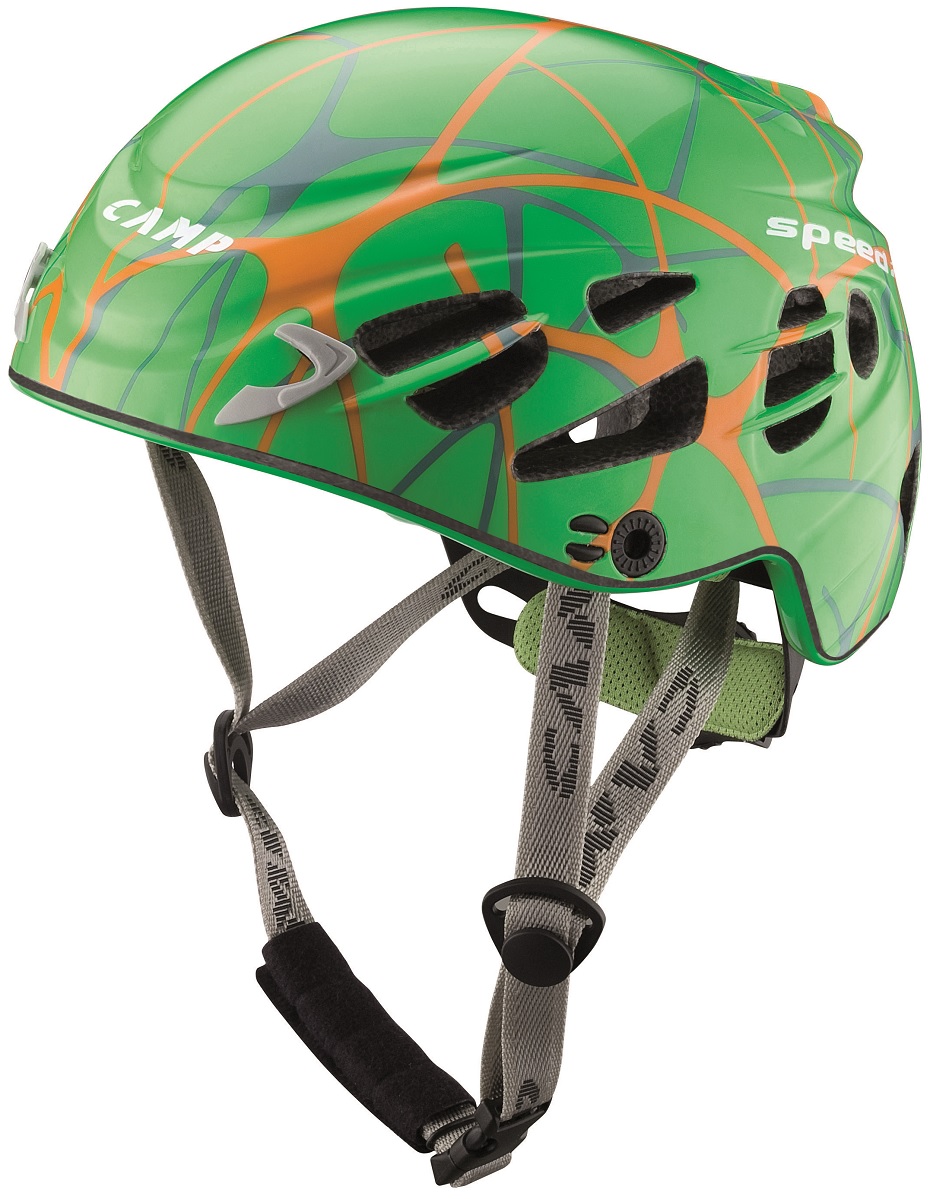
Camp Speed 2.0
Dynafit Radical
Edelrid Shield Lite
Kong Leef
La Sportiva Mulaz (same as Crazy Idea Crazy NRG)
La Sportiva RSR (same as Crazy Idea Crazy Carbon)
Petzl Scirocco
Petzl Meteor
Ski Trab Attivo (same helmet as Kong Leef)
Filed Under: Gear, Tech & Food, Skimo Racing Tagged With: Camp, Dynafit, ISMF, Mammut, Salomon, Ski Trab, skimo helmet

Important Changes to 2017 ISMF Race Gear Rules

August 8, 2016 By Stano Faban Leave a Comment

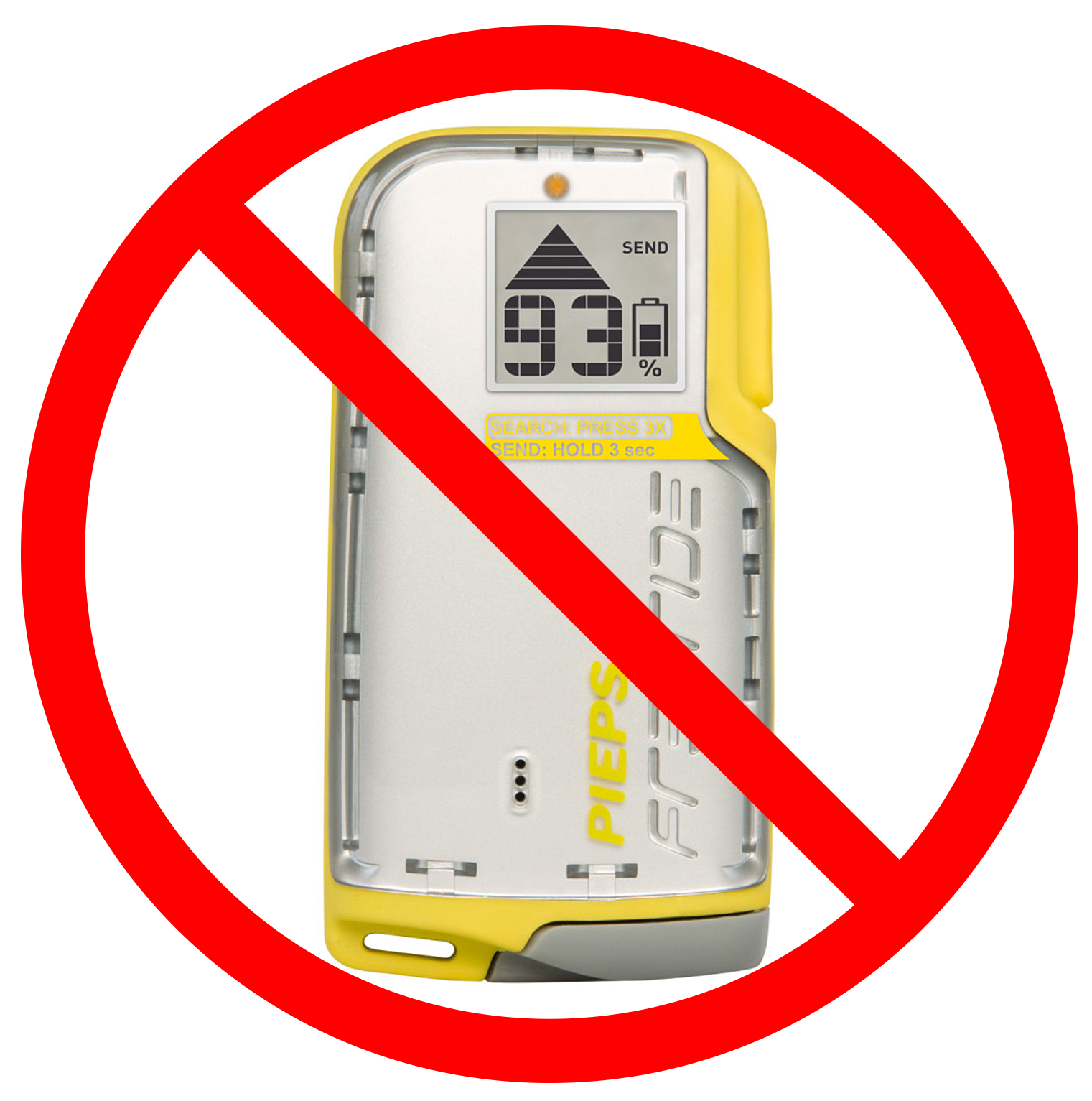
nopiepsSeveral important rule changes were adopted in that will impact racers competing on the World Cup and at World Championships level in the upcoming 2017 season. Sources inside the International Ski Mountaineering Federation (ISMF) say that a grace period was given to athletes last season with enforcement of the rules beginning this year.

Three-antenna Transceivers Will Be Required

All avalanche beacons must be a full three-antenna model. This will primarily impact racers using the lightweight Pieps Freeride which will no longer be compliant. Thankfully, Pieps showcased a new lightweight three-antenna beacon in January, called the Pieps Micro, weighing in at 150g (the Freeride was 110g).
We suspect that all but the most hardcore racers will opt to use their normal ski-touring beacon rather than dropping nearly $400 USD on a new beacon. However, every gram counts and the beacon will last many more seasons than a pair of skis or boots.

Zippered Transceiver Pocket

Another related change is the requirement that beacons must be placed inside an internal zippered pocket. Putting the beacon in a skin pocket is not allowed and even the dedicated beacon pockets found on more recent Dynafit and Crazy Idea suits with the two overlapping flaps of fabric will not be compliant.
Thus, right now it might be a good time to do some surgery on your suit to add a small zipper.

Double Helmet Certification

The other big change is the requirement that helmets must be certified to both climbing standards (UIAA 106/EN 12492) AND a ski standards (EN 1077). Most current helmets (Petzl Sirocco or BD Vapor for example) in use by racers are only rated for climbing. If you are unsure, check your helmet for a sticker that shows the EN 1077 designation. If you have that, you are good to go!
salomon-mtn-lab-helmet-matte-yellow-whiteAs far as we can tell, only a few manufacturers have released double-certified helmets:
Ski Trab Gara – 280g
CAMP Pulse (with the addition of the winter kit) – 339g
Dynafit DNA (we can’t actually find this for sale anywhere) – 290g
Salomon MTN Lab – 300g
There might be a slight chance that some of the currently non-compliant helmets might not have been tested for the ski certification before but manufacturers will pursue this in the future and become compliant if they pass. But it’s impossible to know.

Ventilation

We are very curious to see how the newly certified helmets will ventilate. While safety is a priority, in skimo we spend 95% of the time climbing and sweating heavily, with the surface of our heads being (one of) the most important areas through which the body cools.
Road cycling also went through this debate, however, the speeds reached on a bicycle while climbing are much greater than while skinning. We suspect that it will take a couple of years before a happy medium is found.
 

Filed Under: Gear, Tech & Food Tagged With: Camp, Dynafit, ISMF, Pieps, Salomon, Ski Trab

New Ski Mountaineering and Skimo Racing Skis: La Sportiva, Fischer, Black Diamond, Dynafit, Salomon, Atomic, Hagan, Voile

February 14, 2016 By Stano Faban 2 Comments

During my recent visit to Outdoor Retailer show I had a chance to touch, flex and discover new skimo racing and ski mountaineering skis that will be coming out in the fall of 2016.
My overall observation was that now most manufacturers, instead of just few, will have a light line of skis. And I do mean light, and I do mean a line of skis. This means that going forward, whether you will want a light pair of 80mm skis, or 90mm, or even wider, then you will have more choice than ever before.
» For current lightest skimo skis see our comparisons chart.

La Sportiva and Ski Trab skis

The most interesting finding while browsing the La Sportiva booth, and apart from the new Stratos Hi-Cube ski boots, was that starting next season Ski Trab is partnering with La Sportiva to bring their skimo racing and light touring models to North America.
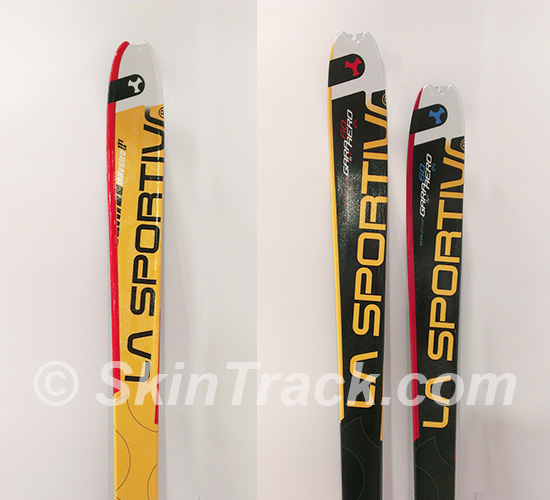
Below you can see that they will be La Sportiva branded Ski Trab skis. On the left, it’s the Maestro LS (940g at 171cm, width 75mm) suitable for lots of spring ski mountaineering, and on the right, are the racing models Gara Aero LS for men and women (715g at 164cm, and 685g at 157cm).
la-sportiva-ski-trab-skis-2016
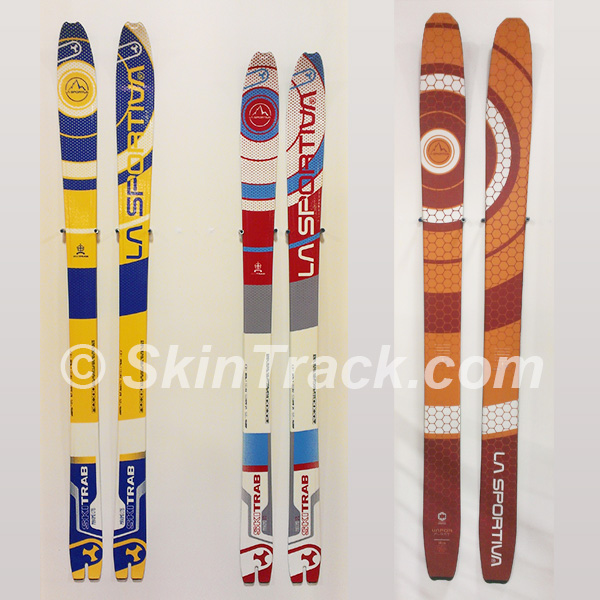
Here are some wider skis from La Sportiva, from left – Maximo LS men and women models (1310g at 178cm width 90mm, and 1205g at 164cm width 92mm)  that are intended for fun, light and fast ski touring. Then in contrast on the right you can see the new Vapor Float powder machines weighing only 1400g at 178cm while measuring 117mm in waist!
la-sportiva-skis-2016-fat

Fischer skis

Just like with the new great looking Travers Carbon ski boot, Fischer is disrupting the market with some light touring skis as well.
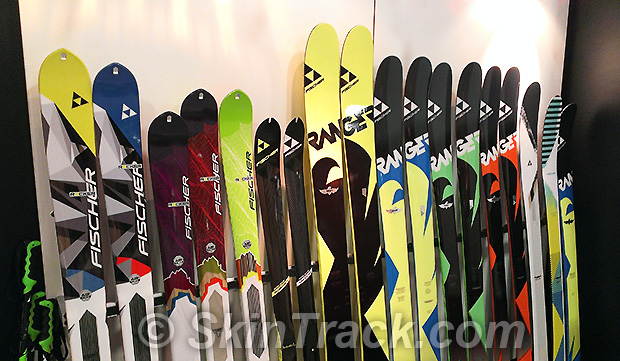
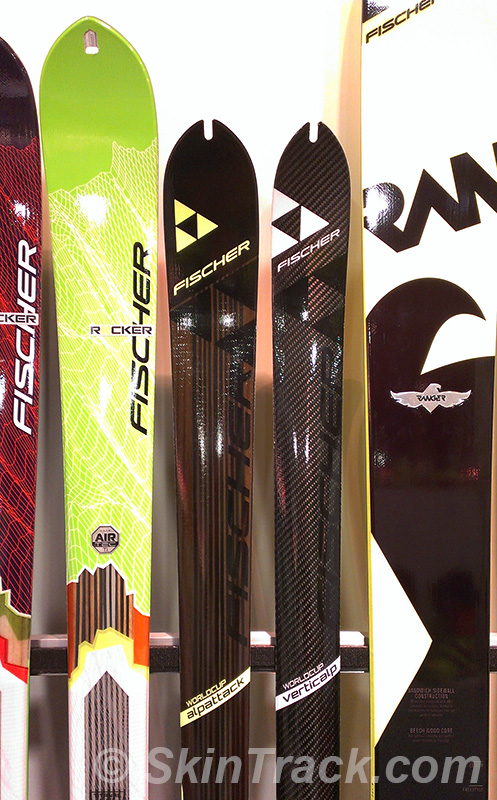
The photo below shows their full ski touring and skimo racing line. The first two from left are Hannibal 100 and Hannibal 94 (1500g at 180cm width 100mm, 1250g at 177cm width 94mm) for ski touring in powder and soft snow. Then I want to highlight the Transalp 80, in green and fifth from left, as highly suitable for any type of ski mountaineering whether that be steep faces, couloirs, or just enjoying corn in the spring, weighing only 950g at 163cm in width 80mm! The Ranger line is freeride oriented – wider, fun but still pretty light given the widths.
fischer-skis-line-2016
For ski mountaineering racing, Fischer is pushing the weight limits with their two models (photo below):

  • The VerticAlp (in black on the right) is a pure vertical race specialist – 580g in 161cm – and it features a substantial camber to mimic classic xc skis for improved kick, and almost no side-cut (82-64-72) to ensure the skis doesn’t glide sideways on any terrain. This is a great design given that modern vertical races are hosted mostly on groomed runs and roads.
  • The AlpAttack (in black on the left) is a super light skimo racing skis – 650g at 161cm – with what appears to be a stiff torsional construction, thus, it should ski well at high speed and in hard/icy conditions. The 99mm at the tip, in contrast with 65mm waist and 81mm tail, should make the ski float well in powder and crusty snow.

fischer-race-skis-2016

Black Diamond skis

While Black Diamond has been producing some light skis already, their new full Helio line is screaming ski mountaineering in all conditions. On top of that, Black Diamond has moved production of its skis from China to Austria which should result in greater durability than before.
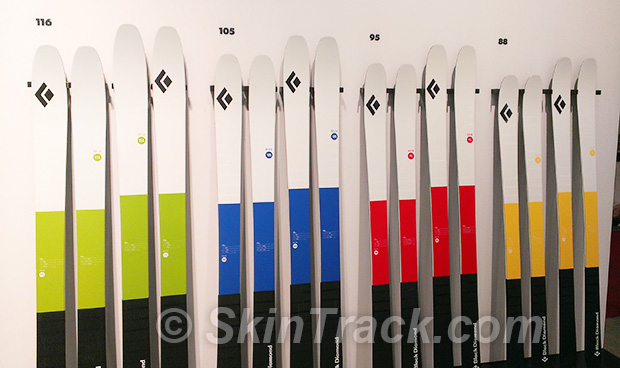
All Helio models feature carbon reinforcements, ABS sidewalls and ultra-light balsa flax wood core. All skis feel very light yet strongly built, and are shaped and rockered exactly for the type of snow or skiing their widths predetermines them.

  • 116 model weighs 1550g in 176cm at 143-116-126 and features generous tip and tail rocker.
  • 105 model weighs 1450g in 175cm at 132-105-119 with slightly smaller rocker at both ends than the 116 model.
  • 95 model weighs 1250g in 173cm at 123-95-113 and slightly shorter rockers than 105.
  • 88 model is shaped a bit differently than any of the above. It seems to be built for spring, steep and hard snow ski mountaineering. Weighing 1200g in 168cm at 121-88-111 the ski feels torsionally stiff and has just enough rocker to make it a well rounded tool.

black-diamond-skis-2016

Dynafit skis

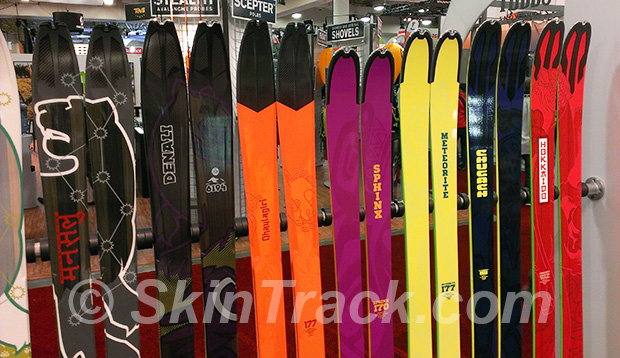
After liberating the world from heavy and clunky bindings in late 80s, Dynafit is now also known for its light skis in all kinds of widths and shapes. However, in last 2-3 seasons, the brand is poking into ever more into the freeride skiing. Here are couple of upcoming models from the photo below:

  • Third pair from left, the new Dhaulagiri, named after 8000m peak, appears to be suited for a variety of conditions but will mostly likely excel most in softer snow – weighing 1400g in 177cm with a side-cut of 130.5-99-114.
  • The purple Sphinx (1670g in 170cm at 124-96-114) is a woman-specific model while the green/yellow Meteorite (1820g in 177cm at 126-97-116) is for heavier or more aggressive skiers. Both versions should be suitable for higher speeds given their bigger mass.
  • The Chugach (1950g in 181cm at 107mm width) and Hokkaido (2100g in 182cm at 117mm width) models are big mountain skis and more traditional shape than other recent Dynafit models.

dynafit-skis-fat-2016
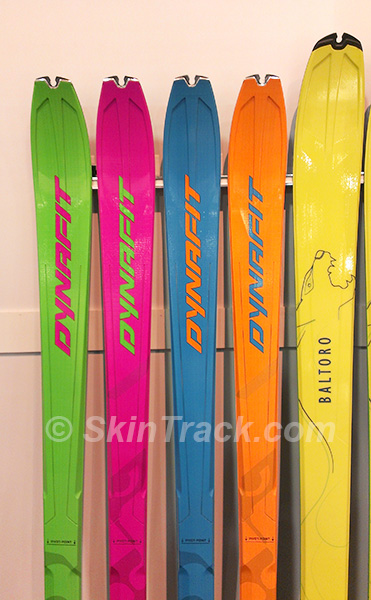
In skimo racing department, Dynafit is now using their flex tip technology and new side shaping (like in the above Denali and Dhaulagiri models) with different colours for let and right skis:

  • DNA model, the two skis on the left, is Dynafit’s lightest weighing 690g in 161cm with a side-cut of 99-65-80. 
  • PDG model, two skis in the middle, is a heavier version of the DNAs with the same side-cut and length but at 790g. Usually, also about half the price of the DNA.

dynafit-race-skis-2016

Salomon S-Lab Minim ski

With long tradition in ski edges, boots and bindings manufacturing, Salomon has only started to build their own full skis in around 1990.
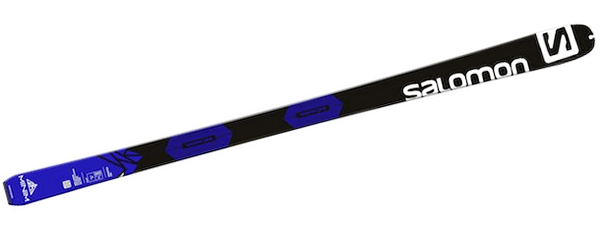
I went to the Salomon ski booth to mostly check out their new light S-Lab Minim ski mountaineering ski as it was developed in collaboration with Kilian Jornet, who previously skied Atomics for a long time.
The Minim ski will weigh 720g in 160cm and is slightly wider than all other skimo racing skis – with a side-cut of 97-68.5-83 it is 3-4mm wider in the waist. It features Karuba woodcore and CFX Superfiber reinforcement.
Salomon-s-lab-minim-skis-2016

Atomic skis

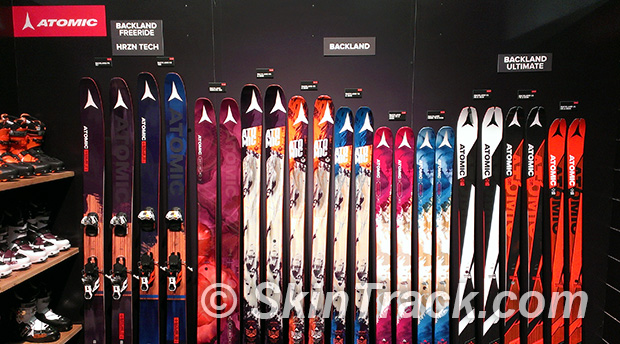
Like Fischer, Atomic is an Austrian manufacturer and has been building skis for decades. Although they have couple of touring and freeride models I was mostly insterested in checking out their Backland Ultimate line (on the right side below) as they are the brand’s most suitable for light and fast ski mountaineering:

  • Backland UL 85 weighs only 1050g at 163cm with a 85mm waist
  • Backland UL 78 comes in 980g at 163cm with a 78mm waist
  • and Atomic’s skimo racing skis, the Backland UL 65, weighs only 680g at 162cm with waist of 65mm and a reshaped tip

atomic-skis-2016

Hagan and Voile skis

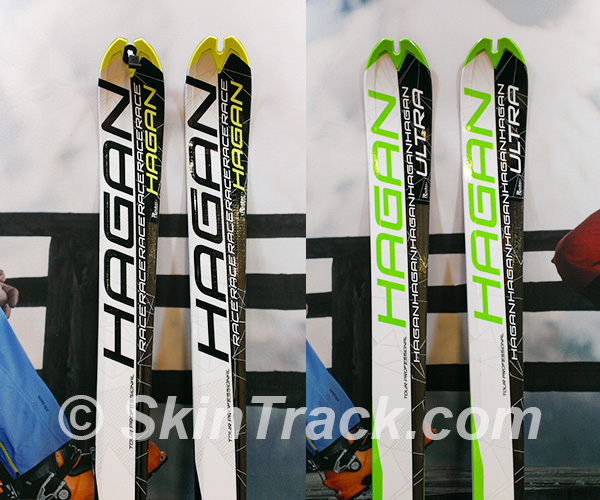
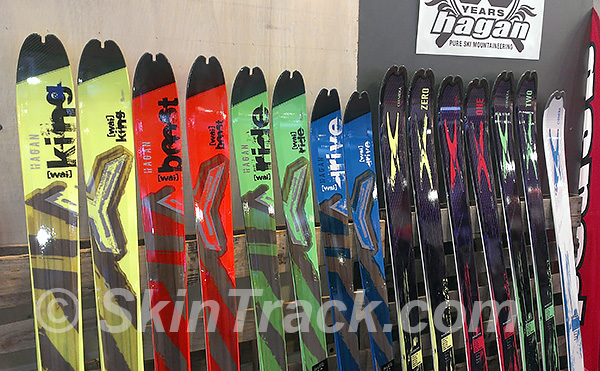
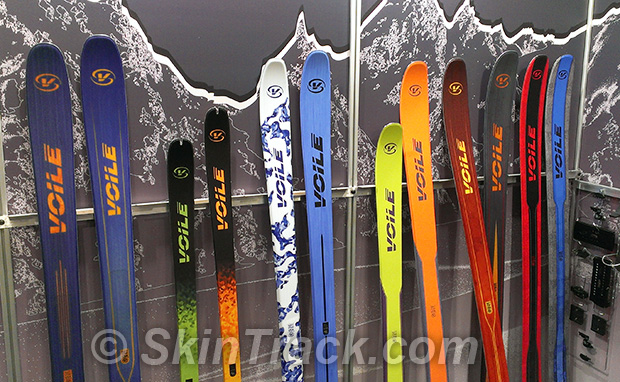
While Hagan has been manufacturing skimo racing skis for long time Voile entered the market only two years ago. However, both brands have a couple of lightweight models in various widths. I didn’t get any specifications for the below skis but both brands have improved their existing models and should not definitely not be overlooked when buying a new quiver next season.

Hagan's new racing models feel torsionally stiffer and tip's shape has been improved for skinning.
Hagan’s new racing models feel torsionally stiffer and tip’s shape has been improved for skinning.
All of the Hagan wider models feel very solid and lightweight.
Voile is a Salt Lake City manufacturer with reputation for well built yet lighter weight skis. Their skimo race skis have substantial rocker and can been clearly picked out in this photo.
voile-skis-2016

Filed Under: Gear, Tech & Food, Skimo Racing Tagged With: Atomic, Black Diamond, Dynafit, Fischer, Hagan, La Sportiva, Salomon, Ski Mountaineering, skimo racing gear, Skis, Voile

Long-term Review: Dynafit RC-1 Skimo Boots

December 21, 2015 By Stano Faban 3 Comments

2015 Dynafit RC-1
2015 Dynafit RC-1

Quick overview:

  • Usual full price: $2150 USD
  • Weight: 507 g (size 27)
  • Cuff Rotation: 75 degrees
  • Forward Lean: 12/18 deg
  • Material: Carbon Fibre
  • Liner Type: Palu Race 400
  • Pros: lightweight, stiff
  • Cons: fragile, binding compatibility, liner quality
  • Suitability: high level skimo racing

Bottom Line:

The lightest boot on the market, they race well but are somewhat fragile. A big investment with big weight savings!

Photos:

Product description and How we tested it:

Departing from the tradition of developing their own lightweight boots in-house, Dynafit has begin licensing the work of renowned boot maker Pierre Gignoux (PG). The RC-1 is Dynafit’s lightest offering coming in at a svelte 507 grams per boot in size 27 – well below the options offered by competitors such as La Sportiva and Scarpa. The low weight of the all-carbon boot is immediately apparent when you slip it on.
One of the most noticeable features is the liner which only goes as high as to cover the ankle bones. Above, foam padding on the outer shell clamps onto the athlete’s shin, making an upper liner unnecessary. The liner is incredibly lightweight but this comes at a cost to durability. Several wear points exist at the heel and near the cuff pivots. It would be interesting to try the bikini-style liner available from PG or something similar to sock liner (but cut to ankle height) used in the Scarpa Alien 1.0. A tighter fitting sock liner might improve the fit as well as reduce wear.
The boot uses a simple vertical throw lever for locking the cuff into ski mode (similar to the Scarpa Alien lever). This is different from the ‘Ultra-Lock’ lever on previous Dynafit Dy.N.A. and PDG boots but requires less cutting of the skimo race suit bottoms and results in less snow making its way into the boot. The lever is easy to flick down and it accurately snaps into ski position without a need to guide it. Placing of the lever’s lock post (the bottom piece), skimo suit or pants don’t cover it, unlike with the Ultra-Lock system, making for a slightly faster/easier transition.
The foot-locking mechanism is a ratchet strap on the instep and a cord tightened by the throw lever to tighten the upper cuff. The 2016 version of the boot, called DNA now, features ratchet straps on around the upper cuff as well, to provide easier fit fine tuning (though, likely at a small weight penalty). Lower tightening is also accomplished with a quick lace system similar to that seen on many Salomon running shoes.
Early (black and white) versions of the RC-1 were sold with a relatively thin sole. This sole was poorly glued to the boot and was prone to damage. Inline changes (both to black/white and green/pink) brought a new, higher quality sole with better glue. Luckily, PG is friendly with warranty requests and will replace the old sole with a new one.
It is worth noting that no version of the RC-1 uses Dynafit’s proprietary toe tech fittings (which is odd but understandable given an independent manufacturer), but rather a custom fitting designed to be used with the RC-1 bindings (also engineered by Pierre Gignoux). I decided against mounting the RC-1 bindings on my race skis and instead went with the traditional Low-Tech Race. To make a good fit, this required a small amount of surgery to remove a few mm of sole on the bottom of the toe. Stepping into a Low-Tech, the binding snaps and locks but not quite as tight as it does with Dy.N.A. boots. Interestingly, when paired with Plum Race bindings, the binding does shut completely. Despite this being a bit disconcerting, I’ve never had a binding release and I am comfortable skiing them on steep terrain in a race.
The boot fits slightly wider and longer than traditional Dynafit boots. The sole is also perfectly flat and quite hard. I immediately put a custom insole into the liner to get the support my, generally not very picky, feet needed.
I used a variety of crampons with the RC-1. The only compatibility issue was with the front welt. Unlike most plastic boots with a well defined edge on the front welt, the RC-1 welt is very smooth and rounded (and made of carbon). This made any crampon with a toe bail feel less secure. Most commonly, I used the CAMP Race-290 crampons.  Strap-on crampons work fine as expected. While racing the Trofeo Mezzalama last spring, steel crampons were required for sections of exposed ice. I had only a pair of BD Sabretooth Pro crampons (clip-on version) which generally stayed attached despite the minimal welt. While I am suspect of any crampons on race boots, these boots are particularly insecure unless using a strap system – be careful.
My boots have seen about 70 days of use, mostly racing. My main durability issue has been the liner but my lower shell also developed a crack in the carbon that propagated out from the cuff pivot. PG was quick to replace the shell when I stopped in their tent at the Pierra Menta!
It is worthwhile to note that PG makes a slightly heavier version – called Black – that appears to be much more robust for training and mountain adventures (it has a covered tongue rather than being open) but is also plenty light for racing (600 grams).
Overall thoughts: If you want to race on the same boot as the best racers in the world (Laetitia Roux, Anton Palzer, Kilian Jornet, Emelie Forsberg, etc…) these are the right pick. They are the lightest available, ski well, and are fast in transitions. Just take good care of them!

Pros:

  • Lightest on the market.
  • They ski well.
  • I like the rear throw lever.
  • Excellent customer service/warranty service at PG.
  • Moderate crampon fit.

Things to be improved:

  • Fragile (but that comes with the territory).
  • Does not use the Dynafit Quick-Step toe fitting.
  • Warranty issues must go through PG in France.
  • Liner is quick to wear.

Filed Under: Reviews Tagged With: Dynafit, Dynafit DNA, Dynafit RC1, Pierre Gignoux, skimo boots

New Skimo Gear for 2015-2016 Season

September 28, 2015 By Stano Faban 7 Comments

La Sportiva Sideral 2.0
It’s that time of year when all the manufacturers are coming out with the newest products. Here we want to give you a quick overview of what is new this season. Frankly, it is a relatively quiet one, with very few truly new products. Several companies have given current products some big updates however.
The biggest change of the season is in skimo racing bindings. Weight continues to be shaved off despite new ISMF regulations that require race bindings to have manual locking mechanisms (pulling up on the toe piece to lock in). All the major brands now have a competitive (light weight) binding with a manual lock.

La Sportiva

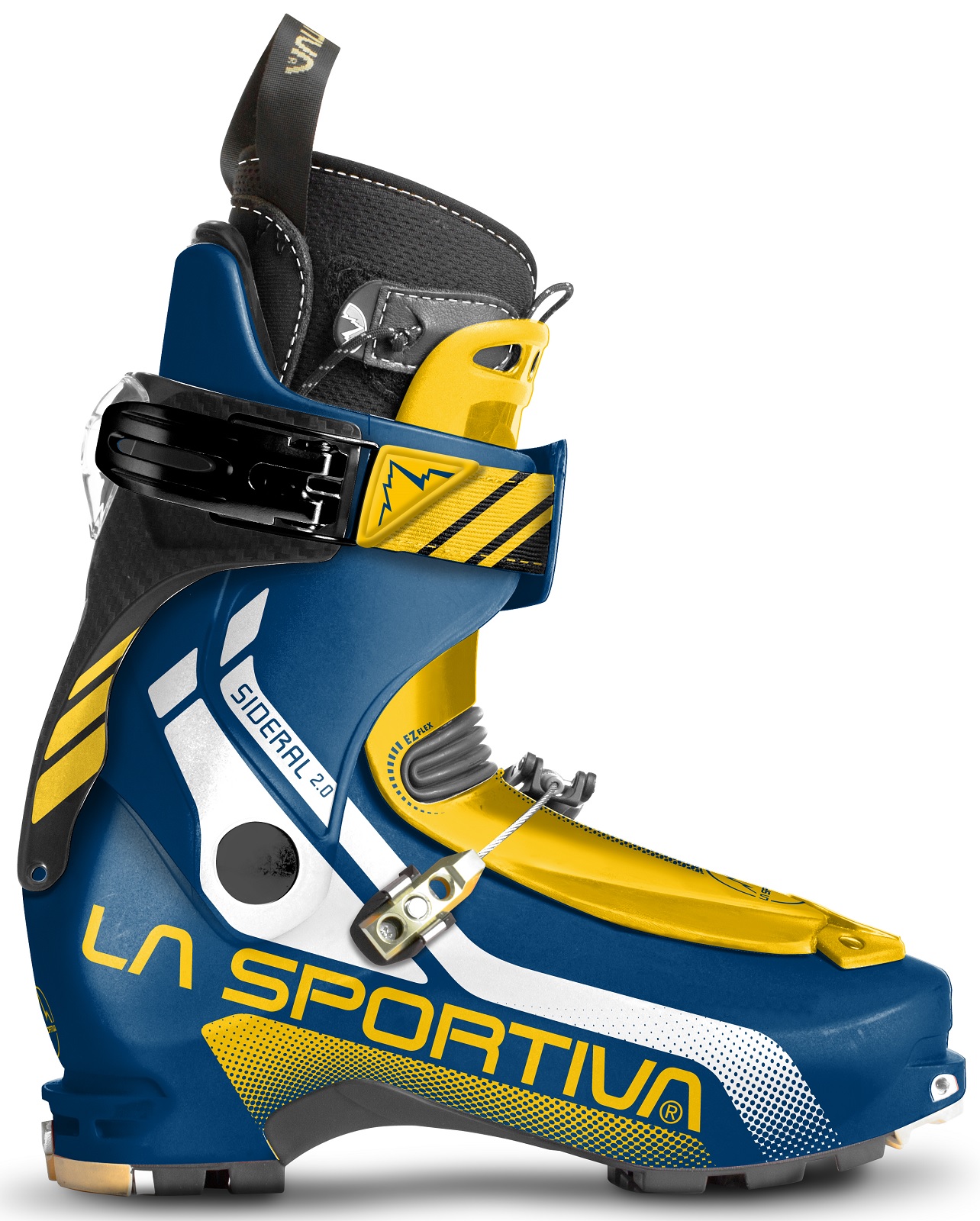
No major changes to the La Sportiva ski line but the citizen race/ski touring boot – the Sideral – has been update to the 2.0 version. It features improved buckles (borrowed from the Spectre model) and an updated sole that offers compatibility with Tech, Frame and Trab TR2 binding systems.

  • Here is Sideral 2.0 on Skimo.co
  • And at Cripple Creek BC

Dynafit

Dynafit continues to improve its ski running line with the retail release of the 2.0 version of the DNA Race ski, boot, and Low Tech Race binding.

Dynafit Low Tech Race 2.0 Binding
DNA 2.0 ski (and PDG 2.0) – The new DNA ski is 40 grams lighter than the black DyNA thanks to its carbon construction. It is also shaped a bit differently (similar to the Cho-Oyu or Denali shape) compared to previous version, while retaining the same dimensions (99-65-80) and turn radius (20m). The PDG 2.0 adopts the same shape and shaves 25 grams off its predecessor.
DNA Boot (PG RC-1 2.0) – Last year, Dynafit stepped away from their DyNA race boot and began licensing the Pierre Gignoux Morpho 400 as their RC-1 race boot. The 2015/16 DNA Boot is an improved RC-1 with a new color scheme (green and pink to match the skis) as well as an improved sole (way better than the RC-1!), and a new upper cuff strap system. Probably, it will be pretty difficult to find much stock in the US but if you find yourself in Europe it’s much more common over there.
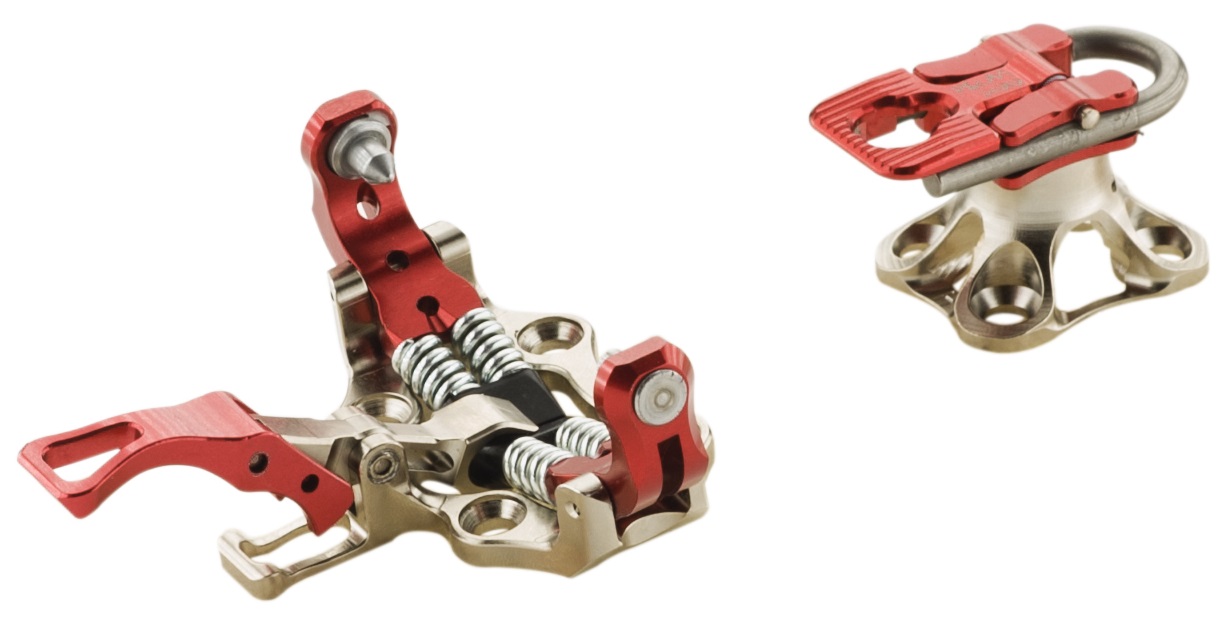
Low Tech Race 2.0 Binding – With ISMF regulations requiring a race binding toe that does not auto lock, the Low Tech Race has taken an TLT Superlight toe piece with locking lever and trimmed it down to the essential material, pairing it with a Gignoux plastic heel piece to create a lightweight (around 100g) binding with a removable crampon attachment.

  • DNA skis on Skimo.co
  • DNA boots (previously RC-1) at Dynafit.com
  • Low Tech 2.0 bindings on Skimo.co
  • Dynafit PDG 2.0 skis on Cripple Creek BC
Plum Race 99 Bindings

Plum

Race 99 Binding – This is an exciting entry into the game from Plum as the lightest all-metal binding on the market at a scant 99 grams. Mount these on any of the lighter skis and you might find yourself needing to add weight to meet the ISMF minimums! We got a chance to check them out at the 2015 Pierra Menta in March and at the Plum factory in Annecy, they are pretty cool!

  • Race 99 on Skimo.co
  • At Cripple Creek BC

Fischer

While racing the World Cup last season, Eric took mental note of all the broken skis that he saw throughout the year, and there were lots! The yellow Fischers topped the list but it looks like they have worked out the issues this year with their new Alp Attack Carbon skis. It has the same design as the (older) yellow version with a new construction and top sheet.
Race binding – Fisher is moving away from ATK as their bindings manufacturer and adopted the Dynafit Low Tech as its own re-branded binding for this season. Using the same toe as the Low Tech described above, it is slightly heavier with the older version Low Tech heel (metal rather than the current plastic Gignoux heel). This unit is likely much more durable for day-to-day use.

Fischer Profoil Skins
Profoil skins – Not really a skimo race quiver but worthy of a mention. The Fischer Profoil skins are just a thin sheet of plastic with no natural or artificial hair. Fischer claims the skins are just as effective climbing, have as good glide as mohair, but due to the material they literally can never ball up with snow (when wet to cold conditions occur). They cannot be trimmed and are only able to be used on a ski of a certain width (to allow room for a certain pattern on the base), but with their light weight and low bulk they could be especially useful on an ultra-wide ski.

  • Alp Attack Carbon skis on Skimo.co
  • Fischer race bindings on Skimo.co
  • Profoil skins on Skimo.co
CAMP Speed 2.0 Helmet

CAMP

Speed 2.0 Helmet – CAMP is responsible for some excellent skimo accessories including their Rapid Racing Pack and their Race 290 crampons, and have now improved their venerable Speed helmet to be slightly lighter and with a new retention system. The Speed 2.0 helmet is comfortable for racing and does not to conflict much with sunglasses or a light light hat.

  • CAMP Speed on Skimo.co

Ski Trab

Gara Titan binding – Ski Trab’s new binding comes in at just over 100g (slightly less than Dynafit Low Tech 2.0) and has all the required features plus a new design that allows the tech toe to close without coiled springs on the wings. Being completely new on the market, it may require some testing of the concept but it’s a possible worthy alternative binding.

  • Gara Titan on Skimo.co
Petzl Rad System
Petzl Rad System

Petzl

Rad Line – This is a special 30 meter, 6mm diameter ‘hyperstatic’ cord that can be used for rappelling and for glacier travel. The cord is pre-packaged by Petzl with three lightweight screw-lock carabiners, a double-shoulder length sling (can be used as an anchor or improvised harness), a micro traction (rope capture pulley (for a crevasse rescue), and a Tibloc (for rope ascent), all in a fancy Petzl bag.
The Rad Line is basically a ready-to-go ski mountaineering kit. Perfect for glaciers in the North Cascades, or Chamonix, or dropping into gnarly lines in the Tetons. Pair it with a thicker 30m lead line for harder terrain or use a skinny pull rope for 30m rappels.

  • Petzl Rad Line at Petzl.com

For now, that’s all we have for new 2015-2016 skimo gear. We will have some more in-depth reviews of all of the above products soon! If we’ve missed anything, please give us a shout in the comments below or via our contact form.

Filed Under: Gear, Tech & Food Tagged With: Bindings, Boots, Camp, Dynafit, Fischer, La Sportiva, Petzl, Plum, Ski Trab, Skins, Skis

Racer Profile – Meredith Edwards (USA)

February 25, 2014 By Stano Faban Leave a Comment

mere raceMeredith Edwards is a fellow Dynafit USA athlete based out of Jackson Hole but currently spending a season racing in Europe. She is the lone athlete representing Team USA on the World Cup so far this season and has performed admirably despite that. We tracked her down coming off the most recent World Cup in Italy for a quick racer profile so we all know who is standing up for North America in Europe. Read on…

In her own words:

My background and favorites

I am originally from Pennsylvania but based out of Jackson, WY. For the 2013/14 winter I am splitting my time between Chamonix and Beaufort, France.
My Favorite place to ski in the US is Grand Teton National Park – Teton Canyon, Table Mtn to be exact. In Europe, I have really enjoyed my time in Beaufort. It’s everything you would hope France would be. Beautiful town, great mountainscapes and wonderful people.
For the past 5 years I have worked with mental and behavior kids at a school in Jackson. Basically, I teach life skills. I have a degree in Exercise Physiology from University of Louisville. I was a two time Division 1 athlete in Field Hockey and Track & Field.
I started skiing at the age of two and started racing around 8. My father was my coach when I was in my teens and I raced till I was 18. When I moved to Jackson in ’07 everyone told me I need to do the skimo race at the village. It took me a couple of years to get the gear but my first skimo race was at Grand Targhee with powder skis mounted with race bindings and second hand race boots 🙂 Pretty much after that I was hooked.

mere beaufort

I had some injuries a couple of the years but as of last year I started to take it seriously. I’m an ultra-runner during the summer and skimo is the perfect sport to stay in shape in the winter and easy on the body. I feel it’s a perfect fit for me.
My favorite race in the US is a hard choice between Jackson Hole and  the Wasatch Powder Keg in Utah. I think Chad Brackelsberg puts on a hard but fun race. The course is a lot of fun with different terrain and technical climbs. It’s also great to have three days of racing – sprint, individual, and teams. As for Jackson, climbing out of Corbets Couloir is always fun and Alta Chute and Tower Three are always a great ski. In Europe, the Verbier World Cup (next year’s Worlds course) is great. It’s steep right from the start to a gliding section to a beautiful peak. It’s long and technical. I think its going to be a great course for Worlds.

This season and racing in Europe

mere rope skiI am currently a Dynafit summer athlete and sponsored by my home gym: Mountain Athlete. They have been great at making me strong and getting me back into shape. I was unable to run this summer due to ankle surgery and they really worked hard with me to keep me strong and going. You can check them out on Facebook. I ride on all Dynafit equipment and really love how they perform. I race on Dy.N.A. and train on PDG. I love my PDG’s – I literally take them down everything and anything.
I find the courses in Europe are very technical for me. I have worked very hard this season to change my stride. I don’t glide well and when you have a course like this past weekend where it is very flat you need to glide.
The Pitturina World Cup went ok for me. The sprint is not my race but I am definitely improving. I missed the semi-final by a couple of seconds and I just need to get faster at my transitions. In the individual race, I had a great start and was in a small pack of women but on the start of the second ascent I broke my pole. I didn’t receive one till the top transition. I find for me, coming from the US, it’s hard to compare myself to the top women but if I look at the gap between me and them and focus on closing the gap, I see that I’m improving a lot and closing in on time. I was 16th in the  sprint and 15th in the individual.
Overall, it has been my hardest season but also a great learning experience. I have never had gear issues before racing in Europe but this year I have broken three poles and a binding! It’s a huge part of racing. Every race is filled with new experiences and things to learn and it has helped my overall ability.
Up next, I will be coming back to the States to race the North American Championships (Wasatch Powder Keg) and US Nationals (Crested Butte). I thought I would do only three World Cups but looking at my overall ranking there are four  women with the same amount of points and I think if I finish out the next two races, I will definitely be in the top 20 (currently I am 22). I would love to do Pierra Menta but I am looking for a partner, and the week after I will be doing Tour du Rutor.
Thanks Meredith and good luck!

Filed Under: People (Interviews) Tagged With: Dynafit, Meredith Edwards, Mountain Athlete, Pitturina Ski Race, Profile, skimo World Cup

Primary Sidebar

  • Facebook
  • Instagram
  • YouTube
Our Facebook Page

skimo-manual-banner-300px
 

Recent Articles

  • Kilian Jornet Interview: About His New Foundation, His Own Environmental Impact, and How He Wants To Help Athletes and The Outdoor Industry To Protect Nature
  • How Fast Are Glaciers Really Melting? How Will This Affect Your Mountain Adventures? Interview with Pascal Egli
  • Book Review – Art of Freedom: The Life and Climbs of Voytek Kurtyka
  • Forest Skis: Innovative, Custom Build, For Backcountry Skiing and Freeride
  • Lighter and Completely Redesigned: New CAMP Ultralight Ski Mountaineering Ice Axes

Categories

  • Contests & Giveaways
  • Crazy Tracks
  • Events & Races
  • Gear, Tech & Food
  • General News & Articles
  • Industry Press Releases
  • Movies & Books
  • News Shorts
  • People (Interviews)
  • Racing 101
  • Reports & Results
  • Reviews
  • Skimo Racing
  • Training, Tricks & Tips
  • Trip Reports & Conditions

Footer

About SkinTrack

Travelling through snowy mountains on skis is like flying… and experiencing life at its core.

Gear reviews, interviews, adventures, contests, skills, skimo training, race reports – we connect you to all things related to self-propelled skiing.

SkinTrack.com, created by Stano Faban, was born out of passion for ski mountaineering and ski touring. Over the years, it has become one of the most popular ski mountaineering blogs in North America.

Recent Articles

  • Kilian Jornet Interview: About His New Foundation, His Own Environmental Impact, and How He Wants To Help Athletes and The Outdoor Industry To Protect Nature
  • How Fast Are Glaciers Really Melting? How Will This Affect Your Mountain Adventures? Interview with Pascal Egli
  • Book Review – Art of Freedom: The Life and Climbs of Voytek Kurtyka
  • Forest Skis: Innovative, Custom Build, For Backcountry Skiing and Freeride
  • Lighter and Completely Redesigned: New CAMP Ultralight Ski Mountaineering Ice Axes

Useful Links

Comparing the lightest: Skis | Boots | Bindings

Skimo Training: Training Plans | Videos

Stay in Touch

  • Facebook
  • Instagram
  • Twitter
  • YouTube

Copyright © 2026 SkinTrack.com. All rights reserved.