
• Skip to primary navigation
  • Skip to content
  • Skip to primary sidebar
  • Skip to footer

SkinTrack

  • Lightest Gear
    • Skis
    • Boots
    • Bindings
    • Skins
    • Packs
  • Skimo Training
    • Training Plans + Skimo Manual
    • Transitions Videos
  • Facebook
  • Instagram

Gear, Tech & Food

Book Review – Art of Freedom: The Life and Climbs of Voytek Kurtyka

October 3, 2020 By Stano Faban Leave a Comment

In the age of social media and instant news, it is fascinating to read a life story of one of the best alpinists in history yet who rejected many invitations to famous events throughout his life.

Thanks for your invitation au jury du Piolets d’Or [the Oscar of the mountaineering world]. I am sorry I can’t take part in it…

I understand the world is suspended on a monstrous structure of wild competition and, consequently, of awards and distinction. But this structure is an enemy of true art…

I sincerely believe that climbing can elevate the climber to physical and mental well-being and to wisdom, but awards and distinction elevate the climber to vanity and egocentricity…”

The 70s and 80s were the golden era of conquests in the Himalayas. A pioneering Reinhold Messner was arguably the main protagonist and the famous figure.

Risking his life often yet never loosing a climbing partner, Voytek Kurtyka, a Polish alpinist, consistently chose style over fame or altitude of a mountain in a period that was marked by summit hunting.

Smuggling goods from India back to his home communist country was highly dangerous but it was a way that Kurtyka embraced to pay for his addiction to Himalayan expeditions.

So how do you write a biography of someone that is so private?

How do you connect deeply enough to portrait them accurately?

The book Art Of Freedom is a brilliant read that was penned by a Canadian author, Bernadette McDonald. McDonald has written previous books about the Eastern European climbers from communist era and so have built a trusting relationship with the elusive Polish climber.

This biography can be repetitive, with detailed descriptions of climbs, and perhaps too technical for those that don’t climb at all. However, I feel like this was the only way to reveal Kurtyka’s personality, philosophy and life.

Kurtyka and his compatriots came from a poor country with very small mountains yet they were able to innovate on the Himalayan scene by applying their hardness to crazy winter and first ascents. In fact, some of Kurtyka’s first ascents are still to be repeated.

The book also talks a lot about Jerzy Kukuczka, who was racing Messner to become the first person to climb all fourteen 8000m peaks, as he joined forces with Kurtyka for numerous amazing climbs. The two Polish climbers had contrasting philosophies and this allows the reader to go inside Kurtyka’s mind in depth.

Now, I won’t say anything more because I don’t want to rob you of an enriching experience this book can bring you.
Filed Under: People (Interviews), Reviews

Forest Skis: Innovative, Custom Build, For Backcountry Skiing and Freeride

September 26, 2020 By Stano Faban Leave a Comment

There are skis that will almost do the turn for you and then there are skis that you have to ride. Neither of them is better than the other, it just all depends on the kind of experience you want.
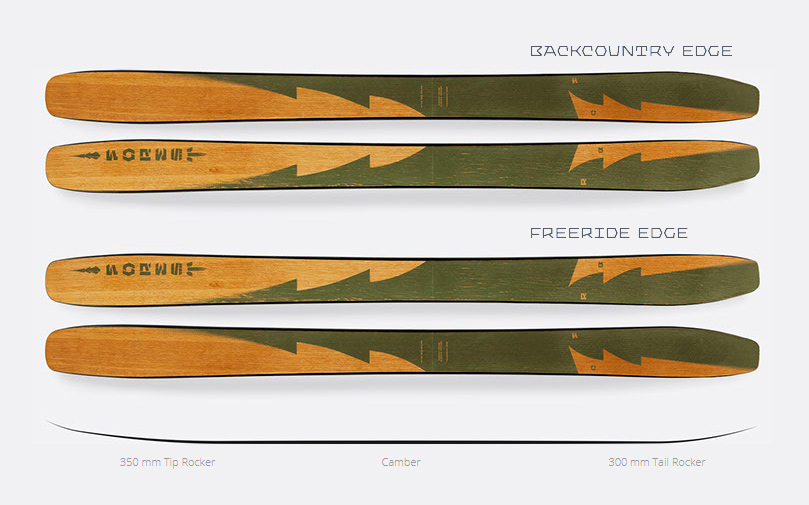
Forest Skis is a small innovative ski brand from Slovakia that you have probably never heard of, yet they are slowly becoming known for custom building skis for those that want really to shred.

One of Forest Skis’ highly prized features is asymmetric ski design, or a “variable effective edge”, that provides the skier with two different riding experience in the same pair of skis.

Just swap the skis from one foot to the other and you switch their performance from aggressive freeride and steep descents to more playful and easier to cruise mode.

To understand better what Forest Skis are about, we talked to the founder, engineer and the main designer, Viktor Devečka.

Q: How did Forest Skis get noticed by the world?

We are not a mass production brand, our growth is slow but sustainable.

The world knows about us thanks to the design awards we won, one of them is the prestigious Red Dot Award for Product Design in Germany. We were at ISPO in Munich a few times and our skis were always one of the highlights.

We are also known thanks to our riders and ambassadors like Ryan Oakden from Canada, a former Freeride World Champion.

Q: What makes your skis special and unique? Everyone says that.

While we have the know-how and we custom build skis, and tailor them to your riding style, I think that the main thing that makes our skis different is that we are both skiers and engineers in one person. There is no loss of information between the skier and the ski designer and builder.

I know the result and experience which I want from my skis, so I design them that way and create the construction.

Also, we make no compromise in designing our skis so they will turn easily for any level of skier. Simply, you either love them or you hate them.

We are not trying to please everyone.

Q: For whom are your skis made?

Our skis perform downhill, so they won’t be as light as Dynafit but they will drive. However, thanks to our customizations, we also make skis very close in weight to the ski touring brands in the 100 to 120mm range without compromising the riding experience.

Now, we have three lines of skis: Full Carbon, Asymmetrical and Indigo Dyed skis.

FullCarbon skis:

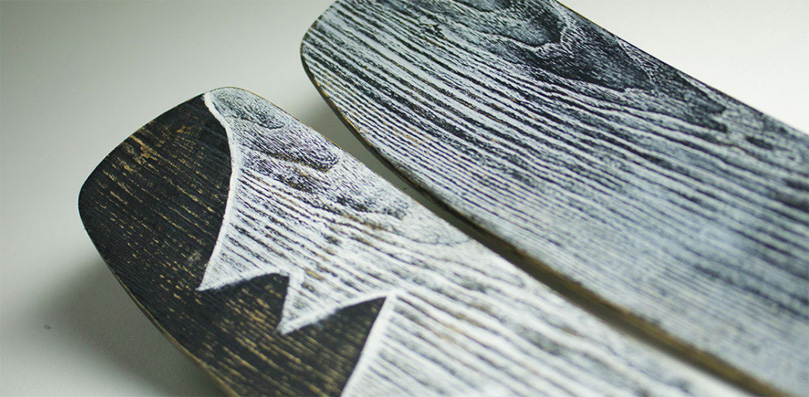
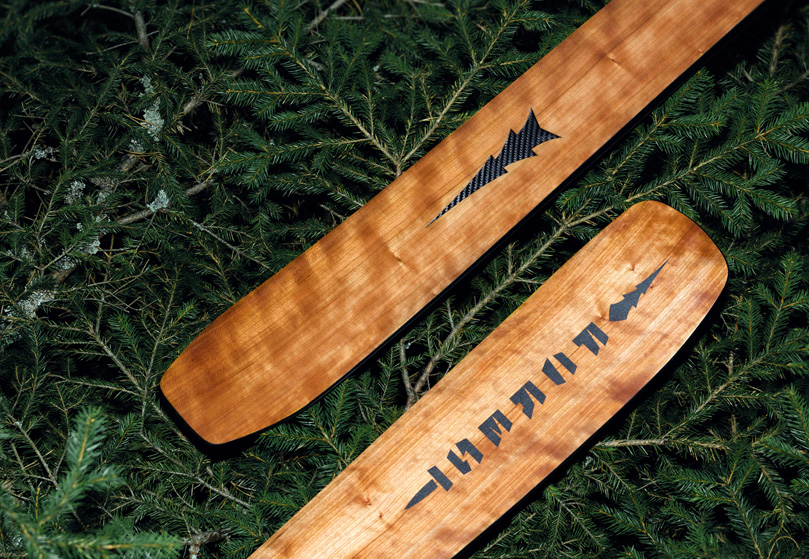
The signature mark is a carbon tree on the tail of the ski. Those are for experienced riders, who know what they expect from skis – no compromise and full power which no other skis can offer.

Asymmetrical skis:

Simply by switching left and right ski, you can adjust your skis to the snow conditions or to your ski style and needs. The skis in this line are softer and more forgiving than the FullCarbon.

This is our crazy idea of skis based on different shapes of an effective edge (on the sides of the ski), and the other ski in the pair is made as a mirror. You have the same radius but the shape of one side of the ski is more playful, and on the other side of the same ski is designed to be more stable.

Indigo Dyed skis:

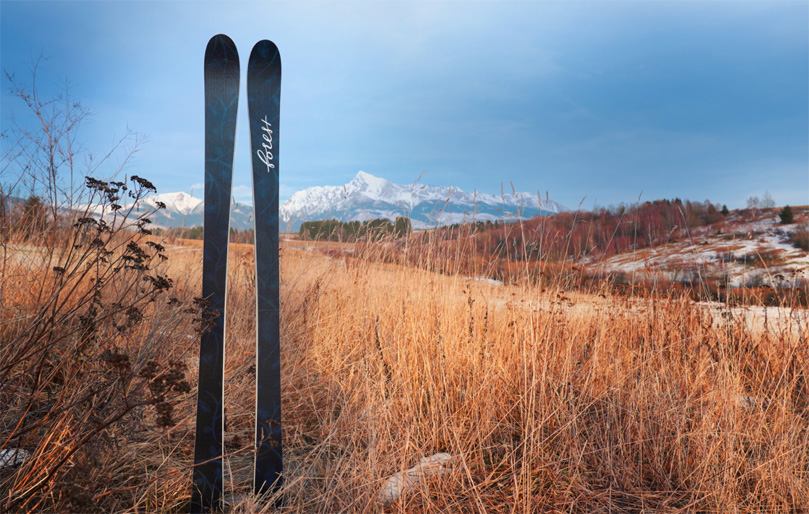
This is our newest line. The skis feature flax linen top sheet, dyed by an old unique technique known as Blaudruck (Indigo dyed) that is a part of UNESCO Heritage.

This line is for more suitable for intermediate skiers. Thanks to the flax linen top sheet that creates amazing dampening, these skis are really forgiving and stable. Combined with the extraordinary graphic design you cannot find a similar ski on the market.

Q: How do you customize skis for someone when many likely don’t know how to ask for specific features?

Over the years, we have come up with a set of unique questions that help us to define what is best for each and every customer.

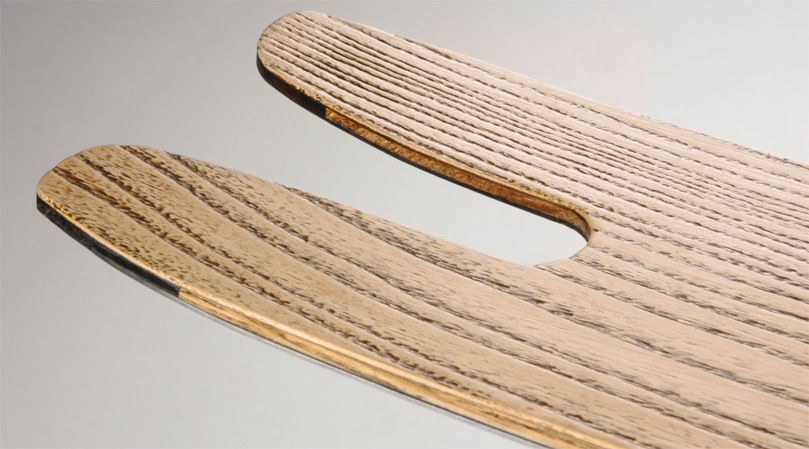
For example, for our wooden skis, you can choose the shape of the tail. This customization exists because we found that different characteristics of riding can be reached on the same skis with simply different tail shapes.

Q: Can you explain some of the most important features a rider can customize on their skis?

Basically, we can customize almost every aspect of the ski to create the look and riding experience you desire.

In our FullCarbon line, one of the most visible customizations is the colour of the wood for the top sheet. You have to like what you ride!

As I mentioned before, we offer different tail shapes and also different kinds of construction. The most advanced in the FullCarbon line is the ultralight construction. With that, we can achieve 300g less weight per ski.

In the Asymmetrical line, you can have standard fiberglass construction with carbon stripes, or lighter FullCarbon construction.

We can also fully customize your skis using our shapes as a base, but you can customize the stiffness, design, weight, etc.

We also love to experiment and play with innovations.

Q: Can clients customize the graphic design? Your skis are beautiful, who designs them?

Yes, we can fully customize the graphic designs on classic ICP foil.

The graphic designer of the whole brand is my colleague and my beloved girlfriend in one person, her name is Bronya.

Q: What makes your skis so durable? Also, what materials and technologies are your specialties?

Durability is a sensitive topic but our skis are built to last. We use hard bases, snowboard edges, strong wood cores.

Also, we use the Dyneema fiber which is four times stronger to break or tear than Kevlar (we use Kevlar as well), and it protects the carbon construction from the impact from sharp rocks.

It is difficult and expensive to work with the Dyneema fiber but the benefits it provides are amazing.

Q: Where can people test or see your skis?

Most of our skis are here in Slovakia. But we have a test centrum also in Fiss in Austria and in Lanzerheide-Arrosa in Switzerland where there is a telemark test center.

We also make a lot of public ski test in the Alps, Slovakia and Czech Republic during the winter season. Then we do occasional pop-ups like for example in Lululemon store in Whistler this last season, or as part of film festivals.

Q: What does the (higher) price for your skis provide your customer with?

With our skis, you are getting not only a product but also an extensive customer service.

In comparison to other brands – on the surface similar to our brand with design or technology, and the amount of production – we are still about 30% cheaper.

Q: How long does it take to make and deliver the skis after someone places an order?

The best time for ordering our skis is summer. We offer a better price during this period, plus you can split the payments and you can choose what you want (custom).

We have an order form on our website that you have to fill and you will get your skis in the autumn.

In the winter time, you can choose from the skis in our stock. Custom skis can take up to 1.5 months to make during the winter as we are busy with many things.

Q: Which notable athletes ride on your skis? What do they love about them?

All our athletes ride our skis because they are built with no compromise – simply for pure and powerful riding.

I already mentioned Ryan Oakden from Whistler in Canada. Then we have some of the best skiers from Slovakia, Martin Labuda and Marian Treger, that also live in Canada.

Knut Skinnes is a great telemark skier and en environmentalist from Norway. Then Monika Tatarkova who is a head judge in FWQ races.

We also have a small team of riders and photographers in France, for example also a pro skydiver Roman Dusky or paralyzed sit-ski freerider Marian Ligda, a former excellent Freeride competitor (we met with Marian after his injury and we developed special ski for him).

Q: Do you hand-make the skis personally? How do you oversee the quality of each pair?

Yes we do, and we collaborate with LTB-snowboards in production. The factory is already 34 years on the market and lots of experience with building skis and snowboards.

Thanks to this smooth work arrangement, I can focus on the development and get the perfect quality for our products.

All of the skis are going through my hands, I check them and finish them. Also, I make all the special custom skis. I am adjusting the machines and coordinating every step of this hand-made production. We are always improving.

Filed Under: Gear, Tech & Food, People (Interviews) Tagged With: Forest Skis

Lighter and Completely Redesigned: New CAMP Ultralight Ski Mountaineering Ice Axes

September 22, 2020 By Stano Faban Leave a Comment

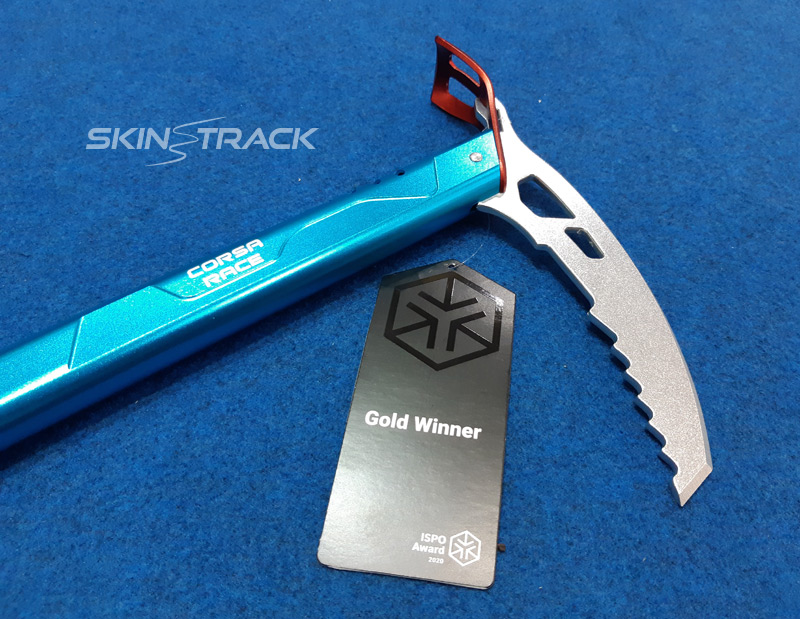
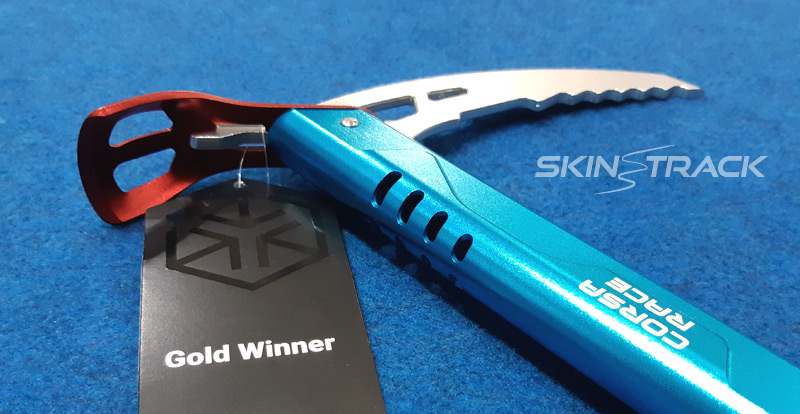
CAMP picked up Gold Award at 2020 ISPO for their new Race Corse ice axe.

After few years of loosing ground to its competitors, CAMP has came back to reclaim the prize for the lightest ice axe in the world!

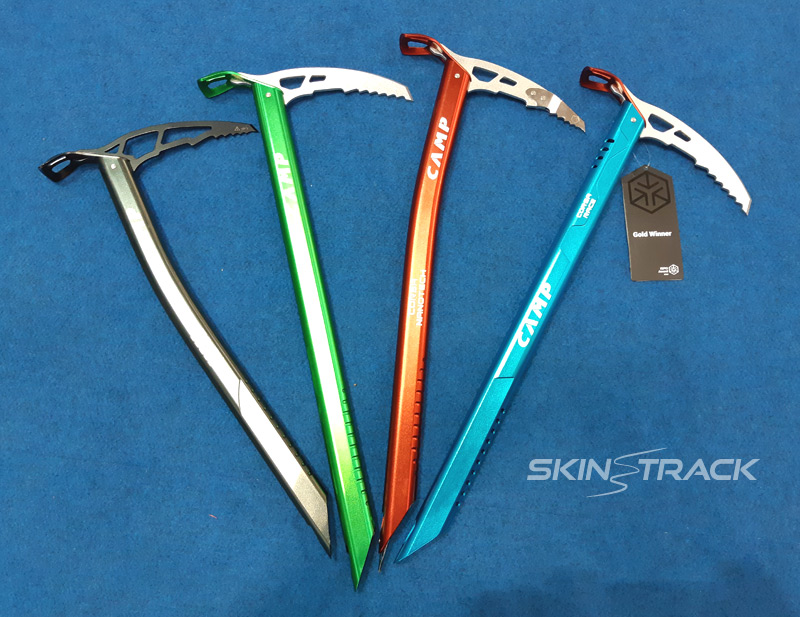
The new blue Corsa Race weigh feathery 185 grams at 50cm! It will be in stores later this year.

The Italian company, known for its ultralight ski mountaineering and climbing gear, has actually redesigned its whole Corsa line of super light ice axes. Further shaving weight while managing to add some new exciting features along the way.

From left: Corsa Alpine, Corsa, Corsa Nanotech, Corsa Race.

New CAMP Corsa Ice Axes

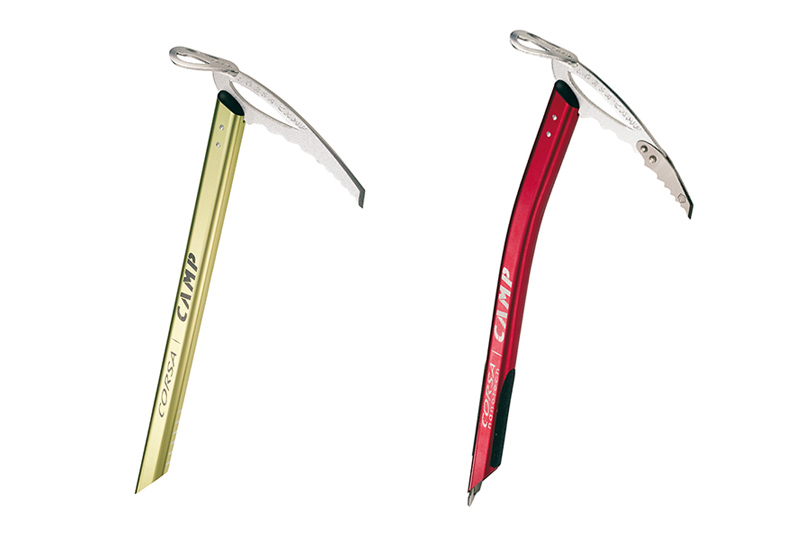
It’s apparent that CAMP did a lot of thinking and testing as the new Corsa ice axes look very different from their predecessors. Below, the previous generation of the Corsa (202g at 50cm) and the legendary red Corsa Nanotech (246g at 50cm) ice axes.

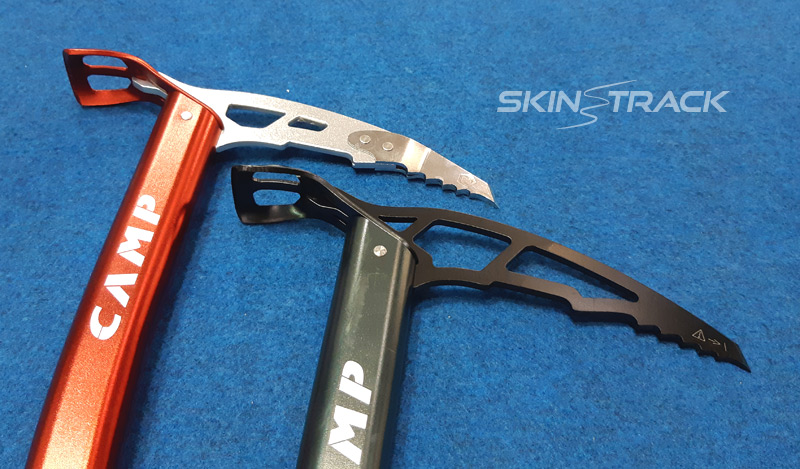
The most obvious design changes can be found on the heads and picks, both delivering improved hand holding in various positions while walking.

The picks of the Corsa Nanotech and the black Corsa Alpine are specifically designed for more technical use. BTW, the black Corsa Alpine sports an all steel head and pick!

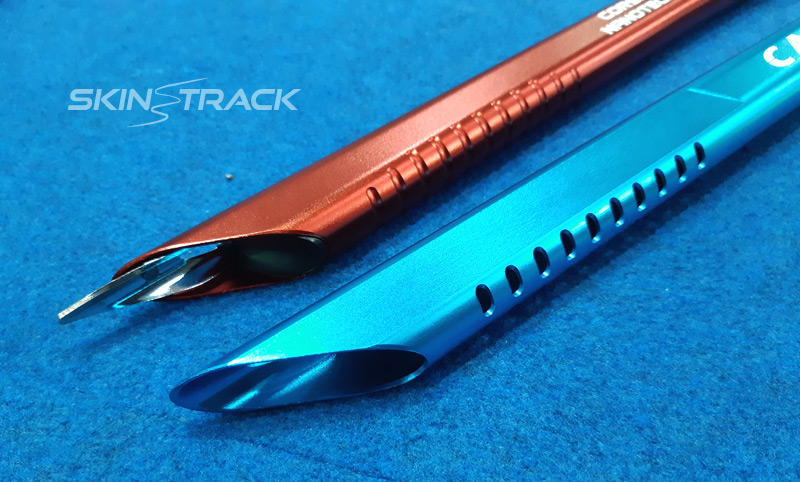
The second important update improves handling and grip for climbing by introducing groves, or holes on the blue Corsa Race, on the lower part of the shafts.

Just like its father, the red Corsa Nanotech will feature a sharp pick at the bottom of the shaft.

The weight savings come from shaving off material at strategic places without reducing the strength of the already light materials.

Notice regional material thinning on the shaft that not only saves weight but also improves handling.

The all time popular red Corsa Nanotech will stay red and will weigh in at 225g at 50cm, and will also come in 60 and 70cm lengths.

The black Corsa Alpine features a full steel head and will be a tool of choice for more technical adventures yet weighing only 240g in 45cm. You can also have it in 55 and 65cm lengths.

The new green Corsa will be essentially a less fancy Corsa Race while still only 202g at 50cm. Also available at 60 and 70cm.

Filed Under: Gear, Tech & Food Tagged With: Camp, ice axe

New and Updated Hagan Skis For Ski Mountaineering, Freeride and Ski Touring

September 9, 2020 By Stano Faban Leave a Comment

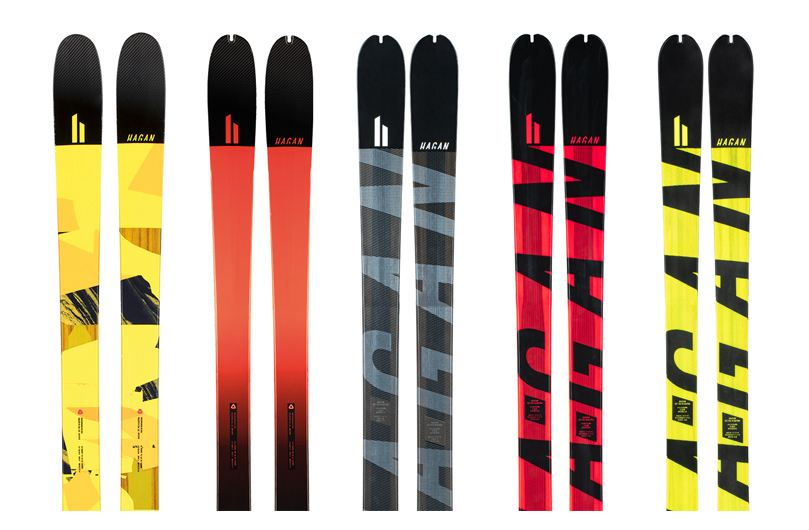
Just like SkiTrab’s new ski offerings for 2020/21 season, Hagan has a couple of exciting new models coming out for this winter as well, especially for those of us that love ski mountaineering and ski touring above all.

Hagan goes back almost 100 years and it had been one of the first to manufacture specialized touring skis but then “took a break” from leading the way. However, over the last 10 years the company has been making a strong comeback with skis that deliver an excellent ski mountaineering and touring experience.

Boost Series – For Fun Powder Skiing and Freeride

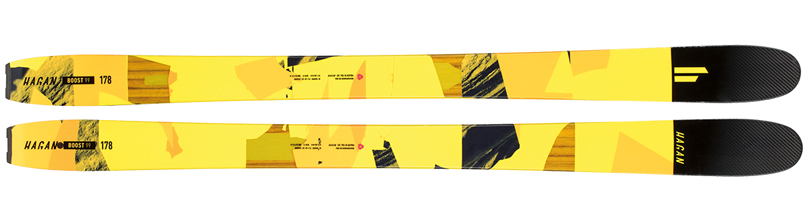
Hagan calls its freeride line “Boost” and the ski we want to point you to here is Boost 99, with a 410mm rocker in the front and 200mm at the back.

As the name suggests, the ski is 99mm under foot yet floats and keeps stable at higher speeds equally as well as a slightly wider ski. We have skied it twice so far and liked how it predictably flexed and behaved overall.

While the Boost 99 is mostly build for fun on the down, Hagan kept to its ski mountaineering roots and managed to hold the weight at 1500g for 178cm (131-99-116). Not the very lightest on the market but with a wood core and even a titanal plate insert. The ski comes in 168, 178 and 188 lengths.

Ultra Series – For True Ski Mountaineering

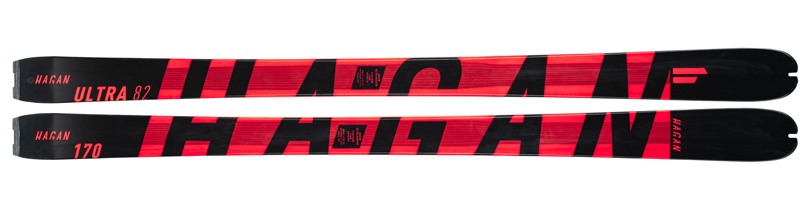
Introduced only a few years ago, the “Ultra” line is where Hagan shines. We have skied the Ultra 82 model the last two winters and really like them – read our review here.

The Ultra line is aimed at advanced skiers that often get after technical descents. Weight is kept on the lighter side yet the skis still feature a wood core which helps a lot to smooth out the ride for otherwise fairly stiff skis.

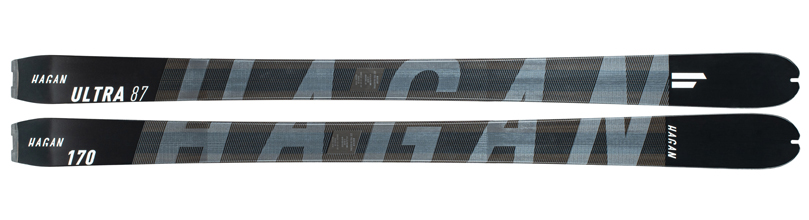
Ultra 87 is a brand new ski that evolved from the 82 model, but by prolonging the tip rocker (300mm) and adding a tail rocker (120mm) the ski will perform better in deeper soft snow. The ski weighs 1120g at 162cm and measures 121-87-107.

Based on feedback after 2 years, the Ultra 82 has been updated for this season with some small changes in its structure and new more durable top sheet, similar to other skis in this line. The ski weighs 1070g at 164cm and measures 117-82-102 with a 250mm tip rocker. No tail rocker which makes it nicely stiff and fun for challenging snow or more extreme terrain.

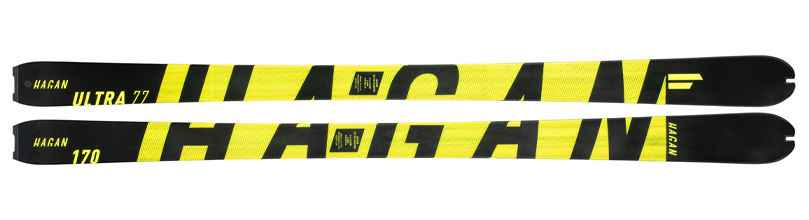
Ultra 77 is build for fast & light oriented ski mountaineering but still offers a great tool for technical downhills. It comes at 950g for 163cm length (112-77-99) and has a slightly different structure than the two models above. It features a 250mm tip rocker like the Ultra 82.

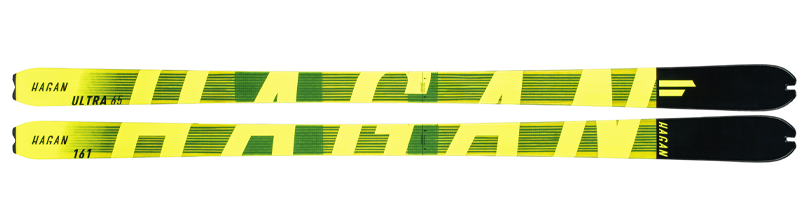
Then there is Ultra 65 which obviously is a ski build for skimo racing. Again, not trying to be the lightest on the market, Hagan updated this ski with many features based on the experience from the 82 and 77 models. Super solid downhill performance coming out of a 700g for a 161cm ski (97-65-80).

Core – For All Mountain Ski Touring

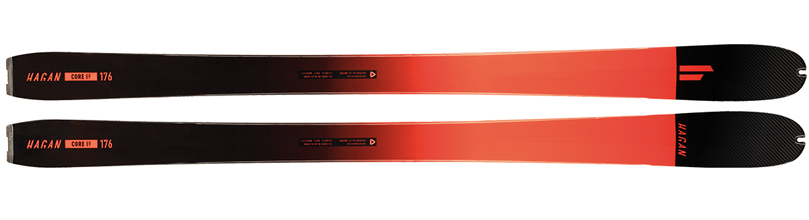
In the Core series, we want to point you at the Core 89 model but also check out the Core 84 and Core 84 Lite models.

If you don’t need a specifically powder oriented ski, and want something more forgiving for the downhills than the stiffer Ultra series, then you might like the Core 89. But don’t worry, this ski might be something you will prefer in a resort as well.

The weight is slightly higher, 1280g at 170cm, than the Ultra line but its 89mm waist makes it more suitable all year round – from deeper soft snow to spring skiing. The ski also features a generous tip (320mm) and tail rockers (120mm) that will make it easier to turn for intermediate skiers.

There is more from Hagan so check out their website but the above models are what we are most excited about.

Filed Under: Gear, Tech & Food Tagged With: Hagan

New SkiTrab Skis Based on Magico and Maestro: Softer Ride and Lower Price

September 7, 2020 By Stano Faban Leave a Comment

With the new winter approaching, we have talked to SkiTrab about their upcoming new pairs of skis in the 75 to 85 mm range that are based on the famed Magico 2 and Maestro 2 models, but at a substantially lower price points.

SkiTrab has been around for close to 8 decades and in the recent years has prided itself with a 14-layer technology that allows them to tweak the performance while keeping weight down and durability high.

Magico 2 at the top and the Maestro 2 below.

SkiTrab’s flagship ski mountaineering skis are the Maestro (925g at 164cm and 108-76-94) and the Magico (1032g at 164cm and 118-85-104), both suitable for more extreme ski mountaineering objectives as they can deal with demanding snow conditions. However, both will be better appreciated in steep terrain and by those that prefer stiffer skis.

New Softer Skis for 2020/21: Ortles, Stelvio and Gavia

To make their skis light yet stiff, SkiTrab uses Aramid-honeycomb core which is used in aerospace and military applications as it provides a superb strength/lightweight ratio. However, this structure also increases the price of the final product.

For the new winter season, SkiTrab has created 3 models based on the Magico and Maestro platforms as it replaced the Aramid core with light wood. While this change has sightly increased the skis’ weight it has also made for a softer and a more forgiving ride. And the prices are much lower.

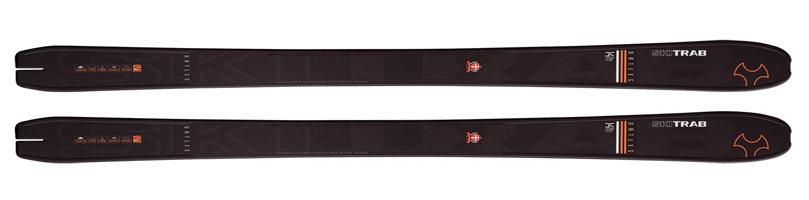
Ortles Skis (118-85-104 and 1055g at 164cm)

With the same dimensions as the Magico 2 skis the Ortles shaves around $250 off the price and adds only about 30g.

SkiTrab Ortles skis

This ski is still build for demanding skiers yet offers a smoother ride as it absorbs shocks better, and also performs slightly better in softer snow than the stiffer Magico, but that depends on riders style and weight.

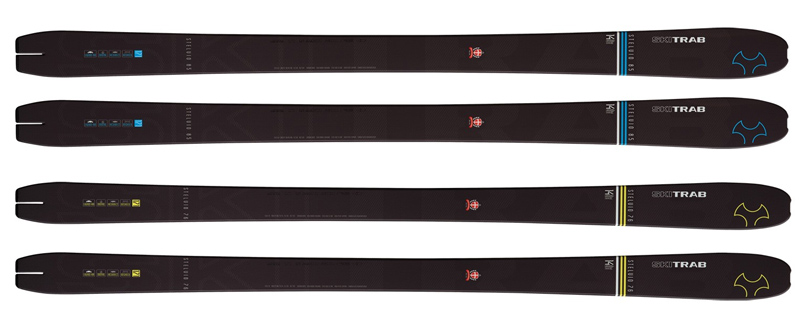
Stelvio85 and Stelvio76 Skis

The 85 version has the same dimensions as the above Ortles skis while the 76 model adopts its shaped from the Maestro 2 (108-76-94).

SkiTrab Stelvio 76 and 85 skis

The weight has increased by about 120g for both the Stelvio76 and Stelvio85 compared to the Maestro and Magico models. But again, the price is much lower, about $350 less.

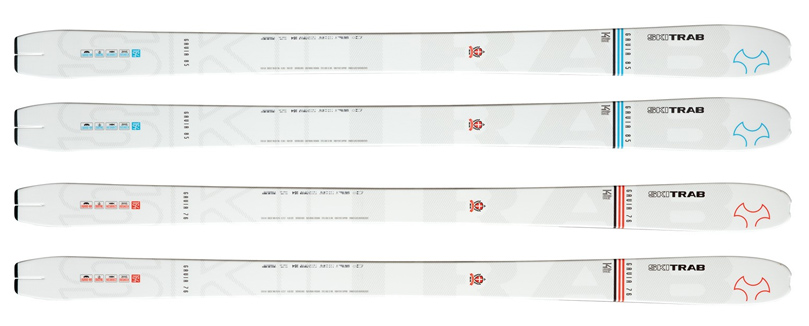
Gavia85 and Gavia76 Skis

SkiTrab refers to these models as the softer version of the Stelvio models, featuring more flex, and recommends them for lighter skiers (or beginner to intermediate). Also, women might prefer these skis over the Stelvio line.

SkiTrab Gavia skis 76 and 85

The weights are slightly lower than for the Stelvio models and price stays about the same.

Filed Under: Gear, Tech & Food Tagged With: SkiTrab

Death and Resurrection of Climbing Skins: 3 Start-ups Recycle Them

June 25, 2020 By Stano Faban Leave a Comment

From companies like Patagonia to individuals with ideas. From recycling to upcycling, to repairing, to reusing, to inventing new materials… The outdoor community is trying to reduce its waste and environmental impact in creative ways.

In ski touring, we all know that the most abused and replaced piece of gear are climbing skins, yet besides replacing old glue no one really thinks of skins second life once we retire them.

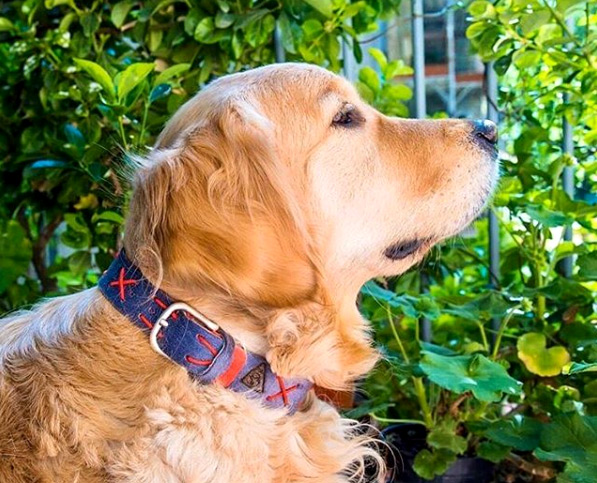
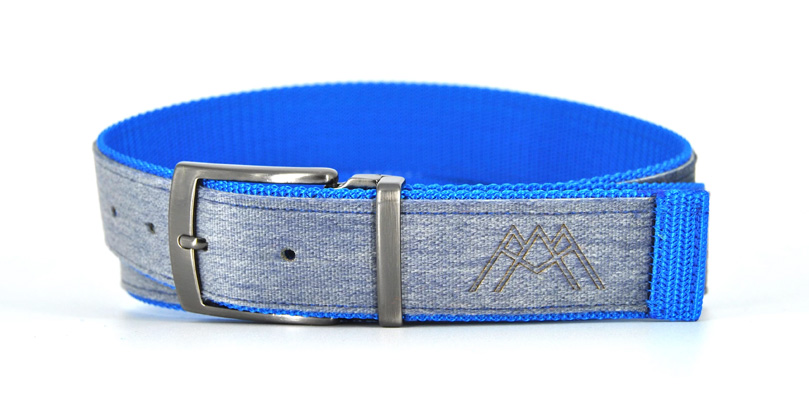
One of many SkinsBelts colourful dog collars.

Then there is the waste material when skins are manufactured. Just before a climbing skin is born it is part of a 2m wide carpet-like roll that already contains 2 layers of different materials – the hair (or the carpet) that are attached to the water-proof membrane that would eventually get a glue coating on its other side.

Such a roll is then cut into the individual skins, however, there is still plenty of waste despite the laser cutting machine doing its best.

What to do with an old pair of climbing skins?

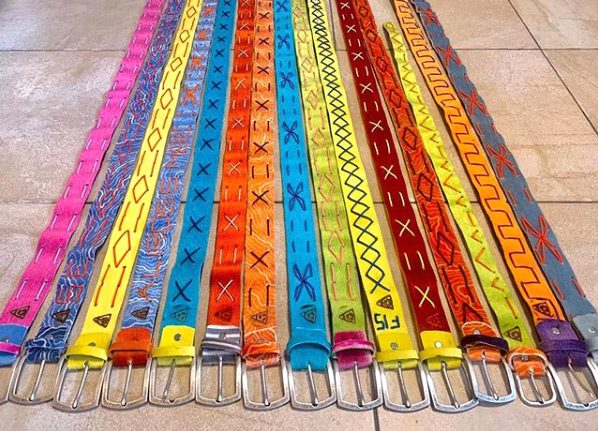
You can ship them to Marta Lotti, the founder of SkinsBelts in Sestriere in Italy, who will recycle your old skins into artistic belts to keep your pants high. Smaller pieces are made into fancy dog collars.

Marta got creative with old climbing skins after finding a full box of them in her father’s house. Currently, the company consists of a small team, including her brother. While they usually recycle old skins they also use waste from production of new skins which is provided by Contour Skins (see below for more info).

How about some fluffy hut slippers?

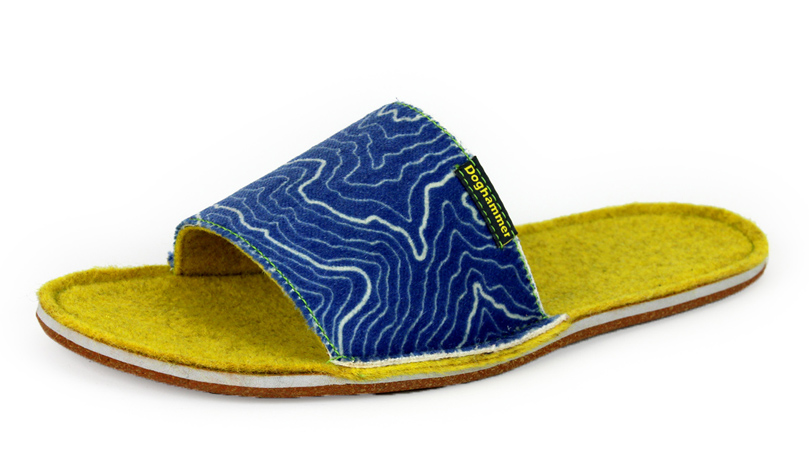
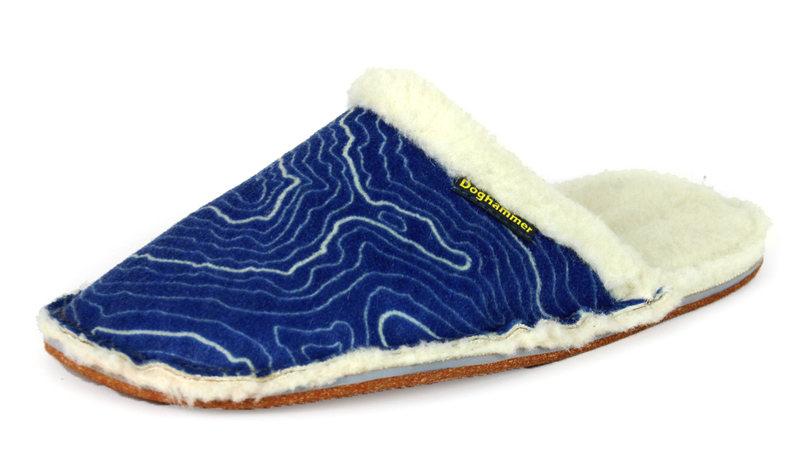
Doghammer is a German company that works closely with Contour Skins in Austria. Contour supplies Doghammer with new skins carpet waste material from their manufacturing and they turn it into a variety of comfy slippers that you can use on hut trips or around your house.

The Doghammer slippers have cork soles which is a staple material for this company due its environmental sustainability and its great overall functional properties. Their cork is harvested from the cork oak tree in Portugal.

Back to belts… Do you prefer a more polished look?

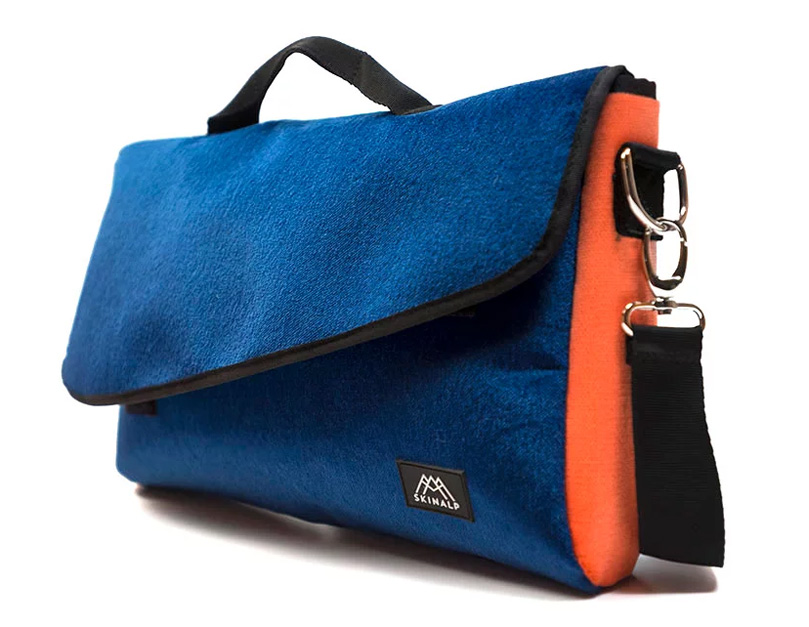
Then there is SkinAlp based in France, another start-up that specializes in belts production but also tapping into messenger bags and valets.

Their supplier of new skins waste material is Pomoca, who’s climbing skins we all know very well. For the belt base material they use “black ECO” made from 100% recycled plastic bottles from Northern Italy.

SkinAlp’s belts have a more polished look than those from SkinsBelts which are more rustic looking. Both are stylish so it’s up to you for which occasion you fit your pants with which belt.

Filed Under: Gear, Tech & Food Tagged With: Contour Skins, Doghammer, Recycling, SkinAlp, Skins, SkinsBelts

Arva ST30 Ski Mountaineering Pack: Versatility, Durability and Minimalist Design

June 12, 2020 By Stano Faban Leave a Comment

As backpacks are becoming more and more specialized for every outdoor activity, there is also a movement by some brands to design a pack that does it all at a high level.

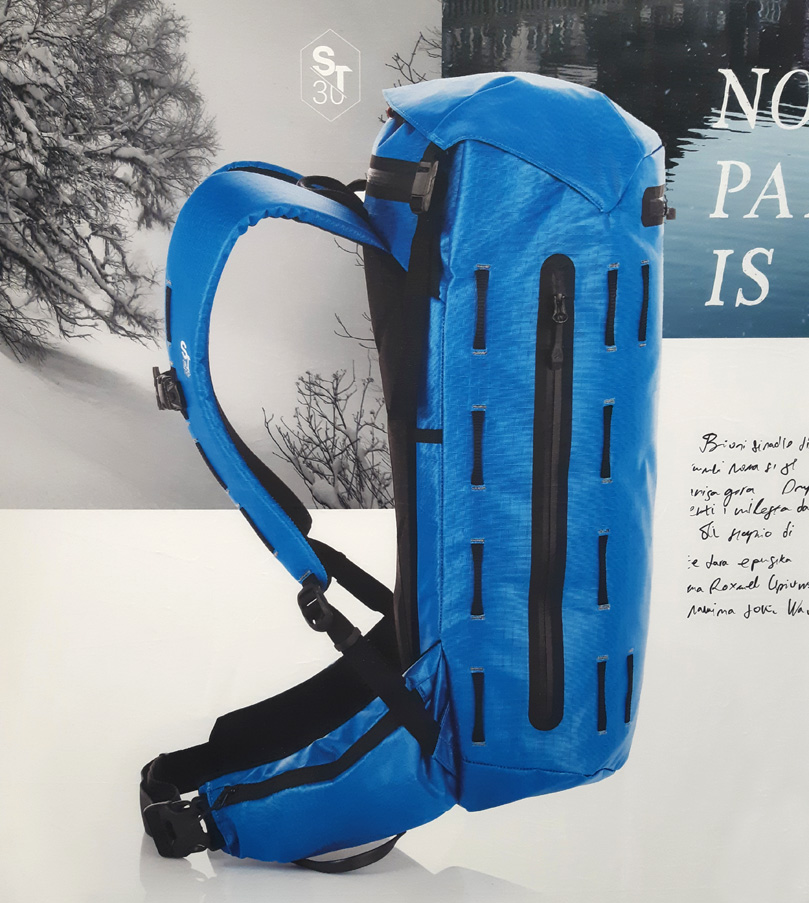
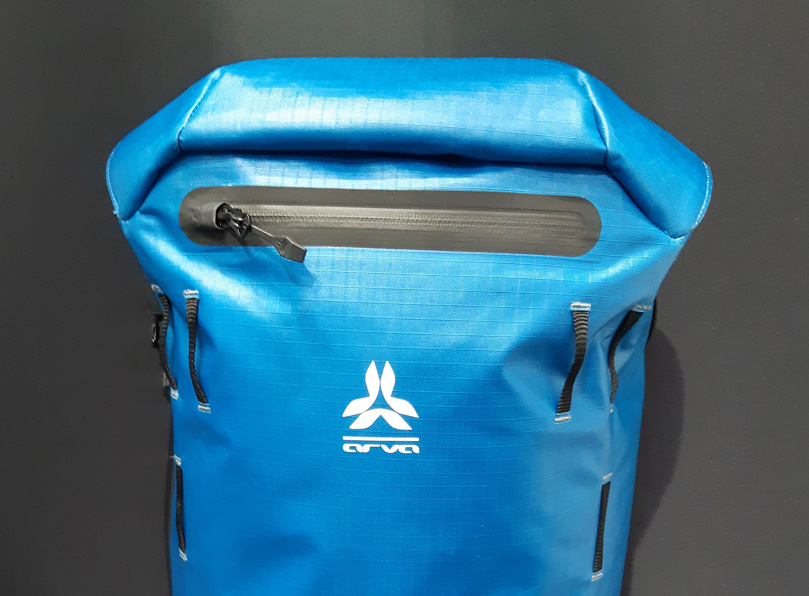
Arva, a French company, known mostly for its avalanche beacons and its history of innovation in that field, is preparing to launch a ski pack that promises to stand up to all abuse during your ski and mountaineering days as well as to look stylish in town or when you travel through airports.

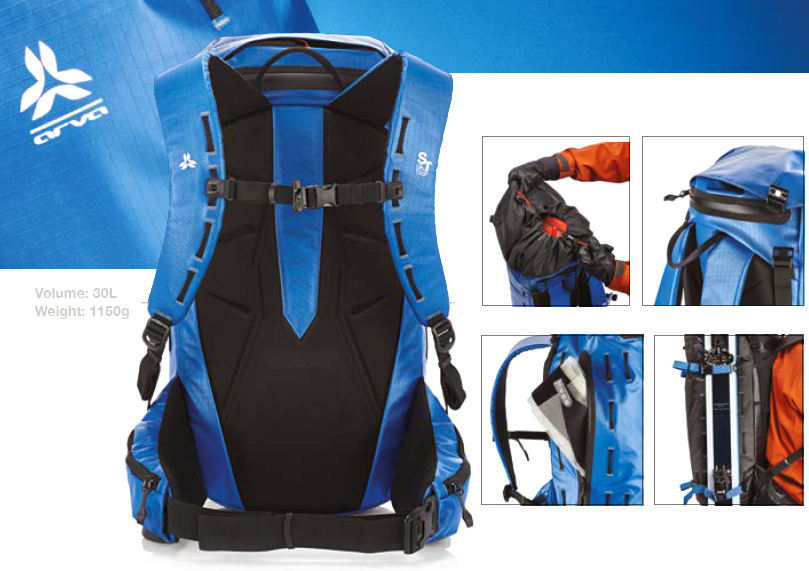
The pack’s name is ST30. The “ST” stands for “Ski Trip” and the number refers to the pack’s 30L volume. The pack is inspired by minimalist design and by decades of experience in the mountains and other adventures.

Despite the streamlined design, the pack still features dedicated avalanche gear pockets.

By reducing the number of seams and making this pack with a very tough N400D PU2 waterproof ripstop fabric, Arva is striving for a very durable product.

At 1150g, the ST30 is reasonably light yet it won’t be the lightest ski pack on the market, but that is not its goal.

The pack has a couple of clever features and pockets, and its multi-purpose strap system on the outside allows for a variety of carrying options for skis, snowboard, ice axes and other gear.

If you are looking for a purely ski mountaineering day pack then check out our article about CAMP Ski Raptor that also offers 30L of volume.

Webbing on the front side of the ST30 provides hooking points for straps or slings to design your own variety of gear carrying scenarios.

Filed Under: Gear, Tech & Food Tagged With: Arva, Backpack

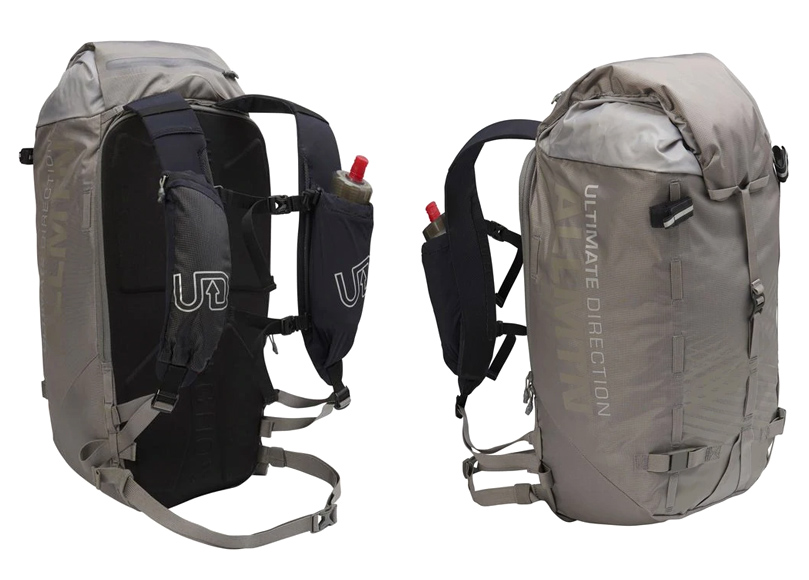
Review of Ultimate Direction All Mountain Pack: Ski Touring Is Not Its Virtue Yet It Works Well

May 21, 2020 By Stano Faban Leave a Comment

Overview

Suitability: climbing and mountaineering rather than ski mountaineering and ski touring
Usual price: around $165 USD
Weight: 590g (size S/M)
Ice axe carry: 2 with quick access
Pros: light weight, durability, fit
Cons: lacks 1-2 separate pockets to be a better ski pack

Bottom Line

As an “all mountain” pack it works quite well for ski mountaineering and touring, however, it takes some time to adjust to its lack of dedicated pockets or compartments that we all like on specialized ski packs.

Review

Truth be told, this pack has never been designed as a true ski mountaineering or touring pack. It has been only my decision to push its limits as a ski pack because that’s my main passion, and I am on a search which single pack would “do it all” the best. You can read the packs full description on the UD website.

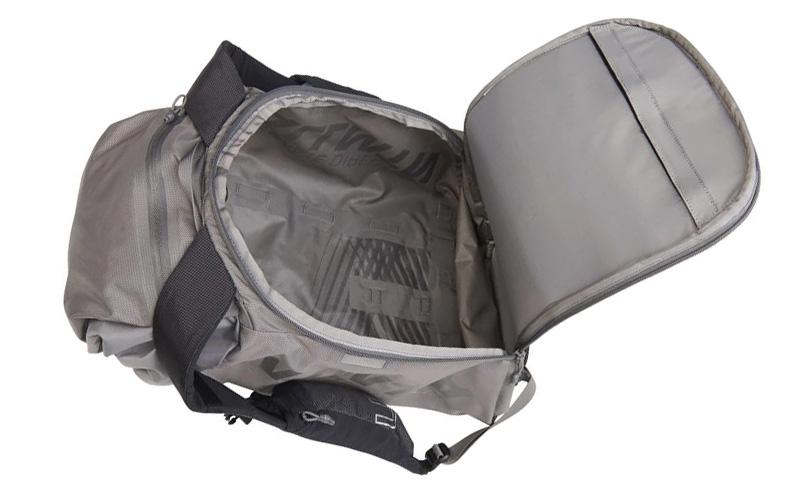
I have used the Ultimate Direction All Mountain pack for skiing for about 20 days in total over the last couple of months. It has been a “learning curve” the first few times out as the pack has only 1 big compartment and 1 very small pocket on the top lid.

I shuffled my gear inside a lot to find what works best because it was quickly obvious that transitions will take longer as things will kind of disappear inside.

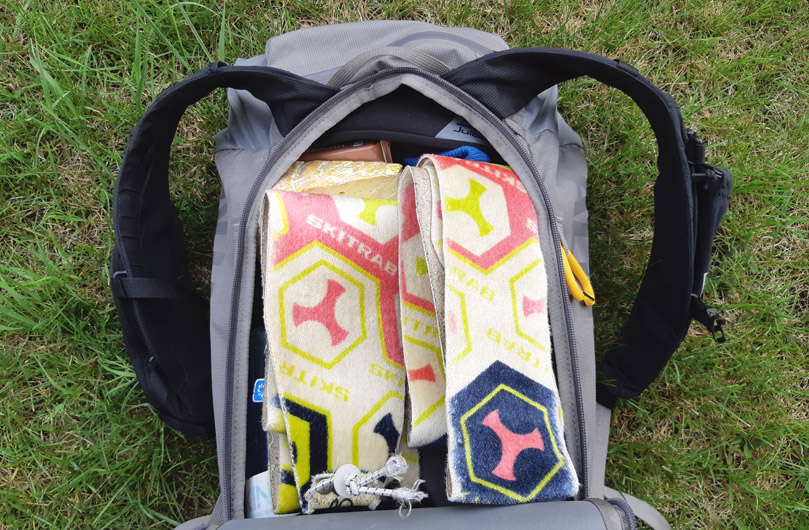
However, after my “trial period” I came up with a pretty good system and started to appreciate the pack much more. Probably the feature I like the most on this Ultimate Direction pack is the easy access through its back panel that has a zipper all around. Without it I wouldn’t use it as often.

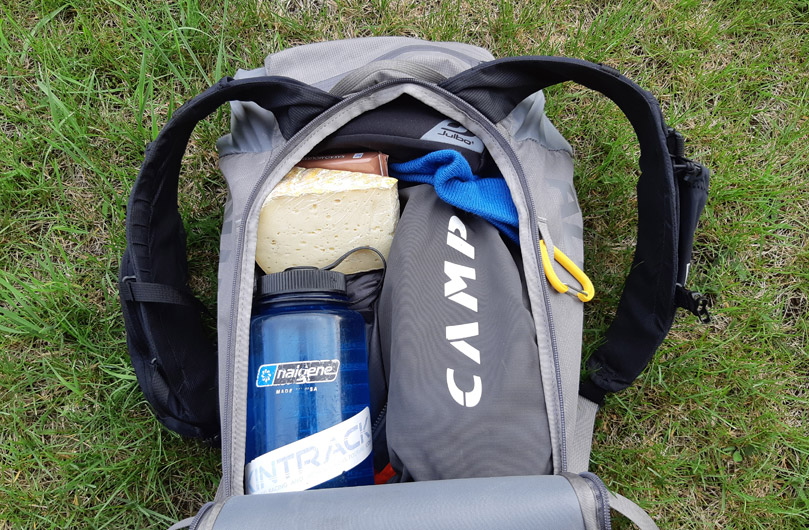
My best system relies on access via the back panel. Below the bottle and crampons there are wind/rain pants and first aid kit. Behind is the shovel bladed, and on the sides are shovel handle and a probe. The googles at the top are a bit squished while an insulation jacket is between the shovel blade and the bottle with crampons. The cheese seems to like this pack 🙂
Once you add skins, the pack is at its absolute volume limit.

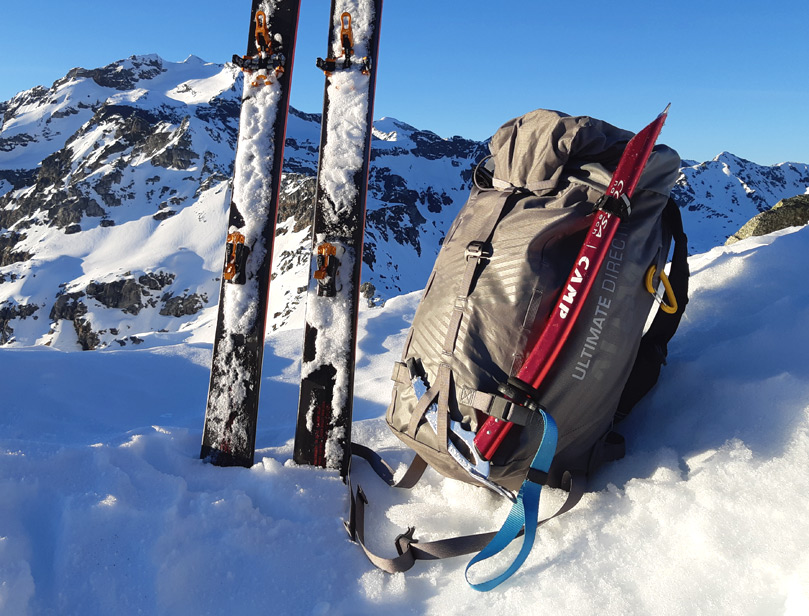
This pack also comes with a removable, diagonal, quick ski carry system that is based on skimo race packs which is a great to have when your main activity is skiing.

The pack fits very well and feels secure at all times thanks to its simple hip-belt and two chest straps – I have been using only one as I like easy access to my jacket’s zipper.

The shoulder straps have a clean design while still providing some storage. The left one has a pocket for a flask or a small bottle – sometimes I use for my phone so its handy for photos. The right shoulder strap has water-proof, zippered pocket that will accommodate most smartphones – I usually use it for a knife, lip cream and few small items.

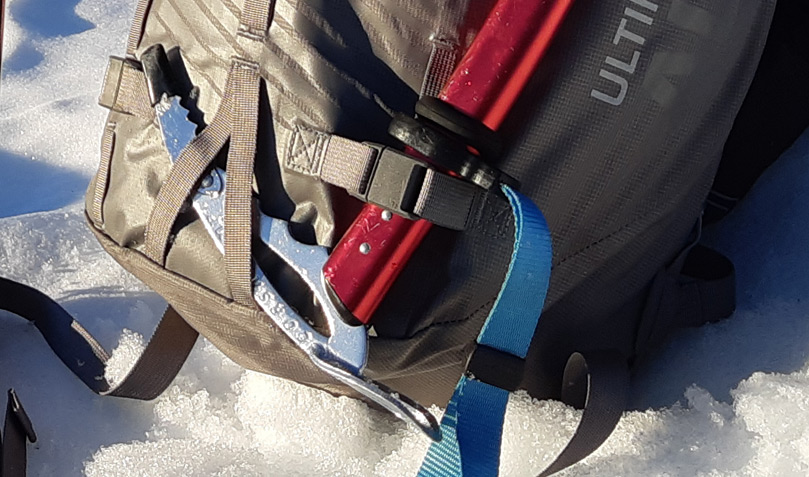
There are attachments for two ice axes that have quick-access buckles – meaning, that you can take an axe out without taking the pack off your back. This is a great feature, however, the bottom quick-access straps could use extra 1-2 cm (1/2 inch) slack as it’s little cumbersome to buckle in the ice axe shaft in place when the pack is fully stuffed.

Just reach back and press the grey buckle and you can easily pull out the ice axe in an instant.

So far, the pack is proving to have great durability. This is likely thanks to its construction simplicity and the use of Nylon ACE RIP fabric that is light yet strong.

The webbing on the outside of the pack is very useful for hanging extra gear.

The shortcomings of this pack for skiing, in my opinion, are its lack of compartments (or pockets) as these would make a life of a ski mountaineer much easier. Right now, all your gear plunges into one main compartment – shovel, probe, jacket, pants, food, water, first aid, googles:

  • At minimum, a dedicated zippered crampons pouch at the bottom would allow for more efficient gear organization, especially when you don’t bring crampons along. This pouch could have zippered roof so if you if need the one big compartment then you can easily create it.
  • Ideally, the pack would have another floating pouch at the top of its main compartment to store google, glasses, camera or sandwich so they can be protected by being always on top of all the other things.

What We Think Could Be Improved

As mentioned above, the lack of compartments hinder this pack to be much more suitable for ski mountaineering, without necessarily becoming worse for anything else, I believe.

Then using distinctive colours for the belts, or at least the buckles, would improve usability of this pack as one could quickly see where these elements are without much attention.

As my last point, I think the pack could have 2-3 litres of more capacity.

Filed Under: Reviews Tagged With: Ultimate Direction

Scarpa F1 LT: New Specialized Ski Mountaineering Boot Replaces Popular Alien RS

February 13, 2020 By Stano Faban 6 Comments

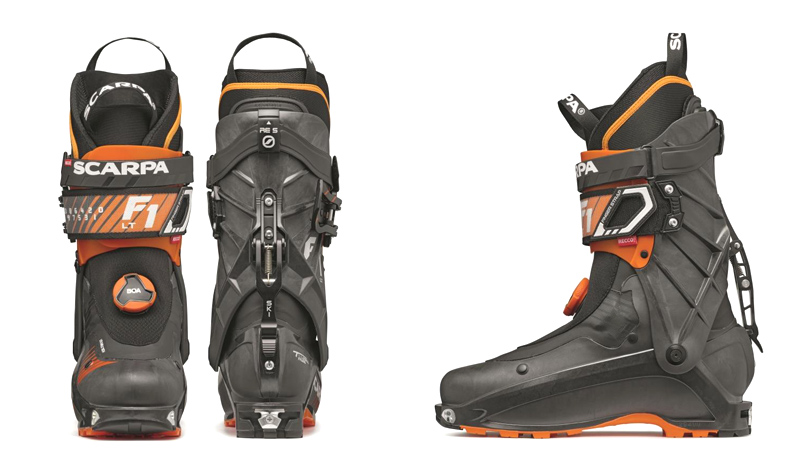
Scarpa made a radical choice going into the winter season 2020/21. It will be replacing the popular Alien RS boot with the new F1 LT.

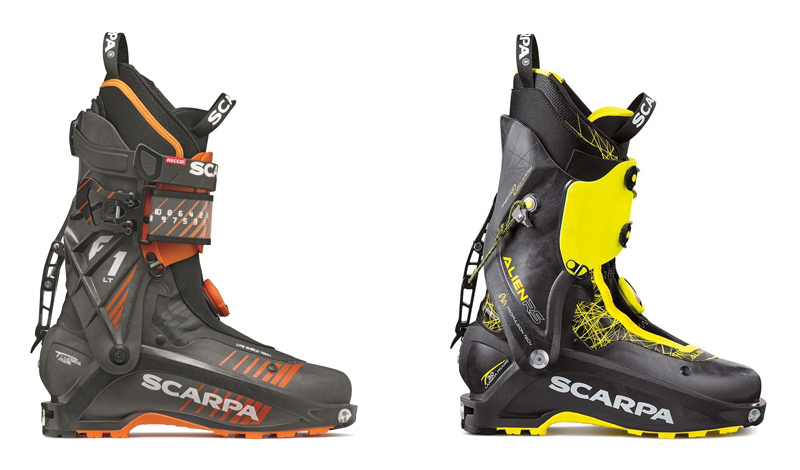
Basically, the new F1 LT is a blend of features and functionality from the Alien RS and the F1 boots that will further enhance the already great downhill performance of the Alien RS while promising to keep the same comfort for walking and skinning.

However, the discontinuation of the Alien RS is already causing a debate among its fans as it was in many ways a very innovative ski mountaineering boot.

I had an opportunity to talk to Scarpa’s boot designer about the differences and similarities of the F1 LT and Alien RS at the recent 2020 ISPO gear show in Munich. He also hinted, or I understood it that way, the reason behind their intriguing choice to discontinue the Alien RS was a feeling that the new Alien 1.0 revealed last year was perhaps too similar in terms of a customer type (or intended use), and so orienting the F1 LT even more for technical skiing made sense.

In a press release Scarpa described the F1 LT as:

“Your new friend for ambitious traverses and technical ski mountaineering descents. Combining ultra technical elements with a backcountry-oriented design, the all-new F1 LT is our most versatile and lightweight alpine touring boot.”

Comparing Scarpa F1 LT and Scarpa Alien RS

The new F1 LT will be only a little heavier, at 990g in size 27 versus 920g for the Alien RS, and perhaps targeting a slightly different type of skier, but the

The most obvious change comes with the cuff closing mechanism as Scarpa have decided to drop the cord tightening system that was connected to the back locking lever and allowed for one-motion cuff locking and closing as it’s usual on skimo racing boots. Now, these systems will be independent on the F1 LT.

Also, the new cuff features reinforcements in critical areas where the Alien RS had some weaknesses.

The F1 LT – cuff with reinforcement ribs, 2 power straps, and a new cuff locking lever.

At first glance, the bottom shell and cuff appear the same as the Alien RS but there are some differences. More people should fit into the F1 LT than the Alien RS. The boot will accommodate slightly wider feet as the foot will sit a bit lower in the new shell, offering a 99-100mm last.

The boot sizing will continue as before and so the F1 LT will be available in full sizes only, which might prevent some of us again to enjoy such a fine true ski mountaineering oriented boot. (I couldn’t fit into Aliens RS size 28 and the 29 felt quite big.)

The liner should stay the same, Cross Fit Tour LT made by Intuition and specifically designed for the last and volume of this specialized boot.

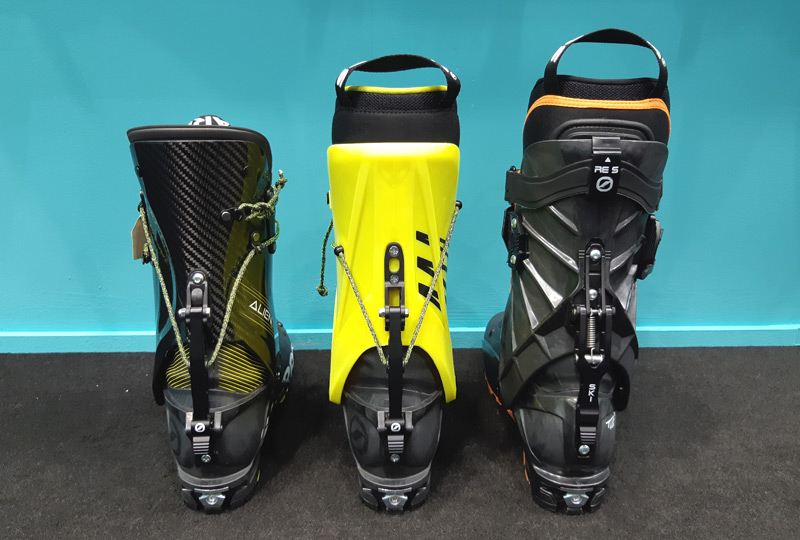
Another obvious change comes in the form of two cuff power straps which are staple features on the F1 boots. The top strap is easily removable and I suspect most Alien RS fans will get rid off quickly to safe few grams. The boots overall height, which is quite high for such a light boot, will be the same as on Alien RS and provide plenty of support so that top power strap won’t be needed by many.

Height comparison of Scarpa’s Alien 3.0, Alien, and the new F1 LT.

Filed Under: Gear, Tech & Food Tagged With: Scarpa, Scarpa Alien RS, Scarpa F1 LT

Review of Julbo Montebianco Sunglasses: Ultimate Eye Protection on Snow

January 2, 2020 By Stano Faban Leave a Comment

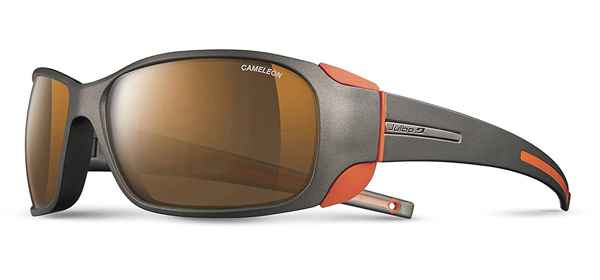
julbo-montebianco-chameleon

Quick Overview:

Usual Retail Price: $100-200 depending on the lens
Weight: 33g
Lens we tested: Cameleon lens – category 2-4 photochromic polarized lens
Pros: the lens versatility, side panels, great contrast, anti-fogging, stylish
Cons: tighter fit for bigger faces

Bottom Line:

Julbo Montbianco sunglasses deliver great eye protection from sun and UV rays on snow and glaciers with the rare category 4 lens. Also, the lens’ ability to transition between category 2 and 4 make them very versatile for various mountain adventures in different weather conditions.

Product Description and How We Tested It:

I have been using the Montebianco sunnies for over a year – about 80 days in total – mainly for skiing, but also for hiking, climbing, mountaineering, and little bit of cycling and running.

Julbo is the “original” mountain sunglasses brand and one of the most recognized names in the outdoor industry. For a couple of decades now, Julbo has been manufacturing eye protection for mountaineering on snow and high altitudes – environments where the sun rays reflection compounds the damaging effects on our eyes.

julbo-montebianco-chameleon-1
Julbo has been specializing in transition lenses for long time and most of their other sunglasses go from category 1 (almost clear) to category 3 (comfortably dark) – these are mostly suitable for off-snow activities such as running, hiking or cycling. In total, there are 5 categories/filters to which sunglasses are categorized into, number five providing the most protection and being very dark.

The Montebianco model has been design for versatility, utility, style and most importantly to protect our eyes. This Julbo model transitions from category 2 (their default state) to category 4 in a matter of seconds when the UV rays are strong enough.

Once the lens is in category 4 mode it is very dark and allows you to comfortably stare into glaring snow whole day. In fact, the lenses has been the darkest I have ever worn.

The lenses also offer a superb contrast vision that is very appreciated during overcast days or in flat light while skiing unknown or through quickly changing terrain.

Some special coating on the insides of my lenses prevents them from fogging up. There were few moments when I needed to remove the glasses and went them out a little, but this happens often with many full-frame sport sunglasses, especially when it’s very hot and humid and you are not moving very fast (breaking trail on skis).

julbo-montebianco-chameleon-2
The “downside” of these category 4 transition lenses is that they don’t clear fast enough when I ski into the forest, or a very shaded area (under a cliff on a north slope for example). On few occasions, I had to remove them for short period, otherwise, everything was too dark.

Another cool feature are the removable side panels that protect eyes from UV rays coming from side angles which happens a lot in the mountains. They are great for winter and spring months. I don’t feel that the panels are needed in the summer unless I spend lots of time on a glacier.

Regarding the fit, like with any sunglasses, this is highly individual. These Montebianco glasses seem to fit well medium male faces. They fit great even when used with a helmet – mountaineering or a climbing one. For me, they feel slightly tight after few hours but I have a larger head.

The Montebianco frames are very durable but you want to be somewhat protective of the lenses to avoid scratches. This is not a sign of “less quality” but a small price to pay if you want to have lenses with so many different coatings that improve and protect your vision.

What We Think Could Be Improved:

There are many features that make the Montebianco model a great choice for your outdoor activities but of course, there are a couple of things that could be improved:

  • Adding some rubberized areas on the legs/stems would help holding the glasses on a ski toque while not in use.
  • It would be great if the transition from category 4 filter back to 3 or 2 if faster, however, I don’t know if this is technologically possible at the moment.

Filed Under: Reviews Tagged With: Julbo, sunglasses

  • Page 1
  • Page 2
  • Page 3
  • …
  • Page 10
  • Next Page »

Primary Sidebar

  • Facebook
  • Instagram
  • YouTube
Our Facebook Page

skimo-manual-banner-300px
 

Recent Articles

  • Kilian Jornet Interview: About His New Foundation, His Own Environmental Impact, and How He Wants To Help Athletes and The Outdoor Industry To Protect Nature
  • How Fast Are Glaciers Really Melting? How Will This Affect Your Mountain Adventures? Interview with Pascal Egli
  • Book Review – Art of Freedom: The Life and Climbs of Voytek Kurtyka
  • Forest Skis: Innovative, Custom Build, For Backcountry Skiing and Freeride
  • Lighter and Completely Redesigned: New CAMP Ultralight Ski Mountaineering Ice Axes

Categories

  • Contests & Giveaways
  • Crazy Tracks
  • Events & Races
  • Gear, Tech & Food
  • General News & Articles
  • Industry Press Releases
  • Movies & Books
  • News Shorts
  • People (Interviews)
  • Racing 101
  • Reports & Results
  • Reviews
  • Skimo Racing
  • Training, Tricks & Tips
  • Trip Reports & Conditions

Footer

About SkinTrack

Travelling through snowy mountains on skis is like flying… and experiencing life at its core.

Gear reviews, interviews, adventures, contests, skills, skimo training, race reports – we connect you to all things related to self-propelled skiing.

SkinTrack.com, created by Stano Faban, was born out of passion for ski mountaineering and ski touring. Over the years, it has become one of the most popular ski mountaineering blogs in North America.

Recent Articles

  • Kilian Jornet Interview: About His New Foundation, His Own Environmental Impact, and How He Wants To Help Athletes and The Outdoor Industry To Protect Nature
  • How Fast Are Glaciers Really Melting? How Will This Affect Your Mountain Adventures? Interview with Pascal Egli
  • Book Review – Art of Freedom: The Life and Climbs of Voytek Kurtyka
  • Forest Skis: Innovative, Custom Build, For Backcountry Skiing and Freeride
  • Lighter and Completely Redesigned: New CAMP Ultralight Ski Mountaineering Ice Axes

Useful Links

Comparing the lightest: Skis | Boots | Bindings

Skimo Training: Training Plans | Videos

Stay in Touch

  • Facebook
  • Instagram
  • Twitter
  • YouTube

Copyright © 2025 SkinTrack.com. All rights reserved.