
• Skip to primary navigation
  • Skip to content
  • Skip to primary sidebar
  • Skip to footer

SkinTrack

  • Lightest Gear
    • Skis
    • Boots
    • Bindings
    • Skins
    • Packs
  • Skimo Training
    • Training Plans + Skimo Manual
    • Transitions Videos
  • Facebook
  • Instagram

Kilian Jornet

Game Changers 3-article series: Interesting ski tourers answer "Who is the one person that changed or influenced your ski adventures?"

June 25, 2012 By Stano Faban 3 Comments

Here are answers to the 2nd question of the Game Changer article series. I was able to put together a very representative group (in terms of their main skills and passions) of ski mountaineers to answer these questions to make for a great read, and include my answers at the end.
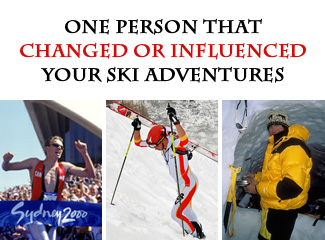
Person that influenced your ski adventures or racing.
» To read answers to the 1st question in this series see: What is the one piece of gear that changed or influenced your ski adventures?

Who is answering?

In short:

  • Greg Hill
  • Melanie Bernier
  • John Baldwin
  • Christina Lusti
  • Stano Faban

For more details about these ski mountaineers see the first article of the Game Changer series.

2nd question: Who is the one person that changed or influenced your ski adventures (whether that be touring or racing)?

I would like to hear who influenced YOUR ski adventures. You can do so via comments section at the end of this article.
Greg Hill says (http://www.greghill.ca):
I am not someone who likes to place people on pedestals, I feel that we are all unique and usually deserved of respect but most likely not so great that we should be idolized.
I respect anyone who pushes themselves to be their personal best in whatever avenue they choose. But of course there have been people who have stood out in the past.
Alex Lowe was a champion of men and having seen what he could do and how he progressed mountaineering was impressive. He chose his path and went after it with wild determination. His technical climbing, exuberant character and his style were standards to be sought.  Sadly enough he died doing what he loved.
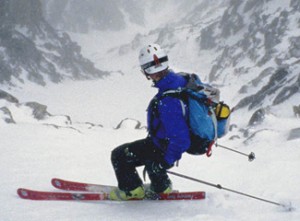
Andrew McLean
Andrew McLean staring down one of his many first descents.
Andrew McLean was someone who influenced me early on in my ski mountaineering career. What Andrew has done, in terms of firsts, is huge, his list of accomplishments hard to conceive. As a young mountain boy I was blown away by the potential that Andrew demonstrated, how much he could explore and have fun while doing it.
Initially, in the rando races, Andrew was the big name. So while I ran up and down mountains I trained to beat him and also dreamed of befriending him and going on some cool adventures with him. Both those came true and we have been friends ever since.
But he truly showed me the potential of fitness and passion in the mountains and how endless it really is.  He was someone who helped me realize my huge days in the mountains by being humble and psyched about what we do.
Melanie Bernier says (http://inthetrails.blogspot.ca):
The person that influenced me the most for ski adventures and skimo racing is Kilian Jornet (standing skimo world champ).
I remember when I was just starting to race, part of the Spanish skimo racing team came to Canada to race the Spearhead Passage race in Whistler. The sport was very young in NA back then, and I remember while gaining Russet Lake, Kilian had already reached the top of Whirlwind and was on his way back. He nicely cheered me on and kept going. I remember being really impressed and could not believe how fast he could move on his skis.
From competing in more events where he was also racing, I got to learn about his philosophy about the sport of skimo but also running. He also has a great personality and is very humble in all that he does, which is a great quality for an athlete of his level.
Looking at all that he does and how fast he is makes me not only want to train harder but push the boundaries and explore always a bit further.
John Baldwin says:
I have definitely been influenced a lot by the collective sport of ski mountaineering – whether it be new ideas for kinds of trips, new gear, new avalanche skills. It’s always inspiring to see what other people are doing.
I was definitely inspired by such as Whistler’s local Karl Ricker pioneering the Spearhead Traverse, or Chic Scott‘s long trips in the Rockies, or Galen Rowell‘s ski trips in Alaska.
I’ve been inspired by ski descents and skimo racing. I have also learned tons from different friends about things ranging from ski technique to how to know where the snow drifts in light and deep or many other things.
But it is hard to single out one person.
I suppose the biggest influence was the person that got me into backcountry skiing in the first place. It was Hans Fenz, my high school French teacher. I was never any good at French but on weekends he would take a few students backcountry skiing. Trips to Diamond Head and eventually the summit of Mt Baker opened up this magical world for me.
Christina Lusti says (http://christinalusti.wordpress.com):
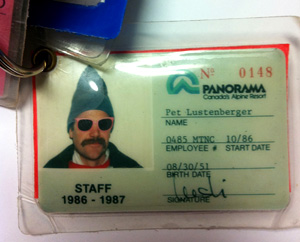
pet lustenbergerMy Dad has been the biggest influence of my skiing career.
It must have started when I was a baby in his back-pack skiing around the local ski hill. Teaching me how to tune my skis, driving us to ski races, helping out on the race course. . . and of course free skiing all over the mountain as a family.
Supporting me through a ski racing career and then up a new path of ski guiding, he has helped me create a life and career around my passion!
My dad loves to ski, watch skiing, talk about skiing!
He grew up on a mountain in Switzerland so skiing was a way of transportation . . . ski racing at a young age, moving to Canada and working for CMH, to running Lusti’s Ski Shop at Panorama Resort.
I think that his passion has been passed over to me. . . I look up to him and how he has formed his life around the greatest sport I know!
Stano Faban (Skintrack.com):
I guess, one never realizes how hard it is to answer a seemingly simple question until he asks the same himself :). So I totally agree – it is hard to single out only one person that influenced us the most.
As I think about it, by looking at a bigger picture, I was always amazed with human powered speed. That means that racing or “racing-like” efforts inspired me the most.
To some, climbing North Face of Eiger in less than 3h (Ueli Steck) is a suicide mission, or to run a sub 30min 10k in an olympic distance triathlon is just that – running 10k in 30min.
To me, the final time of such an effort is an extraordinary summary (even though a very brief one) of what came before. It is a result of a long journey that starts with wanting slowly being transformed to believing. The more obvious things follow such as planning, commitment, determination. But even each of those include tremendous details that have to come together, on a daily basis, 365 days a year!
And because speed comes and goes as we age my biggest inspirers have changed too over periods of time:
Firstly, it would be Miguel Indurain (5-time Tour de France winner) but then reading about Reinhold Messner’s and Hans Kammerlander’s missions in the Himalayas showed me how speed can blend with adventure and mountain environments.
The biggest inspiration in my triathlon “career” came from Jan Rehula and Simon Whitfield after seeing them duke it out for gold at the first triathlon at Olympics in Sydney 2000. I knew Jan since about 1997 and all he could talk about was that race. Then seeing him getting bronze was amazing.
Finally, once I turned to mountain sports fully Ueli Steck (the speed with adventure), Stephane Brosse (completeness and consistency) who recently died, and Peter Svatojansky (determination and sheer will) inspired me the most. These days it is mostly Reiner Thoni and above answering Melanie Bernier.

Previous and Next questions:

  • To read answers to the 1st question in this series see: What is the one piece of gear that changed or influenced your ski adventures?
  •  To read answers to the 3rd question visit Skintrack.com in couple of days – “What is the one event that changed or influenced the way you do your ski adventures now (whether that be touring or racing)?”
  • Signup for Skintrack PLUS newsletter (top right of this page) or follow us on Twitter and will let you know when next article is up.

Who influenced you?

Share who was/is The most influential person for your ski adventures, backcountry or racing.
And thank you for enjoying the read!
Filed Under: People (Interviews) Tagged With: Alex Lowe, Andrew McLean, Chic Scott, Christina Lusti, Galen Rowell, Greg Hill, Hans Kammerlander, John Baldwin, Karl Ricker, Kilian Jornet, Melanie Bernier, Peter Svatojansky, Reiner Thoni, Reinhold Messner, Stano Faban, Stephane Brosse, Ueli Steck

Stephane Brosse: Remembering the greatest rando ski mountaineering racer

June 18, 2012 By Stano Faban 1 Comment

As you have probably already read through various internet sources – a ski mountaineering legend Stephane Brosse died yesterday (June 17, 2012) during a fast mission traverse of the entire Mont Blanc massive. He was accompanied by Kilian Jornet.
I don’t want to discuss details of the accident here, there is plenty of that elsewhere. All I want to do is to introduce him to people that started participating in or following rando racing after he retired from the sport. And pay a small tribute to him.
Stephane had a massive influence on the racing community along with his teams race partner Pierre Gignoux (the maker of the now famous carbon boots). They were fast, hungry, and brought so much innovation to ski mountaineering on many levels.
Here is a beautiful example of that – arguably the most fluent skimo transition ever made – while racing Utah’s Powder Keg in 2005:

Stephane won everything there is to win in skimo racing – World Champs, Pierra Mentas, the old classics (Mezzalama, Patrouille) and too many others to mention.
However, I will remember Stephane as the guy that climbed from Chamonix to top of Mt Blanc and skied back in only 5h 15min! He did this with Pierre Gignoux. (Wikipedia states they did it in 2007 but I think it was earlier.)
Fortunately, these days, the skimo world has as influential person as Stephane was, and I don’t think it was any coincidence they became ski partners. But it is very sad that “the passing of the crown” to Kilian had to happen under such tragic circumstances.
No one is invincible, and nothing is for granted. But that is precisely what makes life worth living. Because it applies both to life as being physically alive and healthy as well as to making us reach for our dreams – we can’t try to fulfill them just at our wish, and it is not granted we will even touch them.
My best wishes to Stephane’s family and friends.

Filed Under: People (Interviews), Skimo Racing Tagged With: Kilian Jornet, Stephane Brosse

How to choose the right length (and kind) of skimo racing poles for you

March 14, 2012 By Stano Faban 10 Comments

Some time ago someone posted a question on Skintrack about ski poles for skimo/rando racing. It never got fully addressed.
Recently, @peteyknight asked about skimo racing ski poles length during our live Twitter interview with Reiner Thoni. And I bet you are asking the same, so I decided to share some personal experience and discuss the topic more.

ski mountaineering racing world championships
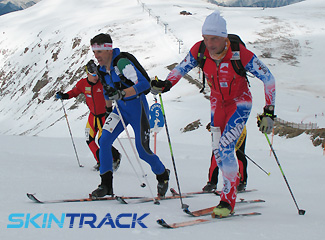
Top 3 from vertical race at 2010 World Champs: in blue Dennis Brunod (he seems about 170-175cm tall), Florent Perrier in red/blue (about 180cm tall), behind Kilian Jornet was about to pass them, more on him below.
Feel free to share your experience and thoughts in the comments below. It will open more opportunities to benefit yourself in finding the most suitable poles for you.

Previous personal experience with racing poles

As anyone I started skimo racing with normal ski poles with full baskets, don’t remember the exact length though. There is nothing wrong with that as during this time you should be evaluating other aspects of your experience more, such as: “Do you like this type of racing? What turns you on to come back?”
After getting inspired by super-fast Euros I decided to put more energy into skimo racing. I noticed that their poles were longer than usual backcountry ski poles and that they were actually cross-country ski poles (smaller baskets too).
To shorten the story, I ended up with 140cm cross-country poles. I am 186cm (6’ 1.2”) tall so it seemed appropriate until I noticed that my shoulders and arms were getting quite tired even mid-way through each race. But still stuck with them.
Few years later a friend from a Spanish skimo team gave me his 130cm Ski Trab poles, he was about 170cm (5’ 7”). Sure, 130cm felt a bit short but was more comfortable on the steeps, in the switchbacks and on the downhills. I stuck with these for few seasons (they were free, eh) until I lost one. Then the dilemma began again. What length?

My racing poles now

In the last three seasons I use 135cm cross-country ski poles and find that length the most suitable overall. As I mentioned above, I am 186cm. My arm span (Wikipedia on arm span) is 186cm too which gives me about an average height to arm span ratio (this ratio is different for women). I am providing this info since I believe it is important to consider also your arm span, not just your height, when choosing your poles.

Some thoughts and examples

Perhaps, a super ideal length for my skimo race poles lies somewhere between 135 and 140cm. However, it is very difficult to objectively select the right one, so by relying on my feelings I am leaning towards 135-138cm, and only maybe 140cm for a flat vertical race.
This leads me to believe that some of the most advanced skimo racers would use, and train to effectively use, two different lengths. In the same time I believe it is very individual.
What length other people use:
Reiner Thoni at cca 188cm (6′ 2″) – 140cm poles (NA and Canada’s skimo champ).  You can read our interview by following Skintrack on Twitter and diggind in our history. The transcript is coming here soon.
Peter Svatojansky at 186cm (6′ 1″) – 138cm poles (podiums at Pierra Menta, World and Euro Champs). Read an older interview with Peter where he provided his ski poles info.
Melanie Bernier at 175cm (5′ 9″) – 130cm poles (3 x Canadian champ and a 5th place from a sprint race at World Champs 2011).
Kilian Jornet at 171cm (5′ 7″) – (best of the best last 3 years) from photos Kilian seems to be using quite long poles for his height, I would guess around 135cm. I also guess that he would be the one to use two different lengths – for individual race and for a vertical.
This video does a good job of showing how long poles the best use (in proportion). Not the best quality but you will get the idea:

How to choose your skimo (randonnee) racing poles?

Since all competitive skimo racers use cross-country (xc) style poles I suggest you consider them as well. Just be careful to pick the ones where hand straps can be easily removed.
Length:
Consider that the poles length should be suitable for all aspects of skimo racing – skinning, bootpack, and downhill.
Since most of xc poles can be cut to adjust length I would  suggest this formula:

  • if you are 190cm+ tall (6’ 3” +) buy 145cm and you can either cut them or keep as is
  • if you are 180-190cm (5’ 11” to 6’ 3”) buy 140cm, cut or keep
  • 170-180cm (5’ 7” to 5’ 11”) buy 135cm, cut or keep
  • 160-170cm (5’ 3” to 5’ 7”) buy 130cm, cut or keep
  • 160cm and less (less than 5’ 3”) probably buy 130cm, then cut or keep

Material and weight:
You have couple of choices:

  • Carbon is very strong and very light but most expensive. Need to be careful not to fall on them because it breaks, does not bend.
  • Aluminum is less expensive, strong but heavier than carbon or composite. Makes for a good beginner or training poles. Usually bends when you fall on it – you can still finish the race. Cheap aluminum poles bend way too much when you put lots of your weight on it, they are too soft.
  • Composite poles are a mix of materials. Price, weight and performance varies quite a bit. Similar qualities as carbon.
  • Fiberglass probably comes only with composites these days. I find it a bit too “bendy” when loaded.

Baskets:
Some xc poles come with very small baskets. You don’t want those. You need something smaller than backcountry skiing pole baskets but still big enough to provide some support when the snow is deep.
Figuring out the length:
See the length formula above before buying. Then it will take some time (maybe even few seasons) to find your ideal.
How about figuring this out with a length-adjustable mountaineering pole?
This only works if you manage to restrict how much of the tip sinks into the snow. Usually, tips on mountaineering telescopic poles can go as deep as 5-6cm. You want to restrict your test poles that only up to 1cm punches in, and then you can use this length as a reference.

What poles do you use? Questions, thoughts?

Share what poles you use and how tall you are. Or if you have any questions use the comments below to ask.

Filed Under: Gear, Tech & Food, Racing 101 Tagged With: Kilian Jornet, Melanie Bernier, Peter Svatojansky, Reiner Thoni, skimo racing poles length, Stano Faban

Vertical climbing speed: Ski mountaineering vs Uphill running vs Slope angle (vs Gear weight)

October 7, 2009 By Stano Faban 23 Comments

How does vertical speed compare between different mountain sports?
And how does slope angle affect that speed?

vertical-speed-ilustrationThese are very interesting questions to which no one has an absolute answer for. I am going to take a shot at it while relying on my knowledge and experience in both ski mountaineering (skimo) and uphill running.
Here is a summary of conclusions from my “study”, but if you have 20min then read on, it’s worth it. Also, share your opinion in the comments below, thus we can all learn even more.

The most efficient angle for:

  • skinning for guided clients is believed to be 12 degrees.

  • skinning for trained athletes is 13-16 degrees.

  • skimo and uphill running isn’t the same.

  • skinning is lower than the one for uphill running.

Why this topic? Why now?

Kilian Jornet Burgada
I was always interested about this topic and what made me to research it now even more is that, these days, we are fortunate to have a single athlete who is arguably the best in the world at both disciplines. This fact makes things easier as we can “forget” about some variables that are very different between individuals such as body weight, years of training, etc..

The athlete’s name is Kilian Jornet Burgada. He is a 21-year-old phenomenon from Catalonia (Spain) that wins races over any distance, from 30min bursts to 30h mountain marathons, whether on skis or in running shoes. If he is a new name for you then check out his results on Wikipedia – Kilian Jornet Burgada.

The second athlete I will be talking about is Sebastian Selas. I will introduce him further down.

Comparison data – raw race facts

The races (performances) I am going to use for my comparison are:

  • 2009 vertical race at European Ski Mountaineering Championships (Italy)

  • 2007 1km vertical uphill running race (Switzerland)

  • 2009 Grouse Grind Mountain Run (Canada)

The conclusions I am going to draw (or not) in this article come from pure facts I could find and know about these races and athletes, and from my personal experience.

I chose the three races/two athletes for couple of reasons:

  • two of the races were raced by the same athlete in two different disciplines

  • all three races are of very similar vertical gain

  • times at two races stand as course records

  • all three races take place at an arguably low altitude (not going over 2000m)

  • both athletes seem to be quite gifted in terms of vertical racing

  • both athletes are about the same age, 21 and 22

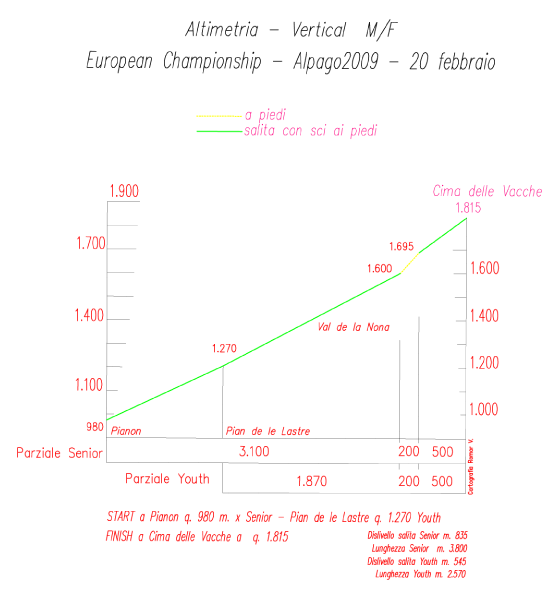
Vertical race at European Ski Mountaineering Championships 2009 (Feb 20, 2009 – Alepago, Italy)

Elevation gain: 835m
Distance: 3800m

Course altitude: 980m – 1815m
Time: 35min 51sec
Winner: Kilian Jornet Burgada
Website: Alpago 2009

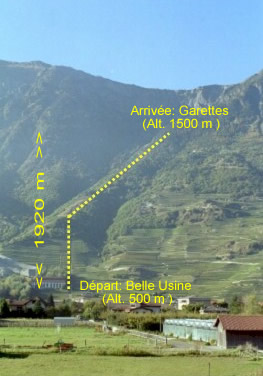
“Vertical kilometre” race 2007 (Oct 27, 2007 – Fully, Switzerland)

Elevation gain: 1000m
Distance: 1920m
Course altitude: 500m – 1500m
Time: 31min 52sec (course record – unofficial world record for one vertical km)
Winner: Kilian Jornet Burgada
Website: Team La Trace

Grouse Grind race 2009 (Sep 20, 2009 – Vancouver, BC, Canada)

Elevation gain: 853m
Distance: 2900m
Course altitude: 270m – 1120m
Time: 25min 24sec (course record)
Winner: Sebastian Selas

Website: Grouse Grind

Ski mountaineering vs uphill running

Since we have the same athlete winning in both disciplines we will go straight to differences between the two mountain sports.

Obvious disadvantage in skimo racing versus trail running is gear weight, especially the weight an athlete carries on his feet as that restricts his leg speed (frequency) the most. Of course, we can compare the clothing and pack weight as well, but I am not going to do it as I don’t believe that weight (about 1.5-2kg difference in this case) affects us as much as what’s on our feet.

Here, just out of curiosity, are the weights per foot:

  • super light running shoe is about 200g

  • super light ski, bidding and a ski boot combination is about 1350g

  • a difference of 1100g

  • pole weight doesn’t matter since Kilian used poles at both races

Skimo vertical race analysis

Based on the raw race facts Kilian’s average vertical speed for the vertical European Skimo Championships was:

23.29 m/m (metres per minute) = 1397.4 m/h (metres per hour)

Click on the image to see a bigger version.
The skimo race course contained a boot-pack section where racers attach their skis to their packs and hike up a preset boot-pack track. This section was only 95m vertical according to organizers.

A super fast boot-pack bottom transition takes around 15-20s and the top one about the same.

According to summary articles of that race Kilian had troubles with his boot-pack bottom transition, so it took him longer than usual, and almost lost a race there.

Kilian’s winning time over the 835m was 35min 51sec but after deducting transitions times I feel comfortable at settling with a time of 35min flat.

That would mean his actual average vertical speed when he was moving was:

23.86 m/m (metres per minute) = 1431.4 m/h (metres per hour)

1. This means it would take him 41min 55sec to skin up 1000m (vertical) if the course would continue and he would keep the same speed.

2. Kilian’s pace in this race was 9min 13sec per kilometre. This is a pace road runners calculate, so it is not a vertical kilometre but a normal one.

Since the 23.86 m/m is the “unbiased” speed (without transitions) we can compare it with his running race as there are no transitions in that discipline.

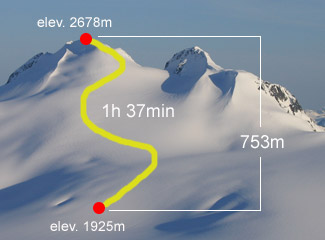
Uphill running 1km vertical race analysis

Again, based on the raw race facts Kilian’s average vertical speed for the vertical kilometre race in Switzerland was:

31.38 m/m (metres per minute) = 1882.8 m/h (metres per hour)

Click on the image to see a bigger version.
1. Since the race was over 1 vertical kilometre, his time to climb 1000m – 31min 52sec – was the same as his overall time.

2. Kilian’s pace in this race was 16min 35sec per kilometre which is much slower than in the skimo race.

In the race, he had to pass a couple of slower competitors, but I don’t think this affects the comparison of the two disciplines too much.

The uphill run was done as a time trial and the skimo vertical race had a mass start. So passing few racers versus fighting in the mass start cancels the factors out.

Comparison – vertical skimo and uphill running races

Here is a conclusion to the first question, “How does vertical speed compare between different mountain sports?”:

We can clearly see that Kilian’s vertical uphill running speed is way faster than the one reached at a ski mountaineering race. This should be no surprise as equipment weight plays an important role. Therefore, of course, this is a bit of comparing apples to oranges, yet it is still interesting to see the numbers.

Also, there is a fact of two years between the two races. In that time Kilian got faster for sure as he proved it at many ski mountaineering races. However, he is running virtually the same time over the vertical kilometer race (at the same venue) past three years, between 2006 and 2008.

Therefore, I consider his record the best time in the world over one vertical kilometre that is not getting any faster at the moment. The vertical kilometre race is still due this year, so we shall see (Oct 24, 2009).

Another factor to consider and compare is the slope angle, which we will get a better comparison lower down when comparing running with running:

The skimo vertical race gained 835m over 3800m which means a slope of 12.69 degrees or 22.52%. Compare this to the uphill run and a 1000m gain over 1920m which means a slope of 31.39 degrees or 61.01%.

Two interesting facts to compare are Kilian’s vertical speeds and his paces per kilometre as they go in the opposite dirrection – smaller vertical speed with faster pace versus  higher vertical speed with slower pace.

Skimo race:

  • vertical speed is 1431.4 m/h

  • pace is 9min 13sec / normal kilometre

Uphill run:

  • vertical speed is 1882.8 m/h

  • pace is 16min 35sec / normal kilometre

Vertical speed and slope angle – running vs running

To answer the second question, “How does slope angle affect vertical speed?”, I didn’t use the same athlete as I couldn’t find enough facts about other Kilian’s vertical races. Instead, I opted to use a race that I know the course of very well; therefore, allowing me for somewhat “accurate conclusions”.

Also, the follow up question should be: “Which incline angle is the most efficient and the fastest to climb at?”. I’ll take a stab at this too, for now lets go back to the second uphill running race.

Photo cropped from The Province photo.
Sebastian Selas. (Cropped from The Province photo.)

The Grouse Grind Mountain Run in North Vancouver in BC, Canada is a very popular uphill race that is regularly attended by very strong athletes; however, no European speedsters have came to check it out yet.

This year (2009) the record was set to an incredible 25min 24sec for gaining 853m over 2900m.

The winner was a 22-year-old local Vancouverite, Sebastian Selas, who is an amateur triathlete and cyclist. Judging by his time, I believe Sebastian would be a serious match to Kilian’s climbing abilities.

But lets look at some numbers, to see how a different angle affects the vertical speed and pace.

Sebastian’s average vertical speed when climbing Grouse Grind trail was:

33.58 m/m (metres per minute) = 2014.8 m/h (metres per hour)

Sebastian’s pace in this race was 8min 46sec per kilometre which is 27sec faster than Kilian’s skimo race pace and 8min faster than his vertical kilometre race pace.

The Grouse Grind race starts in waves that are seeded based on runners’ honest expected time estimates. It starts and finishes with a bit of a flat, around 150-200m in total which should account for about 25-30sec in total. So if we subtract 24sec (which gives us a time of 25min flat) we arrive at an average vertical speeds of:

34.12 m/m (metres per minute) = 2047.2 m/h (metres per hour)

1. Based on the second speed, it would take Sebastian 29min 19sec to run up 1000m (vertical) if the Grouse Grind trail (race course) would continue and he would keep the same speed.

2. Sebastian’s pace in this race was 8min 46sec per kilometre. Using 2.9km here and not sub-subtracting the 150-200m since I am calculating runners pace.

Even though we are not comparing the two athletes on those two specific courses, I think, it is very safe to assume that they are both world class uphill runners for efforts of up to 30-35min, and likely even longer.

Now, lets take a look at the slope angles of the two uphill running races:

Kilian’s vertical kilometer race average slope angle was 31.39 degrees (61.01%), compared to the Grouse Grind’s trail average angle of 18.07 degrees (32.63%) – instead of 2900m, I used 2750m as the actual course length due to the flat start (even downhill) and finish sections to calculate the angle.

The Swiss 1km vertical kilometer race is run straight up, doesn’t let up a bit; whereas the Grind has some switchbacks with low angle incline that allow for some recovery, or at least allow to pick up leg speed again.

One last thing to note here is that Sebastian did not use poles for his run and Kilian did. I believe, both knew what they were doing and picked the right tools for the slope angle they were facing or technique they are using.

Conclusion and an example – slope angles, speed and efficiency

Based on this “study” of mountain uphill running and skimo climbing, and my experience in both disciplines, I am comfortable to say that steeper doesn’t mean faster. However, the more important question is: “Which incline angle is the most efficient and the fastest to climb at?”

To answer that, I can only speculate based on my experience, as would most likely anyone else based on his. But we can clearly see that Sebastian was able to produce an average vertical speed of about 150 m/h (metres per hour) higher than Kilian in his race. This is about 8-9% faster than Kilian’s vertical running speed.

Also, Sebastian’s pace (time per kilometre) values are much more faster than Kilian’s. Sebastian was doing 8min 46sec per KM versus Kilian’s 16min 35sec per KM; that is almost 90% faster pace.

That leads me to say that Grouse Grind’s slope angle is more efficient (18.07 degrees) than the one in Switzerland (31.39 degrees). And that the most efficient angle is somewhere in between the angles of the two courses, while personally leaning more towards the incline values of the Grouse Grind.

But since the techniques of climbing (due to terrain and equipment) in ski mountaineering and uphill running are quite different we should not assume that the most efficient angle for both disciplines is the same.

Based on my experience, I would speculate that the most efficient and the fastest angle for skinning is lower than the one for uphill running.

I believe that in uphill running you can sustain your most efficient leg speed on a steeper slope over a longer period of time than while climbing on skis. This has very much to do with equipment weight and leg speed (and technique).

In fact, you can see this if we compare the paces per KM and vertical speeds:

Kilian went at a slower pace (9min 13sec / KM) and at a slower vertical speed (1431.4 m/h) on a lower angle course (12.69 degrees) when compared to Sebastian’s 8min 46sec / KM, 2047.2 m/h speed, and 18.07 degrees angle slope.

To demonstrate this without calculations here is an example:

Imagine running on a flat ground wearing a 400g pair of shoes (200g per foot). You run for 1km flat-out and record your time and you count your steps.

Now you do the same with a 2700g pair of shoes (1350g per foot). Your time will be slower and you will most likely (absolutely sure about this) do more steps. If you manage to keep the same number of steps you will be even slower.

Without going in more detail about step frequency (because it’s a very individual thing) the example demonstrates you had a lower average speed while running with heavier shoes.

Translating this onto a 20 or 30 degree slope would show at least the same difference. Running with heavier shoes at the same vertical speed, with the same leg turn-over (leg speed) would tire you way faster than lighter shoes.

Subsequently, if you would want to keep the same vertical speed on the same incline you would have to change something – and that is either a faster leg turn-over or have lighter shoes (equipment).

If you don’t trust my example, go and try it out, but before you run around your house in ski boots make sure your neighbors know about the experiment, otherwise they might call for help 😉 and hopefully you don’t think I am crazy for writing all this 🙂

As for ski mountaineering skin track angles, mountain guides are thought to set about 12 degree tracks for their clients, so it must be believed by the experienced ones this angle to be the most efficient angle for most of the clients. The slope angle of Kilian’s skimo vertical race was just over 12 degrees as well.

However, I believe that trained athletes have their most efficient and the fastest skinning angle a bit steeper than average Joe. I would estimated it at about 13-16 degrees.

Now, what’s left to do is to either get Kilian run the Grouse Grind next year or get Sebastian to go to Switzerland for this years race (Oct 24, 2009), so we can truly compare the two machines and have more consistent data.

I hope you enjoyed this article and you are welcome to share your opinion on this topic in the comments below.

Filed Under: Skimo Racing, Training, Tricks & Tips Tagged With: Grouse Grind, Kilian Jornet, Sebastian Selas, slope angle, vertical speed

  • « Previous Page
  • Page 1
  • Page 2
  • Page 3
  • Page 4

Primary Sidebar

  • Facebook
  • Instagram
  • YouTube
Our Facebook Page

skimo-manual-banner-300px
 

Recent Articles

  • Kilian Jornet Interview: About His New Foundation, His Own Environmental Impact, and How He Wants To Help Athletes and The Outdoor Industry To Protect Nature
  • How Fast Are Glaciers Really Melting? How Will This Affect Your Mountain Adventures? Interview with Pascal Egli
  • Book Review – Art of Freedom: The Life and Climbs of Voytek Kurtyka
  • Forest Skis: Innovative, Custom Build, For Backcountry Skiing and Freeride
  • Lighter and Completely Redesigned: New CAMP Ultralight Ski Mountaineering Ice Axes

Categories

  • Contests & Giveaways
  • Crazy Tracks
  • Events & Races
  • Gear, Tech & Food
  • General News & Articles
  • Industry Press Releases
  • Movies & Books
  • News Shorts
  • People (Interviews)
  • Racing 101
  • Reports & Results
  • Reviews
  • Skimo Racing
  • Training, Tricks & Tips
  • Trip Reports & Conditions

Footer

About SkinTrack

Travelling through snowy mountains on skis is like flying… and experiencing life at its core.

Gear reviews, interviews, adventures, contests, skills, skimo training, race reports – we connect you to all things related to self-propelled skiing.

SkinTrack.com, created by Stano Faban, was born out of passion for ski mountaineering and ski touring. Over the years, it has become one of the most popular ski mountaineering blogs in North America.

Recent Articles

  • Kilian Jornet Interview: About His New Foundation, His Own Environmental Impact, and How He Wants To Help Athletes and The Outdoor Industry To Protect Nature
  • How Fast Are Glaciers Really Melting? How Will This Affect Your Mountain Adventures? Interview with Pascal Egli
  • Book Review – Art of Freedom: The Life and Climbs of Voytek Kurtyka
  • Forest Skis: Innovative, Custom Build, For Backcountry Skiing and Freeride
  • Lighter and Completely Redesigned: New CAMP Ultralight Ski Mountaineering Ice Axes

Useful Links

Comparing the lightest: Skis | Boots | Bindings

Skimo Training: Training Plans | Videos

Stay in Touch

  • Facebook
  • Instagram
  • Twitter
  • YouTube

Copyright © 2026 SkinTrack.com. All rights reserved.