
• Skip to primary navigation
  • Skip to content
  • Skip to primary sidebar
  • Skip to footer

SkinTrack

  • Lightest Gear
    • Skis
    • Boots
    • Bindings
    • Skins
    • Packs
  • Skimo Training
    • Training Plans + Skimo Manual
    • Transitions Videos
  • Facebook
  • Instagram

skimo training

Biking Instead of Running? Proven Tips for Effective Summer Skimo Cross-training

May 9, 2016 By Stano Faban Leave a Comment

The following article is a guest post by Peter Knight and is similar to our last week’s post – How to Start Running After a Skimo Season Without Getting Injured – but with specialized information for skimo racers that prefer cycling and mountain biking rather than running in the summer. Peter is a Canadian Skimo Team member that keeps on improving every season but he came to the sport from mtb and road roacing. I have known him for over 5 years and since I have full confidence in his advice I asked him to summarize his tips below.

Early spring
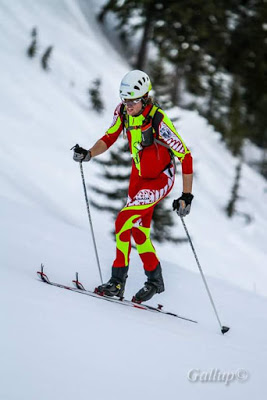
Peter Knight
Peter Knight
With dry trails and roads, and excellent skiing at higher elevations, spring is my favourite time of year.
If you are still skiing on the weekends, and putting in big days, it is important to contain the excitement and ease up on the after-work riding. If you have hung up the bike over the winter it might take a couple of 1­-2 hour rides to ease the legs and butt into riding again. The good news is that, in my experience, the first hard bike ride never hurts as much as the first hard ski. After transitioning into riding, it can be pretty easy to step it up to 4­-6 rides per week. It’s also nice being able to train right from your front door!
Spring came early for me this year. Bike trails and roads dried up while creek crossings opened up and snow melted from valley approaches. In addition, biking (indoors and fat-biking) made up most of my midweek training during the skimo season so it didn’t take me long to adapt.
Bike fit is important:
Make sure your bike and shoes are set up properly. I set up all my bikes: mountain, road, and fatbike with identical saddle positioning.

Summer training and planning

After a season of skimo racing, the engine should be in top shape, but it will be tired. It is important to take a couple of weeks and weekends easy before getting back into training. And while the engine is in top shape, it will take some time for the legs to adapt to the sharp accelerations of bike racing. Unfortunately, where I live, there are lots of great events scheduled in May, but if you are like me and have spent your weekends in April skiing instead of cycling then your legs might not be ready yet.
While long climbs should be our strength, due to skimo training, I think it is valuable to work on a variety of systems:

  • Sustained power output on the flats (like a time trial),
  • and short, repeated efforts with reduced recovery found in mountain biking and criterium racing.
  • Mix it up and try not to fall into a trap of doing the same workout/effort over and over again. For this reason, I think I’ll pull out the road bike more often this year. Find a group ride or a midweek race series to push yourself.

Personally, I focus on Olympic format XC races lasting under 2 hours while occasionally dabbling in longer events. While the short events seem to be dying out in favour of longer races and stage races, their duration, intensity, and community is similar to skimo. Rides over 4 hours on the weekend are the exception rather than the norm.
Stano’s experience: I regularly jump between trail running and road cycling during the summer and fall as in my experience the two sports complement each other very well as skimo cross-training activities. Trail or mountain running is preferable in terms of building specific strength, movement and skills that translate nicely to skimo, however, doing a 3-4 hour ride is much easier on tired running legs than doing another 2-3 hour run. The regular change in activities also keep things fresh while I perform majority of intervals only by uphill running.

Riding in the fall
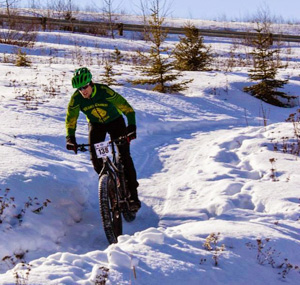
This last winter, due to living in flat Edmonton, Peter rode his fat bike a lot as means of training for skimo.
This last winter, due to living in flat Edmonton, Peter rode his fat bike often as means of training for skimo.
Cyclo-cross racing is getting increasingly popular in the fall. While I believe the repeated high intensity efforts are valuable, focusing specifically on this discipline requires racing twice on the weekends, and even adding a midweek race. That doesn’t leave a lot of room for other specialized workouts. Thus, my opinion is that the odd race is good but a full season might leave you tired or lacking once on the skis.

Stretching and strength building

Stretching and strength tips are similar to running. I’m looking forward to trying the exercises for glutes, hip flexors and IT band mentioned in the running article last week – How to Start Running After a Skimo Season Without Getting Injured.
Filed Under: Training, Tricks & Tips Tagged With: cycling, Peter Knight, skimo training

How to Start Running After a Skimo Season Without Getting Injured

April 30, 2016 By Stano Faban 5 Comments

Although the ski season is not fully finished yet, we are all thinking about summer activities more and more with every sunrise. A year ago we published a post discussing a couple of general points for Transitioning from Skimo to Summer Training, however, we haven’t talked about specific things related to running, which tends to be the bread-and-butter activity for skimo athletes in summer.
stano-running-needle-peak
We would like to provide you with more in depth advice with how to safely get back into running after spending the previous 4-6 months doing very low-impact sports compared to trail or road running.
The biggest issue for most people is to actually follow a conservative approach because they are super fit coming off a ski season, thus, think that if they can do 5-7h ski sessions then why it should be a big deal to run only 2-3h.

Create a simple plan

If you don’t plan doing any running races this summer, or only very low key, then you can skip to the next sub-heading. But if you would like to compete in a couple of events more seriously then it’s very helpful to decide on this by end of April. With that, also try to pin down what distances, which exact races and their dates.
Unless you kept running a little bit during the winter, or started already in March, then I would recommend to pick your big goals past mid-June or so. This is not only for maximizing your potential, by giving yourself time to peak again, but rather to minimize the chances of injury. Running is a much more strenuous activity on our joints and tendons than ski touring so giving your body enough time to get used to it is never a bad idea.
It’s also wise to pick such races that fit your strengths as a ski mountaineer – with lots of vertical gain, preferably long climbs, and very little flat sections.
Example: If your goal race will be in early August then spend from mid-April to end of May just easing into things (see below). In June and July, there will be plenty of time to ramp up your volume and intensity – remember, you will be carrying lots of fitness from the ski season so it’s mostly about getting used to different mechanics in the most efficient and safe way.

Easing into it: the first 4-6 weeks

The transition period from skis to running is best done while you are still skiing a bit or taking your 2-4 week rest period after a demanding season.
For first two weeks, I would advise against running more than twice a week and spacing the sessions at least 2-3 days apart. Keep each session under an hour, choose softer trails on rolling terrain and keep your pace very relaxed.
Between weeks 3 and 6, you can bump up to 3 runs per week but still keep the pace fairly easy. One of those sessions can be up to two hours if you are a seasoned runner, however, still stick to soft trails. Another session can involve a long climb and a descent for a total of 1.25-1.5h but keep it easy on the descent. Third session can be less than an hour.
During this “easing in” period you could also introduce some running technique exercises such as in the video below and also have fun with running backwards or sideways. All of these will improve your efficiency, agility and joint/muscle strength.

Strength training and stretching as injury prevention

If you rush or skip the above adaptation period then it’s quite possible you will develop injuries that will stop you from running in a couple of weeks. On top of easing into running, you should really consider doing specific exercises that will strengthen and stretch some key areas that might be imbalanced after a ski season.
Next, I am going to point a couple of the most usual problems skimo people face after a long ski season.
Important note:
Most people and even many long-time runners are always trying to fix pains or tightness in various joints or tendons by heavily focusing on stretching. While this seems logical – “let’s stretch it out because it’s tight” – in many cases you should be focusing more on strengthening than stretching. Most of body muscles are balanced by opposite or different muscle groups and a weakness in those groups will cause the balancing group to constantly overload and get tighter.

Stretching your hip flexors

By dragging the weight of our boots and skis, with uphill skinning motion, the whole winter causes many skimo racers and backcountry skiers to develop tight hip flexors. And as if skinning alone wasn’t enough, we often add to developing this problem by jumping right into the car after a day of touring instead of spending a couple of minutes to stretch. Lots of office sitting further exacerbates this issue even more.
So if you haven’t done much maintenance in the winter then it’s a great time to get that hip flexor extension back. Here is a video that shows an effective exercise and easy to do exercise as well as explains the correct form.

Knee pain, IT band syndrome and weak glutes

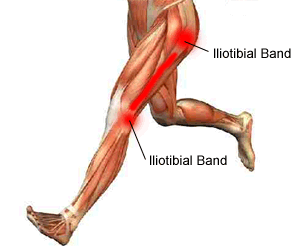
IT-bandIt is not uncommon for skiers to develop IT band syndrome in a couple of weeks by getting back to running after few months off. Here is a good definition of what IT band syndrome is and how it could be felt:
Iliotibial band syndrome occurs when the connective tissue (ligament) extending from the pelvic bone to the shinbone becomes so tight that it rubs against the thighbone. Distance runners are especially susceptible to it. The main symptom is pain between the hip and knees that worsens with activity.

Many people get diagnosed with ITB syndrome after they visit a physio to help them remedy knee pain. But the vast majority never visit a physio and often just rely on “friendly” advice so the only things they start to do is rolling their ITBs on a foam roller and stretching it. This does not solve the root of the problem but just temporary relieves symptoms. Further more, there is plenty of evidence that it’s pretty much impossible to stretch the IT band, however, it is possible to stretch or relax other areas that will feed “slack” into the ITB.
The proper way of dealing with knee pain due to ITB syndrome is strengthen a couple of key muscle groups that have developed weakness over time, thus, are throwing the whole system out of balance, and to stretch or “untighten” others.
This video shows a couple of great exercises to strengthen those key muscles. In most cases, myself included, weak glutes will be responsible for producing knee pain and ITB syndrome. Lots of times, IT band syndrome develops as result of abnormal, out of “alignment”, femur (the big thigh bone) movement which is caused by weak hips that cause our pelvis to drop. This whole chain of reactions is controlled by our “gluteus maximus and medius muscles that are the two major muscles that control the position of our pelvis and overall stability of the leg during the running stride”. Here you can read a lot more about specifics of the IT band issues.

Calf and hamstring muscles strengthening, and Achilles tightness

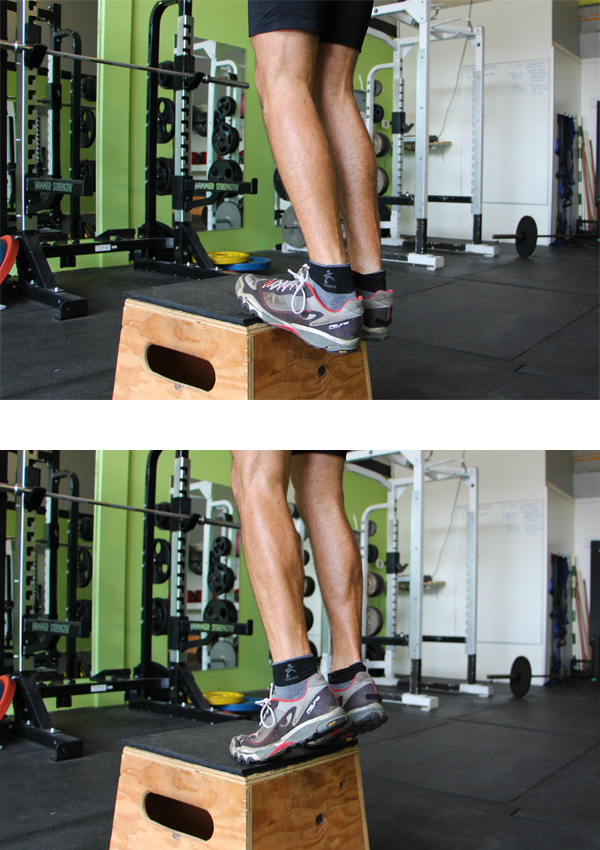
Eric demonstrating calf raises. Image is from our Manual for Ski Mountaineering Racing Training e-book.
The fact is, and this is something very specific to ski touring, that due to equipment used for skimo and mechanics of the sport we engage our calf muscles very little the whole winter (up to 5-6 months at times!), unless of course if you kept on running during the ski season. Because of that it’s why I like to slowly easy into running and really pay attention to my body in the first couple of weeks.
The shorter runs on soft trails with varying terrain/gradient will start activating those calf muscles and Achilles tendon in a gentle way. Supplement these short runs with a simple, full range of motion exercise like calf raises on stairs and you are setting up a good foundation for the whole season.
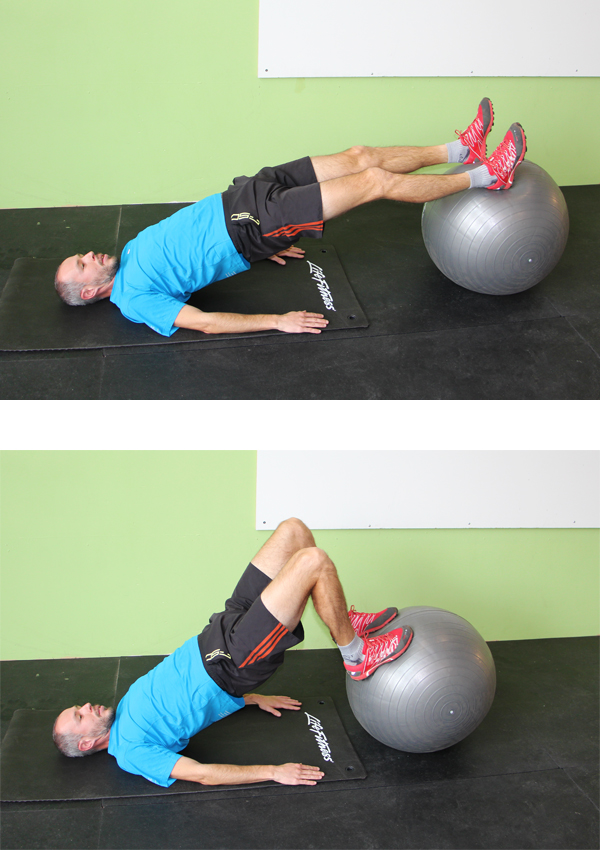
We talked about the importance of strengthening the gluteal muscles (glutes) already but another muscle group to pay attention to are your hamstrings. By strengthening them you will balance out the tightness that develops in your quads from skiing.
Stano showing one of the most effective hamstring and glutes exercises. Make sure to"squeeze you butt otherwise you won't engage the glutes much. Image is from our Manual for Ski Mountaineering Racing Training e-book.
Stano showing an effective hamstring and glutes exercises. and”squeeze you butt otherwise you won’t engage the glutes much. Image is from our Manual for Ski Mountaineering Racing Training e-book.
On top of that, glutes and hamstrings have been shown to be the most important muscles in generating the most force for sprinting for running, and I suspect this is also the case for skimo racing sprints. This is due to the fact that for fast sprinting, or shorter distance running, your strides will need to become longer and to sustain a longer stride you will need strong glutes and hamstrings.
Now that you are strengthening the whole back of your leg it is also wise to stretch those muscle groups to make sure they remain fluid and allow for full range of motion. You can find many good stretches for these groups online.

Running beyond those first 6 weeks

Continuing running beyond the adaptation period should be fairly straight-forward as you probably already know from previous years what your body can handle. If you don’t then a general advice would be:

  • To increase your running training load (mileage, time, speed) very conservatively.
  • Not to run more than 4 times a week, unless you absolutely cannot do any other sports or you are very experienced runner.
  • Vary your terrain – from long hills and descents, to rolling, to flat.
  • To watch out for any small pains and aches as these can lead to more serious problems but are easily preventable by proper strength exercises and stretches.
  • Take time off, even up to a week without running, if you feel like your body is getting beat up too much.

As for more intense training and intervals, make sure you are properly warmed up and don’t have any pains – this is more important with running than skimo. Besides that just proceed with intensity workouts based on the same principles like for skimo and other endurance sports such a cycling or xc skiing.
If you are serious about your training and want to learn more how to maximize your time then we highly recommend you check out our Manual for Ski Mountaineering Racing. It dives into endurance training a lot more than a single article can.

Filed Under: Training, Tricks & Tips Tagged With: IT band syndrome, mountain running, Running, skimo training, trail running

Skimo Training Series: Training tips for September-October

September 24, 2015 By Stano Faban 2 Comments

September marks change of seasons in North America and Europe. One minute you are suffering through the heat of summer then the next it is end of the month and the first snow is dusting the high peaks. During the upcoming weeks, there are a few things you can do to help get ready for ski season.

Eric Carter and Melanie Bernier getting in some early "skinning" mileage.
Eric Carter and Melanie Bernier getting in some early “skinning” mileage.

1) Start mimicking ski movements

Most of us have been running, cycling, or rock climbing all summer so it’s time to start working again on specific muscles for skinning and skiing.
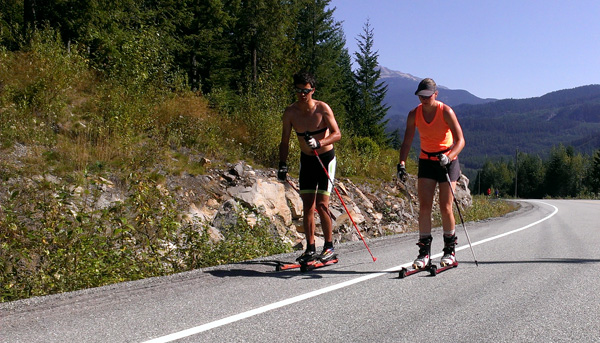
Those with a big road climb in their area can break out the roller-skis. If you aren’t willing (or don’t have a big climb close by) to go to that level of training dedication then uphill ski walking is a good alternative. Find some hills that are steep enough to force you into a walk and use ski poles to push off with full extension in your elbow.
By getting those unused muscles in your back and legs moving, before the snow flies, you will have less soreness to start off when you finally put real skis on your feet.

2) Introduce intensity into your training

This time of the year is a good time to start including intensity training into your weekly routine. Skimo races are frequently at or above lactate threshold pace so Tempo and Threshold work early in the season is key. Start gradually with shorter intervals at lower intensities but work your way towards long interval sessions that mimic climbs in a race.
One of our favourite workouts is the Uphill Hour:
Following an easy warm-up, hike with poles or roller-ski uphill at Tempo pace for 45-60 minutes. Finish with an easy cool down.

3) Plan your race calendar

By October 1st, most race dates are usually decided or you at least have an idea of when your goal race might be since most events have stable dates year to year.
Check SkinTrack race calendar (coming soon), the USSMA calendar, and the ISMF World Cup schedule. Analyse where you need to drive or fly and start planning how far in advance you need to be there. Someone travelling to Utah or Colorado, or even to race Mezzalama in Italy, from near sea-level in Boston or New Hampshire should have very different acclimatization plans than someone that lives in Crested Butte.

How to get ready for a skimo season?

If you have more questions about how to get ready for the upcoming season, check out our skimo training manual – it is full of specific advice on fall intensity sessions and tips on how to plan your race season.

Filed Under: Training, Tricks & Tips Tagged With: interval training, roller-skiing, skimo training

Report: 3rd Annual SkinTrack Summer Training Camp

September 10, 2015 By Stano Faban 2 Comments

Over the last weekend (Sep 4-6, 2015), we hosted the 3rd annual SkinTrack Summer Skimo Training Camp, with activities based around Whistler BC.

As close to revealing himself as it gets.
Trevor as close to revealing himself as it gets.
The camped kicked off at Escape Route, a local outdoor store in Squamish, with a presentation by a local steep skier and Dynafit athlete Trevor Hunt (@coaststeepskier on Instagram).
Forty skiers turned up while Trevor gave an exciting presentation where he highlighted five local steep descents including the North Face of Atwell and the Ledge.
His presentation sparked some interesting discussion and questions ranging from gear (he uses Dynafit TLT6 boots on Denali skis with Expedition Bindings) to how he copes with fear.

Saturday

Eric Carter leading just before cramps got best of him 20 seconds from the line.
Eric leading just before cramps got best of him 20 seconds from the line.
The core training camp group met in Whistler Village where a few of us competed in the first ever edition of the Whistler Valley to Peak running race. The race was 20km with 1800m of elevation gain climbing from the village, up mountain bike trails and service roads, to finish at the peak of Whistler via the beautiful High Note trail.
Eric Carter came second but was very close to winning until cramps got best of him just metres from the line.
Those not racing opted for a slightly less gruelling option of running the Signing Pass trail to High Note to cheer for the racers. After lunch on the deck in Whistler, we returned for some recovery time in Squamish and a BBQ dinner with the group.
skimo_camp_2015_3
Couple of non-racers enjoying the beautiful views and weather.

Sunday

Despite a dreary weather forecast for Sunday, we opted to head into the alpine and hope for the best. Parking at the Rainbow Lake trail-head in Whistler, we headed up the trail with an ambitious plan of a high alpine traverse over Rainbow Peak to connect two valleys and form a perfect loop.

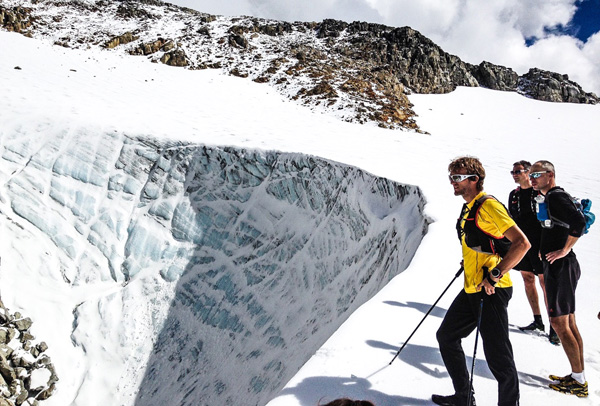
We crossed two glaciers in the process.
We crossed two glaciers in the process. Second and fourth here are Adam Campbell and Nick Elson, arguably the two fastest 50-150km runners in Canada.
Luckily for us, the weather held. We jogged the trail to the beautiful Rainbow Lake and then started climbing scree slopes and rock slabs to reach the Rainbow Glacier. Snow fall from several days prior had covered the glacier ice giving it a nice clean coat.
Part of our group marveling over nature's ability to create mysterious  creations.
Part of our group marveling over nature’s ability to create mysterious creations.
By descending the NE side of the peak and shoulder, we linked up with the recently completed beautiful Skywalk Trail – a new addition built by the Alpine Club of Canada Whistler Section. Skywalk led us down Nineteen Mile Creek and after 6 hours, 30km and 1800m of vert we were back to our cars!

Thank You

We’d like to say thank you to Trevor Hunt, Escape Route, Dynafit and as well the athletes who attended the training camp. We can’t wait to do it again next year!

Filed Under: Reports & Results Tagged With: Eric Carter, Nick Elson, skimo training, Squamish, Whistler

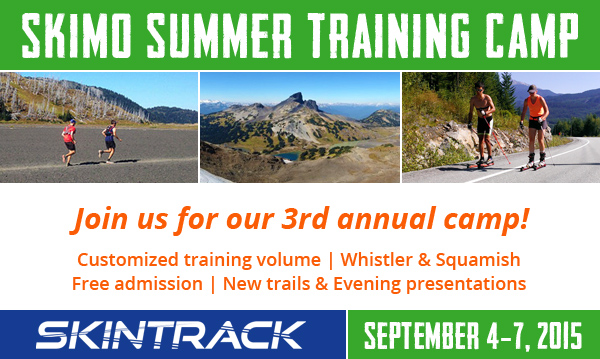
2015 Skimo Summer Training Camp

July 23, 2015 By Stano Faban Leave a Comment

skimo-camp-teaser-2015
If you are reading this then you are invited 🙂
We have decided to change things a little with basing one or two days around Whistler and beyond. This will provide us with new trails and mountain objectives.
The camp will partly serve as the fall training camp for Canadian National Skimo Team but most importantly it will also be open to public.
Not a skier? No problem! This will be a trail running focused camp so trail, mountain, and ultra runners are encouraged to join us!

» Sign up for updates further down «

Quick overview

  • Training for 3-4 days around Squamish and Whistler, BC  with fellow skimo racers and members of the USA and Canadian national teams.
  • Dates are September 4-7, 2015.
  • Activities will mainly involve trail running, light mountaineering, with cycling, swimming and roller-skiing as options as well.
  • Costs will be kept to minimum as we as organizers (Eric and Stano) are fully volunteering our time.
  • Optional Vertical Mountain Running race at Whistler Blackcomb!
  • We are really excited for our Escape Route evening presentation by the one and only Trevor Hunt!
  • Couple of generous sponsors will keep us fueled, geared up and tired.

Sign up for updates

As we are finalizing the exact schedule, please sign up below to keep you updated.
* Also, include information such as:

  • for which days you would like to join,
  • which activities (running, roller skiing) you cannot participate in (cause of injury or don’t have gear),
  • where are you coming from,
  • and how fast can you run a beer mile 🙂
[contact-form-7 404 "Not Found"]

Logistics and Gear

The camp will officially begin Friday afternoon but we understand work schedules may prevent some from joining us then. Feel free to come Friday night or catch up with us Saturday morning.
Athletes are responsible for finding their own housing during the camp but we will do everything we can to help you find a place. If you have friends to stay with in town, great, if not, let us know and we will try to figure something out!
Here is a basic gear list for the camp:

  • Running Shoes
  • Training clothing
  • Sandals, post workout clothing, and beach gear
  • Ski/running poles
  • Food for fuel during workouts
  • Preferred snacks for meals
  • Helmet
  • Roller-skis (optional)
  • Mountain or road bike (optional)
  • Rock climbing gear (optional)

Can I handle it? You should be able to complete 3 days of endurance exercise, with up to 2-3h of running per day in order to attend. Most of our long runs have extended periods of hiking involved so are not as intense as they may sound. If you are unsure if you should attend send us an email!
» Here is how the the first Canadian Team summer training camp in Squamish went two year’s ago.
» Here is how a Canadian Team summer training camp looked like in Revelstoke in 2012.
» To improve your training in the meantime checkout these:

  • Our Skimo Racing Manual e-book
  •  Summer training tips for skimo racers from Adam Campbell (professional mountain runner)
  • “Bread and butter” summer training for rando racing…
  • Hiko-run: Skimo racer’s best summer friend

Filed Under: Events & Races Tagged With: skimo training, skimo training camp

Transitioning from Skimo to Summer Training

April 20, 2015 By Stano Faban 4 Comments

spring-skiing-skimo-transitionSpring arrives at different time in different years. Some of us finish the last race of the season in February or March and are ready to hang up the skis. Others, with sufficient snow or motivation, are able to push the ski season well into May or even beyond.
Regardless, at some point most of us have to pack the skis away for the summer and switch to dryland training.
In this article, we want to provide you with a some tips and cover a couple of key things to keep in mind when you switch to summer training.

Equipment

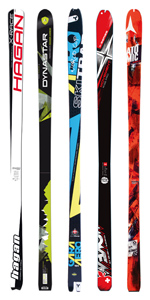
skimo-spring-transition-skis-2Make sure to take take care of your equipment:

  1. Put a layer of warm (yellow or white) storage wax on your skis and leave them un-scraped. This will prevent the bases from oxidizing over the summer.
  2. Remove the batteries from your beacon and store it properly with the battery compartment open (so if you do grab it, you will remember to put new ones in).
  3. Wax your skins and apply them to a glue-saver plastic backing for long term storage.
  4. Make a list of gear that needs to be replaced or repaired and take advantage of end of the season sales. Three specialized skimo stores we recommend are:
    • Skimo.co – http://skimo.co/
    • Cripple Creek BC – http://www.cripplecreekbc.com/
    • Boulder Nordic Sports – https://www.bouldernordicsport.com/shop/c-377-alpine-touring.aspx

Transition Gently

Skimo racers are all about fast transitions but it is never a good idea to immediately jump right into training for another sport.
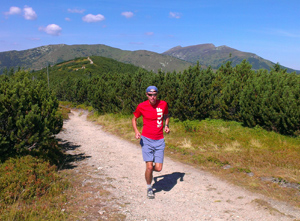
skimo-spring-transitionMost of us are runners or cyclists in the summer and it may be tempting on your first run or ride to try to hit the same volume as when you ended the previous summer.
In an ideal scenario, as the ski season is winding down, you will start to mix in a few easy runs and rides throughout the week to fill in as the ski days dwindle. This is the best way to ease into your new season and to avoid injury.

Take Downtime of 2-3 weeks

While ski touring does not have the high-impact component that running does, it is still hard on our bodies in a different way. With running, it is likely that an athlete will experience musculoskeletal injuries or at least will feel sufficiently beat up to take some rest. Skimo athletes, due to the nature of the sport, are less likely to experience such injuries or symptoms, therefore, are able to push their bodies further towards overall fatigue and overtraining. Because of this, it is especially important to take several weeks of rest at the end of your ski season.
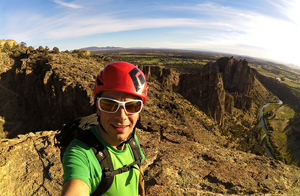
eric-climbing-spring-trainingDuring downtime, we advise athletes to ‘move’ but don’t ‘train’. Fun, easy runs and rides are good if your body feels up to it but even better is to get out and enjoy nature in a different way for a little while – rock climb, paddle, or just hike. Once your mandatory two weeks have passed, consider a third based on how you feel.
Downtime is also important for mental well-being. At the end of the season, most of us are pretty tired of ’training’. Time away from your (racing) sport will allow you to remember why you love them, and by the end of your rest period you should be itching to get back on your bike or lace up your shoes! If not, reevaluate your situation and perhaps seek an experienced coach to help you out

Write your Annual Training Plan!

skimo-manual-banner-300pxWith the spare time you will have in your downtime block, it is the perfect time to develop your Annual Training Plan (ATP). This process is detailed in SkinTrack Manual for Ski Mountaineering Racing so take a look there for more information.
By planning your next season during the rest period, you give yourself the benefit of an entire year to prepare rather than deciding things in a rush as you go.
Keys points for creating your summer training plan:

  • Long slow distance training is the key to developing a successful base for ski mountaineering. The mode (running or cycling) is less important but the hours are.
  • Mountain running should be used instead of flat running whenever possible to help maintain muscle strength necessary for climbing and downhill skiing.
  • Choose a summer race schedule that complements your skimo training. This means races of similar duration and terrain (1-3 hours with significant vertical gain and descent). While ultra-marathons may be the sexy events of trail running right now, they are not the ideal way of preparation for skimo racing for most of us.
  • Stano and I personally find it difficult to get in the strength room at the beginning of the summer. It is just too nice outside to “waste energy” inside. That being said, strength is an important component. Plan to start strength training mid-summer and continue through the fall and early winter.
  • Take time for some adventures. Just like during the winter, it is important to get away from racing and explore the backyard. Plan some long days in the mountains to practice your technical skills and endurance, and you will see the benefits when winter returns.

Takeaway Points

  • Deal with gear issues and store it properly.
  • Take two to three weeks downtime with no ‘training’.
  • Plan your summer and next season.
  • Train hard and wise – make the summer count!

Filed Under: Skimo Racing, Training, Tricks & Tips Tagged With: skimo summer training, skimo training, spring skimo training

Book announcement: Manual for Ski Mountaineering Racing is coming soon

November 2, 2014 By Stano Faban 5 Comments

It has been over a year since Eric and I started working on an idea I have been thinking about for a while. Today, we would like to present you with a cool project we are just finishing and you will be able to get your hands on very soon.

Fast-track your skimo learning

The Manual, as we refer to it, is going to be an e-book that you will be able to read on your phone, or iPad, or laptop, or just simply print out.
We believe the main benefit of this Manual is that it will allow you to speed up your skimo learning curve by at least a few years. You will still need to train, but inside the book we reveal and answer as much as possible yet in a length and format that will take you no more than a day to study.
We didn’t strive for a skimo encyclopedia but rather for a practical tool that you can easily and rapidly learn from.

Skimo technique videos

On top of the manual itself, we have been developing a series of informative technique videos. We are going to start by releasing skimo transitions videos during the next couple of days so you can start practicing speedy transitions for your first races. The cool thing is that we are linking to all of those videos from inside the e-book to make your learning experience as smooth as possible.
Here is one of the videos (click on the “gear” settings button to see it in HD):

I want it, when is the release date?

If you can’t wait to read it then send us your email through the form below and we will let you know a couple of days before it will be released.
The price will be $17 per copy but the first 20 people to email us here will get a 20% discount towards the purchase.
[contact-form-7 404 "Not Found"] In case you missed it, here is a sample, most of a complete chapter from the e-book on skimo racing strategy that we released for free a few days ago.
Thank you and we wish you many happy early season turns!
Stano and Eric

Filed Under: Skimo Racing Tagged With: skimo technique, skimo training, Training

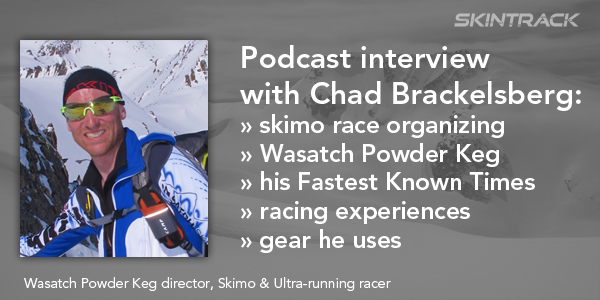
Podcast interview with Chad Brackelsberg on Wasatch Powder Keg, race organizing, racing

January 9, 2014 By Stano Faban Leave a Comment

chad-600x300-banner
I didn’t think the second episode of SkinTrack podcast would come so soon but the opportunity was there so why not. Now, after the interview with Melanie Bernier, you can listen to my conversation with the Wasatch Powder Keg race director Chad Brackelsberg. It’s full of great tips for anyone involved (or wanting to be) in the skimo racing community,
Chad is a skimo racer himself but he is mostly known in the rapidly growing skimo community as the guy that puts on one of the best races on the continent.
At the beginning, I provided a preview of the upcoming events in North America, and at the end, I talked about the Canadian Skimo Championships that will be held at Kicking Horse Mountain Resort, BC over two days on Mar 21-22, 2013.

This interview is full of great tips but we mainly discussed:

  • all about, history included, the upcoming Wasatch Powder Keg skimo race which will be held on March 7-9
  • how the Wasatch Citizen Skimo series is growing
  • what organizers can do to improve their races
  • Chad’s skimo and ultra trail running
  • his passion for FKTs in the mountains (fastest known time)
  • how he balances training, work, and family

Resources related to this podcast episode:

  • Wasatch Powder Keg website – http://wasatchpowderkeg.com/
  • Chad’s blog – http://thebrackpack.com/
  • Couple of times we referred to my interview with Melanie Bernier from 10 days ago
    http://www.skintrack.com/tips-tricks-advice/interview-with-melanie-bernier-skimo-training

Thank you for listening and leave a comment below with ideas how these episodes could be improved.

Filed Under: People (Interviews) Tagged With: Chad Brackelsberg, podcast, skimo training, Wasatch Po

Podcast Interview with Melanie Bernier: Lots of tips from her training for skimo racing, gear, nutrition…

December 28, 2013 By Stano Faban 6 Comments

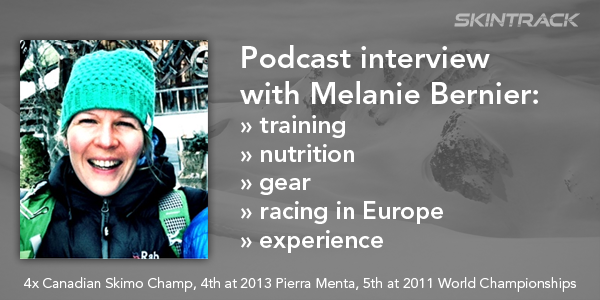
melanie-bernier-episode-1-600x300-banner
This is the first ever episode of SkinTrack.com podcast! It’s not fully podcast-like in a sense that you can download it (will come later) but you can definitely just sit back and listen instead of reading.
For this first episode, I chose to interview my good friend Melanie Bernier who is one of the most inspirational people I know, and a fellow member on the Canadian National Ski Mountaineering Team.
Melanie is one of the most accomplished skimo racers in North America with a 4th place from 2013 Pierra Menta being one of her career highlights. She is fine tuning her game every season and her improvements are results of long-term daily hard work, strong commitment and big passion for skimo.

In this interview we discussed:

  • Melanie’s last winter Euro racing campaign and her most favourite moments
  • her upcoming trip back to Europe for more World Cup action
  • current training
  • nutrition (Paleo diet)
  • her current racing gear
  • skimo pole lengths
  • and her future goals

Resources related to this podcast episode:

  • How to determine your skimo poles length?
    http://www.skintrack.com/skimo-racing/racing-101/how-to-choose-right-length-kind-skimo-racing-poles/
  • How to structure your skimo racing training?
    http://www.skintrack.com/skimo-racing/how-to-structure-your-day-to-day-skimo-training/
  • Pierra Menta
    http://www.pierramenta.com/

I really hope that you enjoyed this interview format and please leave a comment below if you liked it. If not then please leave suggestions on what can be improved going forward with these podcast episodes. Thank you!

Filed Under: People (Interviews), Training, Tricks & Tips Tagged With: Melanie Bernier, Paleo diet, Pierra Menta, podcast, skimo racing poles length, skimo training

How to structure your day-to-day skimo training? Sharing personal experience and tips

November 29, 2013 By Stano Faban 12 Comments

In this post, I am going to share with you my experiences on structuring day-to-day training. From those you should be able to pick up some tips that will help you structure yours.
As the saying implies  – “There’s more than one way to skin a… mountain” – there is not the way, only a way. And because we all have different work and life commitments our training can drastically differ from one athlete to another.

3 + 1 cycle

stano-racing-stodenzinker
Racing in Austria in 2012. It didn’t go very well due to lack of solid training structure the weeks before. But some times it does work 😉
This is my preferred way of structuring training but it has one drawback as you will see.
What does 3 + 1 stand for?
It means you train for 3 days then you take a day off, and then repeat. Some of you may have just realized what could be challenging about following this structure – after two cycles it no longer fits our society’s 7 day calendar.
That could be an issue, could be not, but let’s take a look why I like to follow it when stars align and I can repeat couple of these.
I found out long time ago that just plain more training doesn’t mean I am going to improve. It’s the right amounts of volume, intensity and rest that will do it.
The day off:
I like the 3 + 1 cycle because I feel very confident that I will not overtrain even without obsessing much about the right balance.  One day of rest in a four day cycle seems enough to prevent any negative effects. It’s kind of an “idiot proof autopilot” system.
The 3 days of training:
I found that to train 3 days in a row is ideal to tax my body physiologically yet not enough to burn myself mentally, thus, always keeping a positive attitude going into the next session.
The way I prefer to structure those 3 days is:

  • Day 1 – getting back to it:
    After a day of rest this one features easy endurance (zone 1) with some technique drills and couple of pick-ups of no more than 1-2 minutes each (zone 3). Overall time of the session depends but preferably I would not go over 2-3h.
    I find a not-too-hard gym session on this day to be also a good warm-up as it feels like it readies all my balance and coordination systems/receptors.
  • Day 2 – intensity:
    After a warm up day, where I also refreshed my technique, it’s a great time do go hard. I try to make sure to always come to this day not very tired, which the schedule of the 2 days before is meant to accomplish.
    What I do on this day depends on where I am in the big picture – how much time to my goal there is. Sometimes these would be full out 3 min intervals (zone 4-5), and sometimes these might be longer 8-20min tempo-like intervals (zone 3-4). Point is, I should be hurting.
  • Day 3 – going long:
    After going hard the day before I like to do a longer endurance session (zone 1). Depending on the period in the year this could be anywhere from 2.5h to 7h. This is a good day to go out with friends and enjoy a nice day in the mountains, whether that be skiing, hiking, mountaineering, or biking/cycling.

The intensity day:
I would not repeat the intensity day in each cycle but only in every second. Here and there I try to thread the line to do it in back-to-back cycles but I usually feel so tired by the time the third cycle comes that I just figured it’s not the best way for me.
The not so off day:
Just like with the intensity day, here and there, I would not have a complete rest day in every second cycle. And when that’s the case the activity is only something very relaxing and no more than 1-1.5 h. Either a short ride, an easy soccer or tennis game, or a short hike will do. Swimming is great too.
Bottom line for 3 + 1 cycle:
I feel that this is a super effective way of structuring my training without having to monitor myself much to avoid overtraining. And this cycle also works great for me around a race weekend:

  • Thursday off
  • Friday warm-up (up to 1-2h)
  • Saturday race
  • Sunday ski powder for couple of hours

2 + 3 cycle

Now, let’s take a look at another cycle that I like and can be followed from week-to-week easily as it is structured around 7 days rather than 4.
The 2 + 3 means: 2 days of training + day off + 3 days training + day off = 7 days.
The off days:
Just like with 3 + 1, you can either do completely nothing or have only light activities on every second of those days.
The intensity day – 3 day block:
When I follow this cycle the hard day falls on the middle day during the 3 day block, exactly structured as in the 3 + 1, and only once per week.
The 2 day block:
If I am doing strength training in that period then one of the strength days would fall likely on the first day of these two, followed by a longer endurance session the next day. Or I will do back-to-back endurance sessions of about 2-5h and likely changing sports each day (running, biking, skiing, strength).
Bottom line for 2 + 3 cycle:
This cycle structure works well. It should keep you from overtraining yet working you hard enough. And the 3 day block can be easily fitted around race weekends (or just weekends) if you start your weeks with Monday off (which is great as we all need to get back to work).
But if you want you can always flip it to be 3 + 2 depending which days you want off. If Sundays then you will need to start with a session on Monday. You can figure out the rest.

Mistakes repeated

Despite all the experience I let my structure go loose mid-way last season. At the time it didn’t seems like it but just few weeks later it was obvious. I skied way too much to aid my speed and by the last races I ended up as weak as a sick dog.

What should you do?

That depends on how much time you can/want to devote to training. Overall, I say the 2 + 3 schedule is best if you need to follow a repeating 7 day structure.
Training 3 or 4 days a week:
If you can train only 4 days then I would either structure it as 2 + 2 (2 days on + 1 off + 2 on + 2 off), or as 3 + 1 (3 days on + 1 off + 1 on + 2 off).
If only 3 days then I think it’s best to go with 2 + 1 (2 days on + 1 off + 1 on + 3 off). But once you can only train 2-3 days per week your improvement potential is quite limited, yet by experimenting you can surely figure out the most effective plan within those constraints. My hint here would be intensity.
Let’s hear it in comments below:

  • Are you structuring your training?
  • If yes, how?
  • If not, which one of the above could be for you?

Filed Under: Skimo Racing, Training, Tricks & Tips Tagged With: skimo training

  • « Previous Page
  • Page 1
  • Page 2

Primary Sidebar

  • Facebook
  • Instagram
  • YouTube
Our Facebook Page

skimo-manual-banner-300px
 

Recent Articles

  • Kilian Jornet Interview: About His New Foundation, His Own Environmental Impact, and How He Wants To Help Athletes and The Outdoor Industry To Protect Nature
  • How Fast Are Glaciers Really Melting? How Will This Affect Your Mountain Adventures? Interview with Pascal Egli
  • Book Review – Art of Freedom: The Life and Climbs of Voytek Kurtyka
  • Forest Skis: Innovative, Custom Build, For Backcountry Skiing and Freeride
  • Lighter and Completely Redesigned: New CAMP Ultralight Ski Mountaineering Ice Axes

Categories

  • Contests & Giveaways
  • Crazy Tracks
  • Events & Races
  • Gear, Tech & Food
  • General News & Articles
  • Industry Press Releases
  • Movies & Books
  • News Shorts
  • People (Interviews)
  • Racing 101
  • Reports & Results
  • Reviews
  • Skimo Racing
  • Training, Tricks & Tips
  • Trip Reports & Conditions

Footer

About SkinTrack

Travelling through snowy mountains on skis is like flying… and experiencing life at its core.

Gear reviews, interviews, adventures, contests, skills, skimo training, race reports – we connect you to all things related to self-propelled skiing.

SkinTrack.com, created by Stano Faban, was born out of passion for ski mountaineering and ski touring. Over the years, it has become one of the most popular ski mountaineering blogs in North America.

Recent Articles

  • Kilian Jornet Interview: About His New Foundation, His Own Environmental Impact, and How He Wants To Help Athletes and The Outdoor Industry To Protect Nature
  • How Fast Are Glaciers Really Melting? How Will This Affect Your Mountain Adventures? Interview with Pascal Egli
  • Book Review – Art of Freedom: The Life and Climbs of Voytek Kurtyka
  • Forest Skis: Innovative, Custom Build, For Backcountry Skiing and Freeride
  • Lighter and Completely Redesigned: New CAMP Ultralight Ski Mountaineering Ice Axes

Useful Links

Comparing the lightest: Skis | Boots | Bindings

Skimo Training: Training Plans | Videos

Stay in Touch

  • Facebook
  • Instagram
  • Twitter
  • YouTube

Copyright © 2026 SkinTrack.com. All rights reserved.