

Suunto Ambit 2 quick overview:
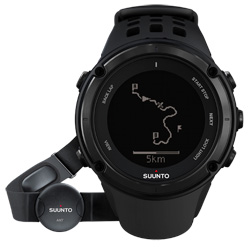
- Usual full price: $550.00 USD
- Weight: 82-92 g depending on the model (mine is 89g for the watch + HR belt 60g)
- Cost per gram: $3.69 / g (watch + belt)
- Pros: Battery life, data analysis, TrackBack GPS function
- Cons: Data transfer, size
- Suitability: Complete sports watch for outdoor/mountain athletes who want the most comprehensive data to monitor their training with the ability to navigate GPS tracks.
- How we go it: Bought through a pro-deal (disclosure notices)
Bottom line:
Expensive but it does everything. If you want the best of the best this is it.
Photos:
Product description and How we tested it:
Four months of summer testing, skiing and running the Sea-to-Sky. It is billed as the wrist-top computer for explorers. The Ambit2 is a fully equipped sport watch with an excellent heart-rate monitor and a GPS device. The Ambit2 has a large battery designed to lengthen its life in GPS mode (compared to a smaller version – the Ambit 2S – geared toward multi-sport athletes).
Suunto has stepped up where Garmin models failed to provide battery life sufficient for ultra-endurance and mountain athletes. The Ambit2 can be used over multiple days and for events lasting longer than 20 hours.
The watch casing itself is similarly sized to other GPS models and though slightly bulky, not overly. Screen size is adequate for reading data and simple navigation. Data fields can be customized to any combination of displays to suit your needs depending on activity. I like to see HR while training but am more concerned with elevation and time during hikes – easy to setup using the online interface.
User designed apps allow custom metrics that can be displayed. While I personally don’t find any of the available apps any better than what is packaged on the watch, this idea has potential for the future as users become better app programmers.
Distances during my runs are generally slightly lower than the devices that running partners use but not significantly. The large face is exposed to scratches, especially while using hands on rock but seems scratch resistant.
Moveslink software is intuitive to use but requires an Internet connection and data is stored online. Every variable can be plotted on graphs versus time and distance.
A track is superimposed over a Google Map. Tracks can be exported and saved within Moveslink to be shared with other users. This allows users to download a track in a new area and use the navigation feature to follow it from start to finish.
GPX files can be exported from Moveslink and uploaded to Strava.com and other training software.
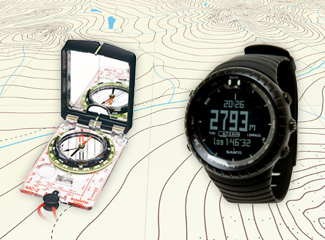
Other features include a compass and accelerometer to enhance distance accuracy.
Pros:
- Fastest GPS connection I have ever had. Always connects faster than the Garmin.
- Best battery life (50hrs) of competitive GPS watches.
- Top quality HR signal.
- Moveslink software allows useful analysis of data after transfer from device.
- Recently announced TrackBack feature allows user to retrace their route back to the starting point. Useful “breadcrumb” navigation tool. Could be crucial to ski mountaineers/mountain athletes who find themselves retreating in a snowstorm when navigation is difficult.
Cons / What can be improved about this product:
- Computer connection uses USB cable (compared to wireless ANT connection).
- Data transfer requires significant time (sometimes >15min).
- Data transfers failed frequently using early software versions. This seems to have been fixed, though transfer times are still long.
- Internet connection required to transfer data and utilize Moveslink.
Product Specs:
- Weight: 89 grams (my model)
- Cost per Gram: $3.69 / g (watch + belt)
- Battery life: up to 50 hrs.
- Water resistance: 100 m / 328 ft
- Warranty: 2 years watch, 1 year included accessories
- Critical accessories:
- HR Strap (Included in HRM version)
- Computer with Moveslink installed
- Optional accessories:
- Running Cadence Monitor (overrides distance data from GPS)
- Cycling Speed/Cadence Monitor
Online stores that carry Suunto Ambit 2 watch:
- $450-600 at Amazon.com
- $550 at Backcountry.com
- $450 at GearX.com (Suunto Ambit2 S)
- $550 at REI.com
- $450 at CampSaver.com (Suunto Ambit2 S)
- $550 at MooseJaw.com
 This article is an extension of “
 ,
, 
 ,
, 
 ,
, 

 ,
, 




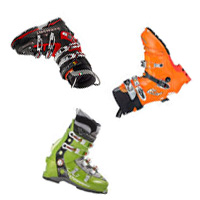 • how many buckles a boot has
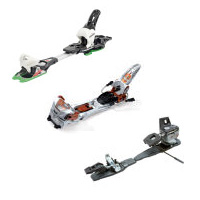 Then Dynafit came out with a revolutionary Dynafit LowTech binding that changed everything. This was primarily due to the very innovative functionality design which shaved pounds and pounds of weight off the previous touring models.
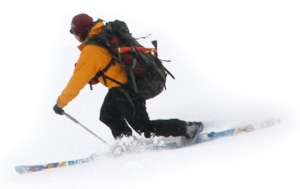 Telemark skiing (or telemarking) gear consists of the exactly same components as alpine touring – skis, boots and bindings. However, this gear functions differently due to the downhill technique of the marvelous telemark turn.
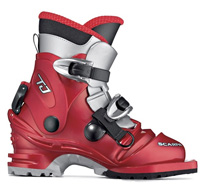 Important differences among telemark boots, including the weight factor, are:
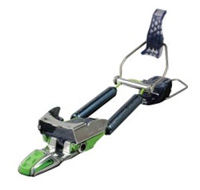 In the past, the biggest concern for telemark skiers (and those that wanted to try it) was a lack of releasability of their bindings in a case of a fall. Therefore, facing a potentially nasty “beating” of your head by your attached skis or spraining your knees. This has been dealt with in the recent years by improved binding models.
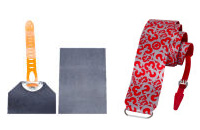 Make your first pair of skins synthetic or mixed ones and maybe after a season or two treat yourself with mohair skins for glacier skinning days.
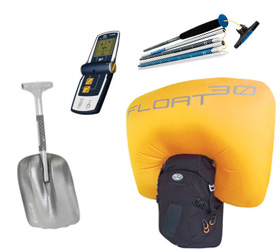 The shovel and probe are more straight forward with each costing only around $40 to $80. Pick a shovel with an extendable handle and a metal blade as this gives you the best tool to dig with. For the probe, don’t go shorter than 240cm, preferably buy one that is 320cm long.
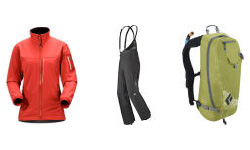 For downhill or more stormy days you should have some heavier duty windproof and waterproof gear. The most recommended are jackets and pants made out of GoreTex fabric.