
• Skip to primary navigation
  • Skip to content
  • Skip to primary sidebar
  • Skip to footer

SkinTrack

  • Lightest Gear
    • Skis
    • Boots
    • Bindings
    • Skins
    • Packs
  • Skimo Training
    • Training Plans + Skimo Manual
    • Transitions Videos
  • Facebook
  • Instagram

Skimo Racing

Skimo News Jan 7/8: Canadian Team Trials, COSMIC Racing, and National Championships in Italy, Switzerland, and Catalonia

January 10, 2017 By Stano Faban 2 Comments

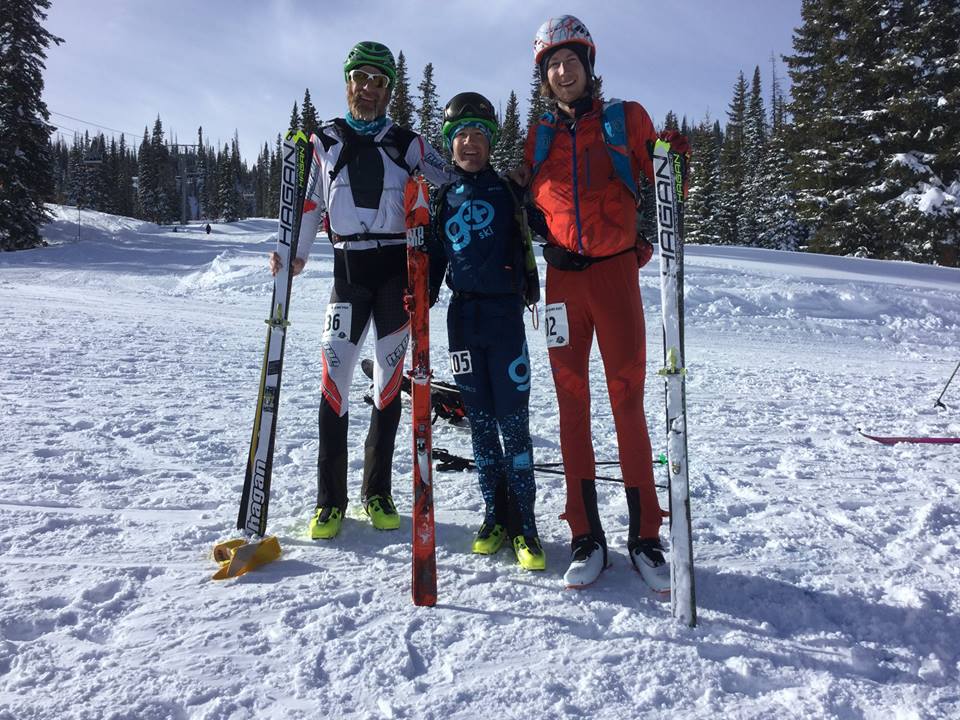
Wolf Creek Men's Podium
Wolf Creek Men’s Podium
With a break from racing over the Christmas holiday, action resumed in all the usual places over the weekend of January 7th and 8th. The current storm hitting much of the West Coast, Utah and parts of Colorado are certainly going to make things look nice for next weekend’s racing!
While not exactly racing news, many of us are aware of the tragic death of Ben Parsons in an avalanche. Please consider donating to the Go Fund Me campaign set up to support his young family: Go Fund Me

USA Race News

Wolf Creek Skimo Race – Jan 7

First we go to the US where the COSMIC series continued at Wolf Creek Ski Area. Paul Hamilton topped the podium with 2015 National Team members Scott Simmons and Billy Laird. The women’s race was not well attended but attracted the highly talented mountain runner Najeeby Quinn who took the win over Madeleine Carey of Santa Fe.
Results

Canada Race News

Castle Mountain/Canadian National Team Trials – Jan 7/8

The fourth annual Castle Mountain Skimo Race – also serving as the Canadian National Team Trials – was held over the weekend in Pincher Creek, Alberta. Castle always attracts a decent crowd with it’s proximity to Calgary and small-town hill feel.
Saturday’s sprint was held adhering as close to the World Cup format as possible with a qualifying round and then quarter, semi, and final rounds contested in heats of four. Essentially serving as a practice event for athletes competing at the upcoming World Championships, it was a good reminder of some of the basics with a few exciting heats! Eric Carter stayed ahead of the men’s field while Kylee Ohler absolutely dominated the women’s. Special mention should go to Tom Stephens, a junior athlete, who managed to snag a spot in the men’s finals!
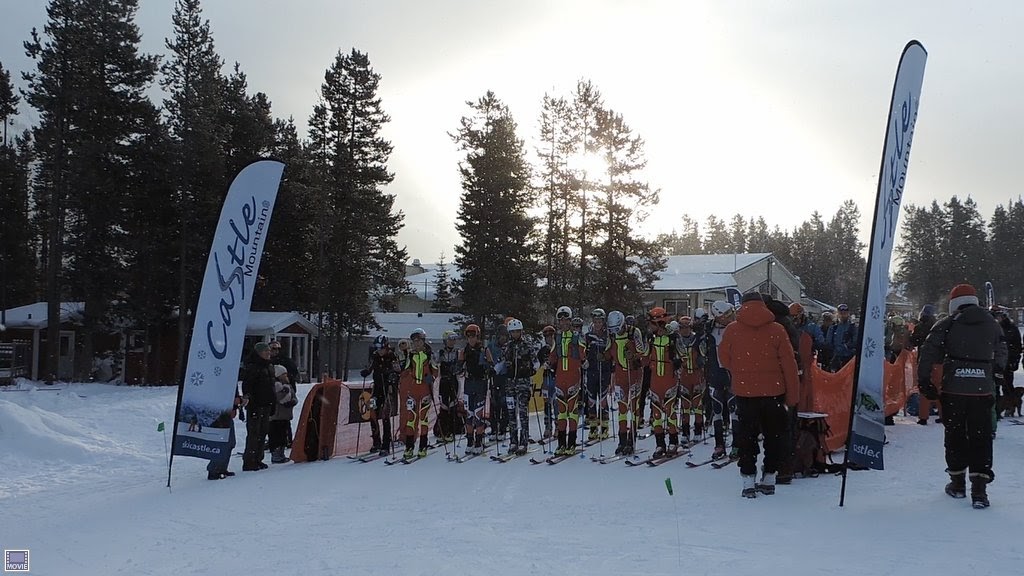
Castle Mtn. Individual Start
Castle Mtn. Individual Start (Glenda Zamzow Photo)
Despite dire weather predictions, a skiff of new snow and reasonable temperatures with low wind made Sunday’s individual race very reasonable. Racers tackled two big climbs through the ski area with excellent side-country descents. Nick Elson and Eric Carter took turns breaking trail on the first ascent before turing up the speed on the second groomed ascent where Carter broke away for the win with Travis Brown and Peter Knight rounding out third and fourth place. In the women’s race, Kylee Toth Ohler continued to ski well ahead of Michelle Katchur-Roberts and Lori-Anne Donald. A notable new face was Gary Robbins, Coastal ultra-runner and race organizer who placed a very respectable fifth in his first serious stab at skimo racing.
Glenda Zamzow Photos
Results

Snow Trail Vertical – Dec 17/Jan 7
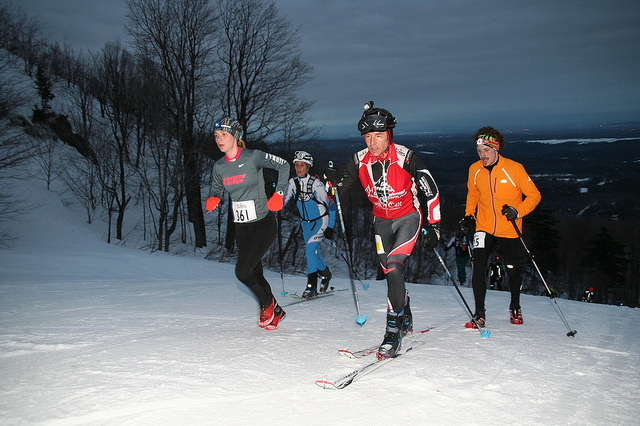
Skimo East Photo
Skimo East Photo
The first two of three Vertical races organized in preparation for the Orford Snow Trail event held on March 18th in Quebec. These races feature a unique format allowing athletes to use whatever mode of human powered travel they prefer to compete to the top including by foot, snowshoe, or ski. The first even was well attended by youth athletes including two 11-year old ladies. The women’s event was won by local MTB legend Isabelle Bernier and the men’s by Mathieu Ladouceur.
The second event featured a well groomed course and despite cold temperatures, was well attended. The men’s category was won by Roger Girard while the women’s race was upset by local skimo champ, Lyne Bessette.
The winners overall of the series of 3 races will win a free registration for the Snow Trail 2017. The organization team of the Snow Trail will have a value of more than 6,000$ in prized to give to the participants during the winter. At the cost of 20$ (including a beer for after the race), there is no good reason not to take part of the preparatory series and enjoy the mountain! For more details, please visit the Endurance Aventure Website.

International Race News

Early January is designated by the ISMF as the period for National Championships to be held so throughout Europe, athletes were racing for their respective countries titles.
In Switzerland, the Individual and Sprint National Championships were held with Werner Marti and Maude Mathys (recently returning from an anti-doping violation and subsequent ban) taking the respective wins in the Individual. Super-espoir Remi Bonnet finished fifth. The Swiss king-sprinter Yannick Eccour only managed fifth in the sprint event with Iwan Arnold and Deborah Chiarello leading the podium.
Over in Italy, Roberto Antonioli and Katy Neve won the Individual National Championships with Alba De Silvestro moving into the senior Women’s ranking and taking a respectable podium position. Michelle Boscocci was the only name notably absent from the men’s race but is sure to be on top form for worlds.
Over in the Pyrenees, power-couple Emelie Forsberg and Kilian Jornet dominated the Catalonian National Champs with Mark Pinch and Claudia Galicia Cortina comfortably taking second position.
The next bout of European racing comes on January 21st and 22nd when the World Cup commences at the wonderful Font Blanca venue in Andorra!
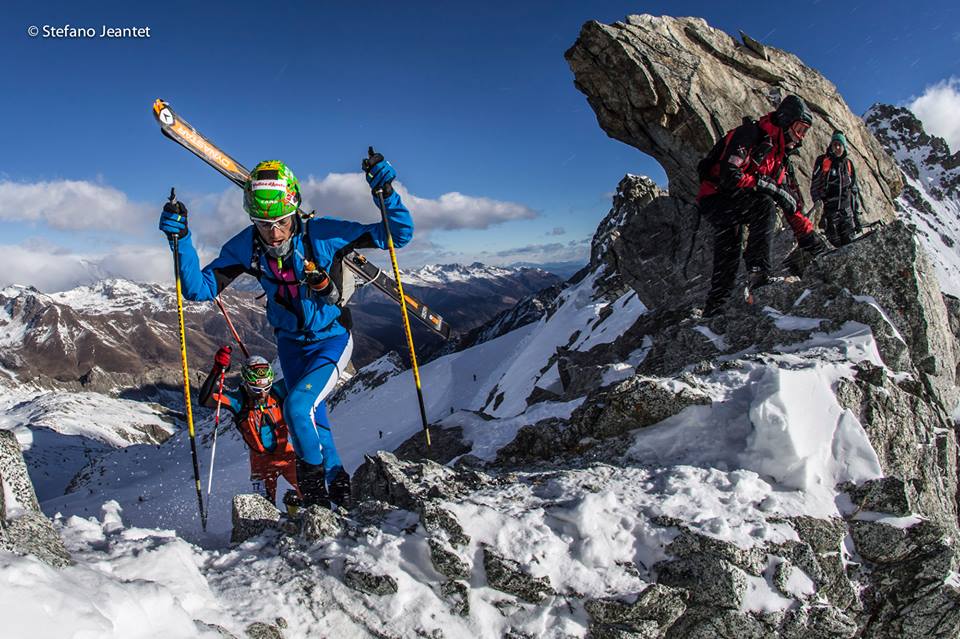
Italian Championships

Upcoming Races

The skimo season is back in full swing in North America with races throughout the US and Canada on both sides of the divide. Find your closest event and get after it! Likely the biggest turnout will be at the Sunlight Heathen Challenge where US athletes will be competing for spots on the World Championships Team. The Sprint and Team’s race  teams will be determined but also up in the air is the coveted fourth and final spot for both the men’s and women’s individual event.
Cosmic Series – Powderhorn Grand Mesa Grind – Jan 14
Cosmic Series – Sunlight Mountain Heathen Challenge – Jan 14/15
Skimo East Series – Trail de nuit de Stoneham – Jan 14
North East Rando Series – Berkshire East – Jan 21
Canadian Cup – Fernie Lizard Skinner Skimo Race – Jan 21

Want to contribute to SkinTrack?

We are looking for brief race report submissions from Colorado and Utah athletes, and from the East Coast as well.
Also, we would be very happy to provide more exposure to women’s races and so we are asking you ladies to submit your race reports.
Get in touch via email or comments below!
Filed Under: Events & Races, News Shorts Tagged With: Ben Parsons, Castle Mountain, COSMIC, Eric Carter, Kylee Ohler Toth, Paul Hamilton, SKIMO EAST, SMCC, Snow Trail, Sprint, Tom Stephens, Wolf Creek

Gear Guide To Your First Skimo Racing Setup: Skis, Boots, Bindings, and more

December 20, 2016 By Stano Faban 16 Comments

When it comes to shopping for your first-ever skimo racing setup there is no “fit-for-all” advice as each person’s goals, budget and athletic background are different. Some are new to skimo racing or even ski touring altogether while others have already achieved some athletic success in other endurance sports and want to give skimo a serious try from the start.
With all that in mind, I will do my best to provide the most useful and honest advice for everyone new to skimo, and point them to the right gear that is currently on the market.
Majority of the below mentioned gear can be purchased online or in person from our two favourite skimo specialized stores – Skimo.co in Salt Lake City and Cripple Creek Backcountry in Vail or Carbondale.

Boots

Don’t make the mistake focusing only on weight and price. Fit is very important when it comes to boots as it will determine how well you will be able to control the tiny race skis on descents as well as for how comfortable you will be training in them.

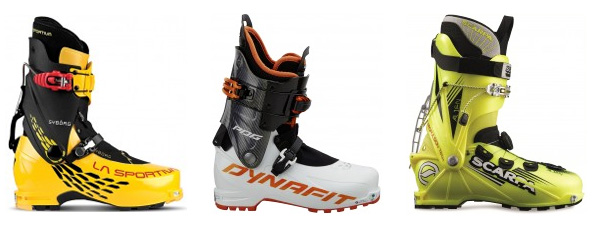
La Sportiva Syborg, Dynafit PDG, Scarpa Alien
The most suitable entry level racing boots are the La Sportiva Syborg, Dynafit PDG and Scarpa Alien. All three are similar weight (800-850g/boot in size 27MP) and are priced around $750 USD (700 Euro, $1000 CAD) depending on the deal you find. Therefore, your decision should come down mostly to already mentioned fit and availability.
Only slightly heavier but more suitable for regular touring with bigger skis are the new Dynafit TLT7 Performance and Atomic Backland Carbon Light, both weighing just over 1kg/boot in size 27MP. Both are priced around $900 USD (850 Euro, $1200 CAD).
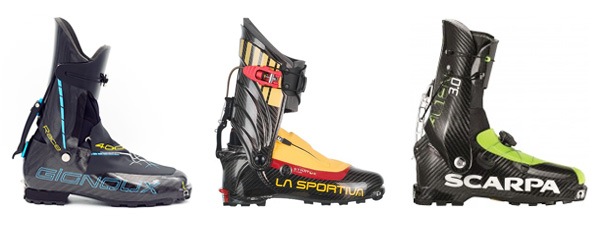
For those that are ambitious right from the start or can spend more money, you can try jumping straight into the Dynafit DyNA (basically a lighter PDG) or Scarpa Alien 1.0. Then the very top level boots, even more expensive, are the Pierre Gignoux Race 400, Dynafit DNA, La Sportiva Stratos (Cube and Hi-Cube), and Scarpa Alien 3.0.
Pierre Gignoux Race 400 (virtually the same as Dynafit DNA), La Sportiva Stratos Hi-Cube, Scarpa Alien 3.0
Pierre Gignoux Race 400 (Dynafit DNA is vitually the same), La Sportiva Stratos Hi-Cube, Scarpa Alien 3.0

Skis

There are many skimo race skis on the market so I won’t list them all but I will give you a couple of pointers and will mention only those with the best price-to-weight ratio.
The good news is that the “entry level” skimo skis are generally only about 100-150g heavier that the top line yet costing about 20-30% less.
For racing, there is a rule that men’s skis have to be at least 160cm long while women’s can be 10cm shorter. You should be looking for skis weighing less then 900-1000g/ski and not wider than about 68mm (ideally 64-66mm) since all racing skins are manufactured for those widths.
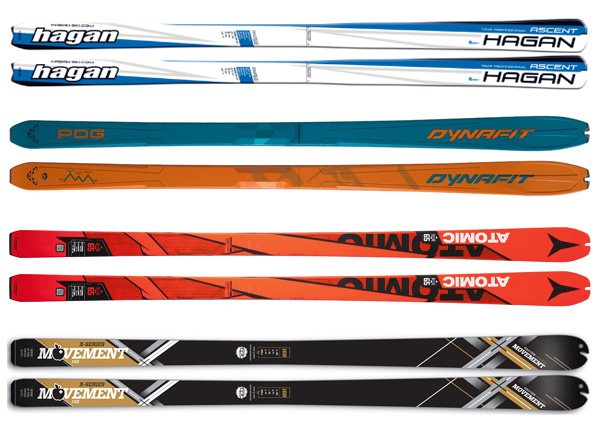
To get you on race skis without paying the top price you should check out Hagan Ascent, Dynafit PDG, Atomic Backland UL 65, Voile WSP, Movement Gold Fish-X, or older models of race skis from these brands that can be still found on sale. You will pay around $600-700 USD ($800-950 CAD, 570-670 Euro)  for all of the above new models.

From the top: Hagan Ascent, Dynafit PDG, Atomic Backland UL 65, Movement Gold Fish-X
Overall, it’s difficult to recommend specific skis for a specific skier because it depends on your weight, height and style of skiing – aggressive, careful, expert skier, intermediate skier, etc. But in general all of them will ski somewhat similarly – the first couple of times, it will feel like you need to learn to ski again 😉

Bindings

There are three important things when shopping for race bindings (even “entry level”):

  • With few exceptions, all models can be mounted only for one boot size as the heels have no adjust-ability!
  • Don’t mix-and-match toe and heel pieces from two different brands on your race skis. First, it’s race illegal, and second it could pose a safety issue.
  • Buy a model without the auto-lock feature – it’s forbidden by the sport’s rules. This means that when you step into the toe piece it won’t lock itself right into the touring (or locked-out) mode automatically but rather you have to nudge it to that position.

The good news is that all bindings listed will likely last you for many seasons. The only maintenance you will need to perform is changing the heel pins every 2-3 seasons (they are cheap).
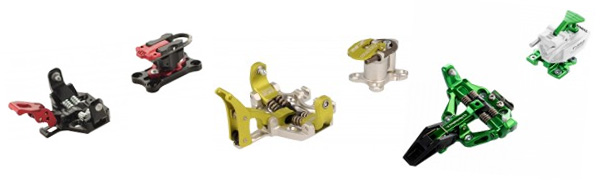
Here are the models we recommend: Hagan ZR (optional mounting plates allow heel to move), Plum Race 150, Plum Race 170 (possible to adjust heel for 2-3 different boot sizes!), Dynafit Superlight 2.0, Kreuzspitze SCTT, ATK Race SLR World Cup.

Plum Race 150, Hagan ZR, Dynafit Superlite 2.0
Plum Race 170, Hagan ZR, Dynafit Superlite 2.0
Once shopping, expect to pay around $500-600 USD (470-570 Euro, $650-800 CAD) for the models mentioned above.

Skins

Thankfully, there is not much to contemplate about “entry level” skins. You can just buy any skins that fit your race skis and are preferably made of mohair (or similar fast gliding fiber). The width should be about 3-6mm narrower than the middle of your skis – in general, race skins are pre-cut to 58-62mm and are the same width in their full length.
With that, we recommend buying the skimo race skins: Pomoca Race and Race Pro 2.0 models, Colltext PDG, Dynafit Speedskin, Ski Trab World Cup, Hagan Mohair.
Some race skins can be bought in a roll or as an ready-to-go package with bungee cord tip attachments already in place. The cost for a pair of skins will be around $100-160 USD (90-150 Euro, $130-220 CAD).

Pack

There are many skimo race packs on the market and more-or-less all of them perform quite well but like with boots the fit is important, and that is the crux with almost all packs if you are either smaller or taller than an average male (175-185cm / 5′ 7″ to 6′). The best idea is to try some on first or buy the one that lets you adjust the sizing.
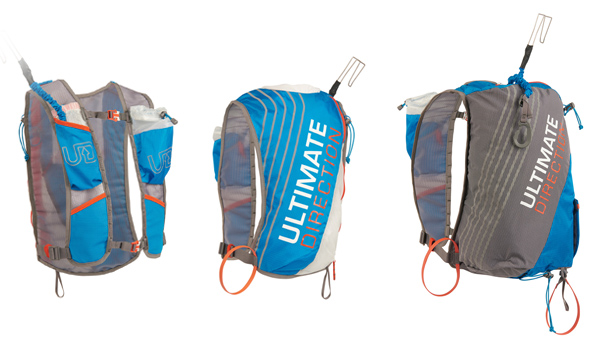
All of last season, we worked with Ultimate Direction to design two race packs that allow for size adjustments and even come in two different sizes – the first skimo packs to ever do this! Both of them borrow some features from their famous running vests that we seamlessly merged with the necessary skimo functionality. Check them out: UD Skimo 8 vest and UD Skimo 18 vest.
For a new skimo racing pack/vest, expect to pay about $100-160 USD (90-150 Euro, $130-220 CAD).

Ultimate Direction vests: Skimo 8 front, Skimo 8 back, Skimo 18 back

Helmet

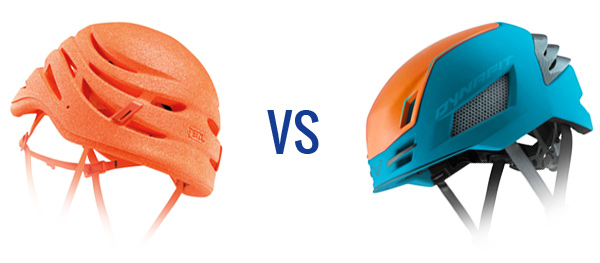
With new regulations coming into effect this season, we recommend buying only helmets that are fully compatible with these new rules – we wrote a whole article about this a couple of weeks ago so there you can find all the right models.
Beyond that, even more than with boots and packs, the fit is very important! And if there is some space for a bandanna/buff to slide inside for those cold days then even better.
skimo-helmets-matchup

Skimo Race Suit & Clothing

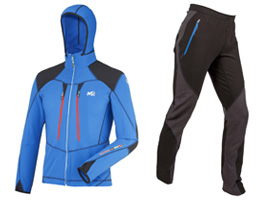
novice-skimo-racing-clothingWhile skimo race suits are fine pieces of gear designed for the most efficient skins management and ventilation I don’t think a novice to the sport needs one for their first couple of races. As long as your clothing is well/slim fitting and your jacket has some nice pockets for skins then you will be just fine.
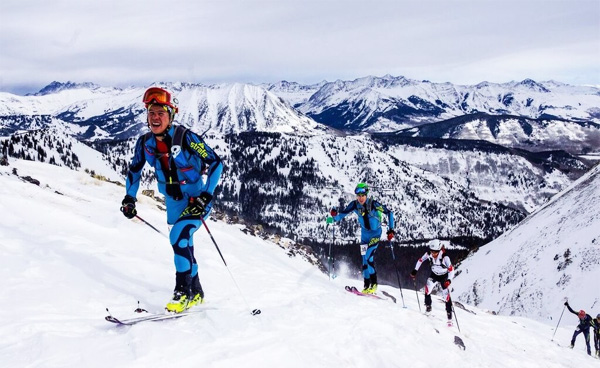
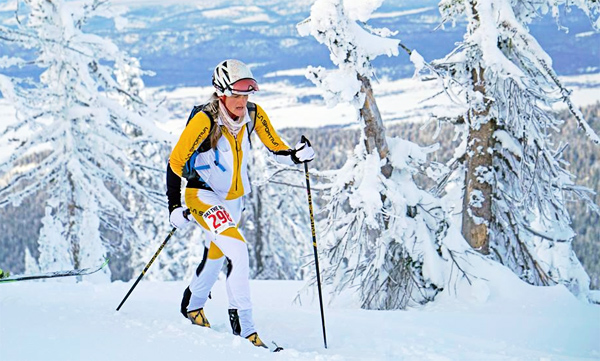
The middle ground between a full-on one piece race suit and just slim fitting touring clothing are some double-piece “suit” options. Perhaps buying just a jacket will give you most of what a one-piece suit can offer.
One-piece skimo racing suits cost around $250-350 USD (240-340 Euro, $340-470 CAD) while the two-piece solutions would come to about the same if you buy both the bottom and the top.

Ski Poles

Just like with the race suit, you don’t need specific skimo race poles for your first couple of events and most of your training. Light ski touring poles will do. In fact, even top racers use pretty much just shorter xc skiing poles as they work quite well.
To figure out the correct length for your ski poles see this article on how to do it – How to choose the right length (and kind) of skimo racing poles for you.
Prices will range from $80 to $180 USD.

Avalanche Gear & Training

Last but not least, let’s take a brief look at the avalanche gear you will need for racing and your training. On top of that, you should also take at least some basic avalanche courses to educate yourself how to use this gear the most effectively as well as to how to avoid avalanches altogether.
Avalanche beacon – choose a 3-antenna beacon from reputable brands like Pieps, Mammut, Backcountry Access, Ortovox. Prices will range from $300 to $500 USD.
Avalanche probe – for racing you only need a 240cm probe but if you are going to buy only one then we recommend 280cm or 320cm length. The extra length is beneficial should you find yourself in a real rescue. Carbon probes are lighter than aluminum but are also more expensive – we leave it up to you to choose. Prices will range from $50 to $150 USD.
Snow shovel – just like with a probe, to meet skimo racing regulations you only need a “kid’s toy” shovel like CAMP Crest but we recommend buying a more robust shovel that is actually usable in a rescue scenario. If you opt for something with a short handle but strong blade of decent size then you will be way more equiped. Prices will range from $50 to $100 USD.

Final thoughts

After reading the whole article it may seem that skimo racing is a super expensive sport but it is possible to be strategic with your spending. You can buy a lot of used gear (don’t do this with avalanche beacon) or using online sales and package deals from specialized shops like Skimo.co or Cripple Creek BC. Also, remember, that lots of this gear will last you for many years and will take you to place no expensive carbon bike can ever do.
If you would like to know more about race gear and even skimo training then check out our Manual For Ski Mountaineering Racing where we discuss specific how-to tricks.

Filed Under: Gear, Tech & Food, Skimo Racing Tagged With: avalanche safety, Bindings, skimo boots, skimo helmet, Skimo pack, skimo racing gear, Skins, Skis

Skimo News Dec 1-19: US Worlds Team Qualifier Races, French Vertical Champs, and more

December 19, 2016 By Stano Faban 3 Comments

The last two weeks have seen big storms dumping snow all over North America and kicking the skimo race season into a full swing.
The first North American event of the year was the Vert 180 at the Calgary Olympic Park, part of the Canadian series. Local race series at Aspen, A-Basin, and Brighton already held their first uphill events and have also started up for the season.

USA Race News

COSMIC Eldora Rando Return – Dec 3

With the popularity of racing in Colorado, and specifically in Denver/Boulder area, it was only a matter of time when a race would be born closer to the Front Range. Eldora resort opened their doors and put on a classic Colorado style event with steep up-tracks and fast groomer skiing!
Max Taam and Rory Kelly battled since the start, with Max maintaining a half a minute lead at the finish. Meanwhile, Jessie Young dominated the women’s race, more than five minutes ahead of Annie Gonzalez in second.
Photos: http://www.cosmicski.com/race-photos/eldorarandoreturn16
Results: https://www.webscorer.com/race?raceid=87912

COSMIC Irwin Guides Race – Dec 10

Irwin is one of the more unique races – situated above the town of Crested Butte, the race starts at and climbs above 3000 meters (10,000 ft), giving much to complain about even for the most acclimatized racers. Irwin also stands alone, entirely outside of a ski area boundary but within the Irwin Guides tenure and is one of very few true backcountry races in North America. Racers are required to arrive at the start line by a snowcat or a sled!

Photo by Kevin Krill & Eleven Experience.
Max Taam leading a pack of chasers. Photo by Kevin Krill & Eleven Experience.
John Gaston showed up for his first domestic win of the season while Crested Butte veteran Brian Smith battled to a tight finish for second just ahead of Max Taam, and about a minute and a half behind Gaston. The top two positions on the women’s podium remained unchanged from the previous weekend with Jessie Young and Annie Gonzales taking first and second but the third spot was taken by Breckenridge’s Nicki Larochelle.
Photos: http://www.cosmicski.com/race-photos/irwin2016
Results: https://www.webscorer.com/race?raceid=88408

USSMA Northwest Passage – US Team Qualifier – Dec 17-18

The first of two weekends used as US Team Trials for the upcoming 2017 World Championships, the Northwest Passage Race in McCall, Idaho was shaping up to be very competitive. Despite being a first time event, and dealing with a foot of new snow the day before and extreme cold on race day, the races went off with barely a hitch.
Friday featured a vertical event over a 500 vertical metres course. The new snow meant the race went up an ungroomed ski run that both the organizers and USSMA leadership desperately tried to maintain a skin track on. Soft conditions and lots of kick turns favoured technically strong athletes.  The top four finishers would qualify for the US Worlds Team in a vertical race.
John Gaston took an early lead and put on a clinic on uphill skiing while Mike Foote, Tom Goth, and SkinTrack’s Eric Carter swapped for the next three qualifying spots and ultimately finishing in that order. A major note is U23 racer Cam Smith from Gunnison who finished barely a minute off the lead group. Expect big things from this guy competing against his peers at Worlds!
Janelle Smiley made her fantastic return to racing following a multi-year break due to a hip injury and dethroned Jessie Young. Veronika Mayerhoffer, an Austrian XC skier attending university in Utah, finished 3rd, with the final two US Team qualifying spots going to the athletes in 4th and 5th – Kristi Knecht and Jaime Brede.
» Vertical results – Northwest_Passage_Vertical-Results-2016
Saturday’s individual event was looking grim with extremely cold temps in the forecast. Luckily, things were a bit warmer (only about -15 deg F) and with no wind making it quite bearable. A Le mans style running start was a fun way to warm up followed by a single climb on a groomed run, after which the race was entirely out of the ski area boundary until the final descent to the finish. The race featured great fall-line skiing on powder slopes and nice, low-angle skin tracks (that were doubled!) with plenty of kick turns. The cold made for difficult skins management and some racers struggled with blown skins.

Janelle Smiley racing to first place. Photo by Eric Hoff.
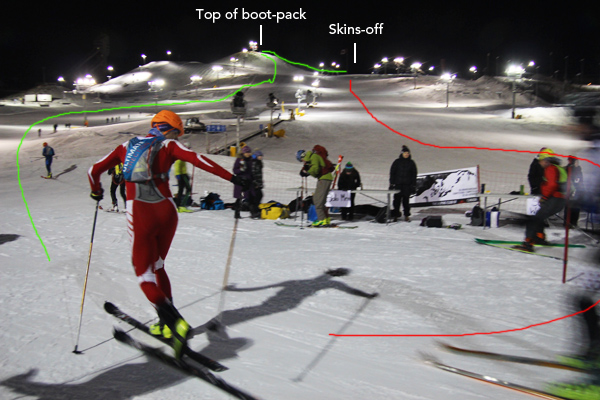
The men’s race was very competitive, the only notable name missing was Jason Dorais. John Gaston took the lead early in the race and stayed away from his chasers. Eric Carter maintained second place throughout while Mike Foote and Tom Goth battled hard for third place (top three finishers would qualify for Worlds Team while the 4th will be determined at the upcoming Sunlight Race). Mike and Tom hit the final skins-off transition together and raced down the final descent to the finish before Tom broke a pole and lost ground with Mike taking the qualifying spot.
Janelle Smiley skied away from Jessie Young early in the race and maintained a solid gap throughout. Nikki Larochelle again showed her strength as a legitimate contender, finishing third with Meredith Edwards in fourth!
» Individual race results – Northwest_Passage_Individual-Results-2016
Photos: Gallery 1, Gallery 2

Europe Race News

French Vertical Champs in Tignes – Dec 17:

Women:

  1. Axelle Mollaret
  2. Laetitia Roux
  3. Mireia Miro (Spain)
  4. Lorna Bonnel

Men:

  1. Xavier Gachet
  2. Remi Bonnet (Swiss)
  3. Matheo Jacquemoud
  4. Alexis Sevennec

» All categories results here

Upcoming Events

COSMIC Wolf Creek Rando Race – Jan 7

One last tune up for the Colorado athletes before the following weekend’s US Team qualifying race, Wolf Creek provides a great course and venue!
Event Page

SMCC Castle Mountain Canadian Team Qualifiers – Jan 7/8

The sprint and individual races at Castle Mountain are part of the selection process that will determine the Canadian World Championship Team.
Expect Nick Elson to be going for the top position while several others will be competing for the podium spots including Peter Knight, Joel Desgraniers, Matt Reid and Travis Brown. Long distance runner Rob Krar is expected to attend in order to try to qualify for the Canadian Worlds Team as well. On the women’s side, Kylee Ohler is a favourite while her training partner Michelle Katchur Roberts will surely be going strong as well.
Event Page

COSMIC Grand Mesa Powderhorn – Jan 14

The day before the Heathen Challenge, this race may see lower turnout due to the draw of the US Team Qualifier. Who has the guts to race all three days? Teague Holmes?
Event Page

COSMIC/USSMA Sunlight Heathen Challenge – Jan 15/16

The second US Team qualifying event, expect some serious competition. First, the sprint race will be a chance for athletes to compete for four spots on the US Worlds Team. It’s possible that some of the individual race contenders may sit this one out to save their energy, leaving places open to other athletes.
The big show, however, will be at 7:30am on Sunday morning when racers will compete for eight spots for the Teams Event at Worlds and, most importantly, for the fourth and final Individual spot on the team. Expect Tom Goth to be back with a vengeance but Max Taam will have a home field advantage. Hopefully we will also see Jason Dorais jump back into the mix as well.
On the women’s side, Meredith Edwards appears to have the fourth spot in her grasp but it is difficult to predict!
There are also 10-12 guys who all pose a legitimate threat for the top eight team spots. In addition to those above, we expect to see World’s veterans Teague Holmes, Rory Kelly, and Jon Brown in the mix!
Event Page

Filed Under: News Shorts, Reports & Results

Race Recap: Vert180 Night Skimo Race in Calgary

December 6, 2016 By Stano Faban Leave a Comment

The Canadian Skimo Cup kicked off with its first race of the season at the Canada Olympic Park in Calgary last Saturday.
With its unusual format – start at 6pm to do as many laps as you can in 3 hours – and working within the venue’s terrain (135m climb) it provides great opportunity to practice skimo transitions and to have fun with friends in a relay team or going solo. There were over 70 athletes participating.

This was the lap layout of the race course. In the foreground you can see a relay exchange in the bottom transition area.

Race Recap and Most Notable

Before you study results in detail below I would like to point out that the juniors were racing for 1.5h instead of 3h and within that time only a 14-year old Tom Stevens managed to clock in 9 laps just like the top men were doing! That is 1215m in 1.5h including 9 bootpack and skins-off transitions, plus 8 skins-on transitions at the bottom. If Tom keeps at it then Canada might have a medal contender for World Championships in cadet and junior categories in the years to come!
vert180-start
Men’s race:
Another notable moment came when Travis Brown, a leader mid-way, had to drop out of the race from first place due to stomach problems that were impairing him the days leading up to the event.
After that the race for first was a close battle between Peter Knight (18 laps) and Joel Desgreniers (17 laps) with Peter coming out on top. Matt Reid (17 laps) secured the final step on the podium.
Women’s race:
Once again, Kylee Ohler, pulled of a great performance the whole day – organizing the event itself and then racing – to come up with a solid win and collecting 17 laps for a total of 2300m. Michelle Roberts was racing well and trying to stay close but eventually lost about by 1 lap (10-12min) to take second. Marg Fedyna took third with 14.

Results

There were also 2 and 4 person relay teams lapping the course and having great time.
» Full results are here: 2016-Vert180-results
 

Filed Under: Reports & Results Tagged With: Canada SkiMo Cup, Kylee Ohler, Peter Knight, Vert180

Interview with ISMF President about Skimo & Olympics and Anti-doping Efforts

December 2, 2016 By Stano Faban Leave a Comment

With many things going in the right direction for the sport of ski mountaineering racing, we reached out to Armando Mariotta – the president of the International Ski Mountaineering Federation (ISMF) – for an interview with 10 questions we were curious about.
We divided them into two sections – Future of our sport and its place within Olympics, and ISMF’s anti-doping efforts.

Armando-Mariotta
Armando Mariotta enjoying some quiet time in a skin track.

Future of Ski Mountaineering Racing & Olympics

Q: By IOC recognizing the ISMF this summer, skimo racing is one step closer to be an Olympic sport. What are the things that still need to happen for skimo to truly be in Olympics one day?
ismf-logo-300x120Just to be clear: the IOC recognition has been for the ISMF and not for skimo as a new Olympic Sport. With the full recognition we can now ask the IOC to accept our sport into next Olympic Games.
Q: Do you think skimo racing as a sport will be included in Beijing 2022 Winter Olympics? Also, would it be officially called “skimo racing” or “ski mountaineering racing”?
Our first effort is to enter the program of Youth Olympic Games in Lausanne 2020 and then we could ask to enter Beijing.
The name of the sport is clearly ski mountaineering.
Q: Which skimo disciplines are the most likely to make it into Olympics?
The first step will be to have an acceptance by the IOC for a new sport into the Winter Olympic Games and then we’ll discuss which discipline(s). As you know for example sport climbing had all the three disciplines but only one medal.
Q: ISMF recently renewed its media contract with Infront Sports & Media – a big sports media company that represents all seven Olympic winter sport federations, manages media rights for the FIS World Cup Events, and even represents big football/soccer teams. What does this mean for skimo?
The contract will give to the ISMF and to our sport many new possibilities to grow in the international TV visibility, a space to the organizers for their sponsors in the TV area range, some money to the ISMF and the possibility to have a Press Agent (Lucia Galli) for the institutional and sport press releases.
Q: What is the ISMF’s plan to encourage more youth participation in our sport? And what are your thoughts on growing our sport as a whole?
With the limited resources we have we are working for youth. For example, thanks to the collaboration of DAV and OSV from 8 to 11 December we are going to organize a youth camp in Austria for aspirant young athletes. In view of the work for the YOG we have new ideas and projects.
Q: Is it true that most of the ISMF personnel (staff, referees, committee members, etc.) are volunteers and receive no money?
You are right. All the members of the Executive Board, Management Committee, Commissions are volunteers as well as the Referee Manager and the Referees.
The only people paid are the Secretary (Giulia Avagnina), the director of the Sport Department (Rebecca Vernon) and the technical director (Gil Orriols).
You can completely read our 2015 accounts revised by the auditor on our Website www.ismf-ski.org – official documents section.

Anti-doping Efforts and Latest Doping Cases

ISMF has accepted WADA anti-doping code couple of years ago, thus, I would like to ask a couple of questions regarding anti-doping efforts in our sport.
Q: During World Cups and World Championships, does ISMF test athletes directly or does it coordinate the testing with a national anti-doping body in that country?
sportaccord-logoThe ISMF some years ago decided to sign an agreement with SportAccord as service provider for the anti-doping tests, so they organize directly all the controls.
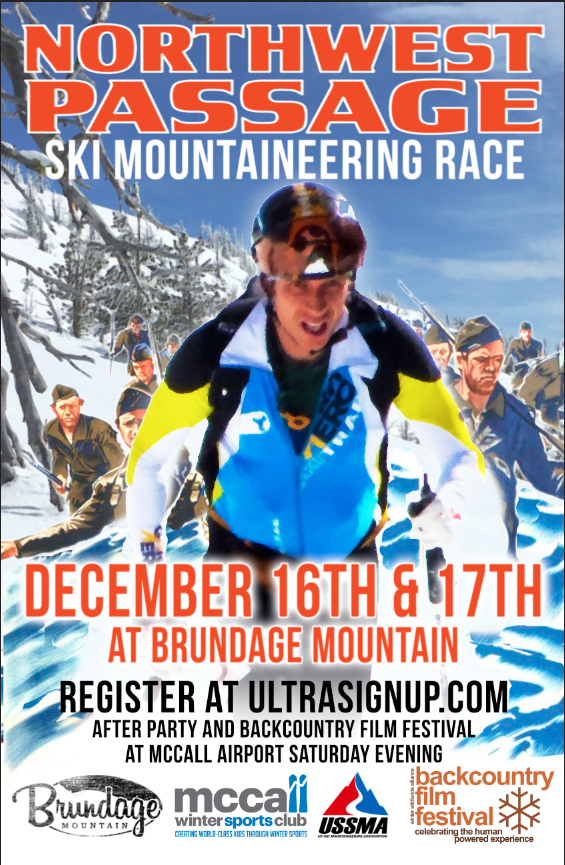
Q: How many in competition and out-of-competition anti-doping tests does ISMF (on its own or through its partners) performs every year?
In the average the ISMF through its provider SportAccord does:

  • 28 In-Competition tests (28 Urine tests)
  • 81 Out-of-Competitions tests (36 Urine tests + 3 Blood tests + 42 Blood tests included the Athlete Biological Passport)
  • 17 Out-of-Competition blood tests covered by National Anti-Doping Organizations (NADO) as part of Athlete Biological Passport (ABP) sharing agreement

Moreover, the ISMF includes at least 10 top-level athletes in the Registered Pool Testing (RTP) every year.
Q: Were there any positive doping tests in skimo in the last 5 years? Where does ISMF publish this information?
There have been two Adverse Analytical Findings in skimo in 2015, if we consider the past 5-year-period: one RTP athlete in World Championships in Verbier, and one popular athlete in a La Grande Course race (long distance teams race).
Information about the first case was officially given with the press-release on 3rd December, 2015 which can be found at www.ismf-ski.org – News section.
Concerning the second case, another official communication will be published always in the news section of the ISMF website in the near future.
Q: How many Therapeutic Use Exemption (TUE) applications does ISMF receive every year? What percentage does usually get approved?
The 2016-2017 season will be the first one with the management of the TUE for the ISMF. In the past, it was a management of national federations, so we don’t have this type of information.

Our Thoughts

From one of the answers it is very obvious that our sport is still small despite so many great races and its history. It seems like the only way to grow is through becoming an Olympic sport because TV rights are where the money is – we wrote about this in regards to skimo two years ago.
With potentially more money coming into the sport in the future there will likely be a rise in the number of doping cases. This is just a fact and not only in sports but sadly in society in general. However, we believe that skimo will continue to be one of the best sports to put your children in.
What are your thoughts? Or questions you would ask? Please share them in the comments section below. Thank you.

Filed Under: People (Interviews), Skimo Racing Tagged With: Armando Mariotta, Doping & Anti-doping, IOC, ISMF, SportAccord

New Skimo Race & US Team Qualifier on Dec 16-17th: Northwest Passage in McCall, Idaho

November 24, 2016 By Stano Faban 1 Comment

NW Passage posterWith the upcoming 2017 World Ski Mountaineering Championships to be held in Transcavallo region of Italy, the US Ski Mountaineering Association has designated two team selection races for athletes to test themselves and qualify for the big event. The first one is to be held at a new race called the Northwest Passage. The venue is Brundage Mountain near McCall, Idaho.
While this is the first year of the event, the organizers at Brundage are clearly excited to be putting on a high level race. The weekend of December 16th and 17th will feature a vertical race (Friday evening) and a multi-division individual race on Saturday. Both of which are qualifiers for the US National Team.

Brundage Course - Front Side
Brundage Course – Front Side
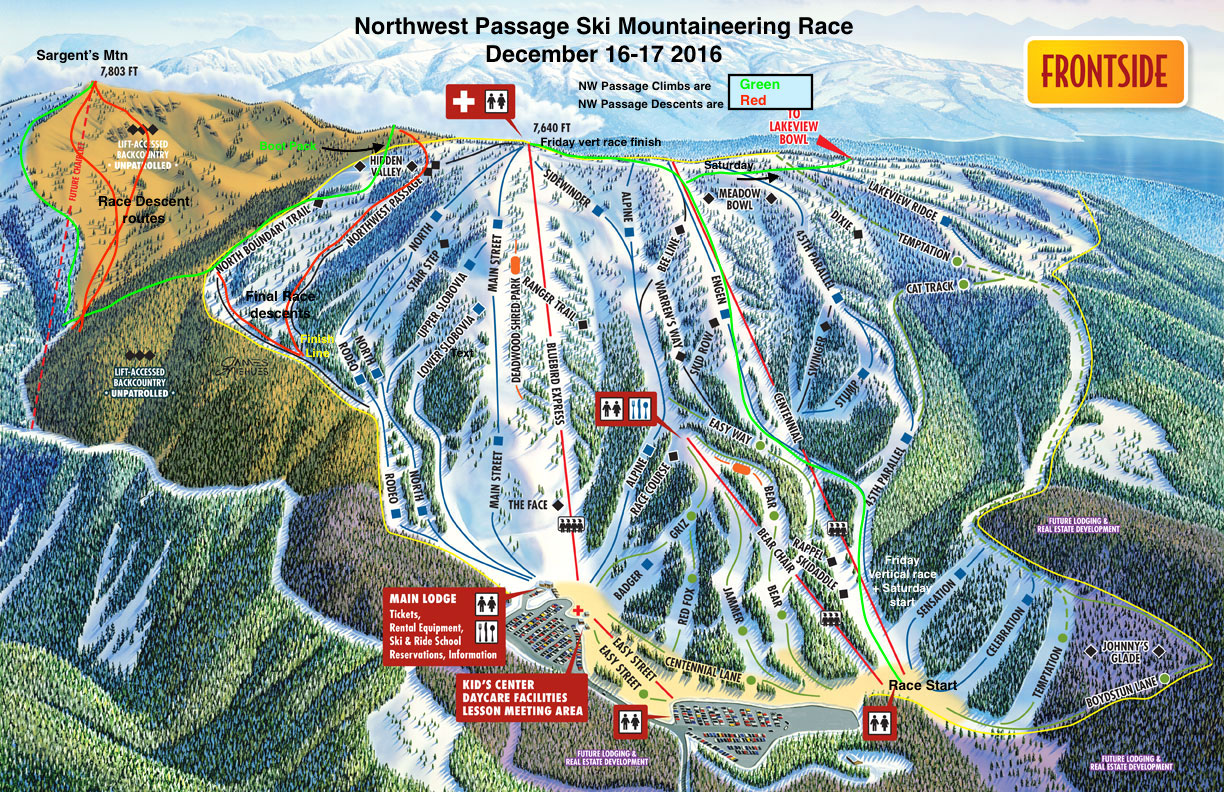
The Vertical event starts at the base lodge and climbs the blue-square pistes called 45-Parallel and Engen, to the top of the Bluebird Express for a total vertical gain of 520 meters.
The Individual event does include a recreational category (11.75km with 1180m+) but all those wishing to qualify for the national team will enter the elite category with 20.75km distance and 1950m+ over five climbs and descents! This is certainly on the lengthy end compared to the event for which athletes are competing to attend but will serve as an excellent challenge for potential team members!
Examining the route on the course map and Google Earth, we are struck by the amount of side-country terrain being utilized. While the race starts and finishes with on-piste terrain, four of the five descents appear to be off-piste – good news for those athletes who want to showcase their skiing prowess rather than pure speed skiing on groomers! Brundage gets ~760-890cm of snowfall per year though with the early season timing, expect some lean conditions!
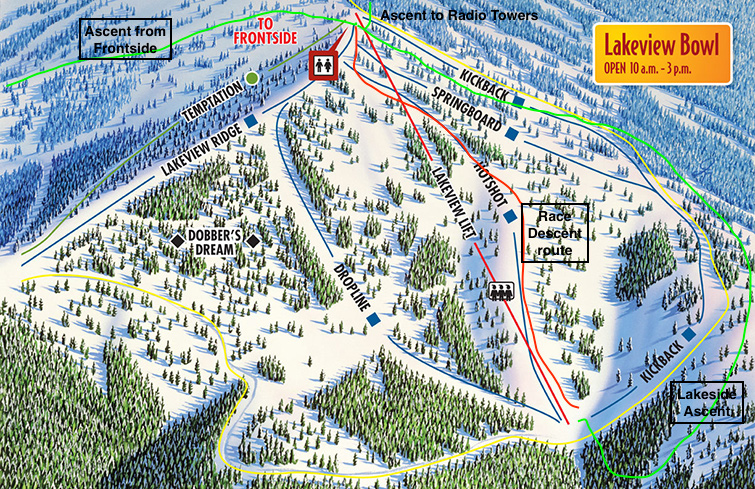
Brundage Course - Backside
Brundage Course – Backside
Another interesting note is the max elevation (topping out the last several climbs on Sargent’s Mountain) for the race is only 2380 meters! This is a dramatic difference from the typical Colorado races that routinely climb above 3000m and will hopefully encourage competition from sea-level athletes!
At the moment, much of the Western US is hurting for snow. Colorado and Utah both seem to be pretty bare except at the highest elevations and where it is possible to blow snow.
Standard USSMA race equipment will be required, as well as a headlamp for vertical racers. Note that if you wish to receive USSMA points, you must compete in both events.
Race accommodation can found at inidaho.com which will have special event rates! Boise is the closest large airport and car rental area.
In addition to the Northwest Passage Race, the McCall Winter Sports Club and the Winter Wildlands Alliance will be hosting the Backcountry Film Festival on Saturday evening. All racers receive one ticket for admission with their registration and the awards ceremony for the weekend will be held at the festival intermission.

IMG_4404Schedule of Events:

Friday: 4:00pm – Vertical Race
Friday: 5:30pm – Mandatory Individual Race information meeting (Brundage Base Lodge)
Saturday: 7:30am – Individual Race start
Saturday: Evening – Backcountry Film Festival (details TBA)
EVENT INFO HERE
REGISTER HERE
RACE TOPO HERE
In case you are curious about the race name or poster, check out the 1940 film Northwest Passage, shot in the mountains of McCall, telling the story of Roger’s Rangers in the mid-18th century, French and Indian War.

Filed Under: Events & Races Tagged With: 2017 World Skimo Championships, Brundage Mountain, Idaho, McCall, Skimo, Team USA

Training Plan: 12 Weeks to Your Best Skimo Race

November 21, 2016 By Stano Faban Leave a Comment

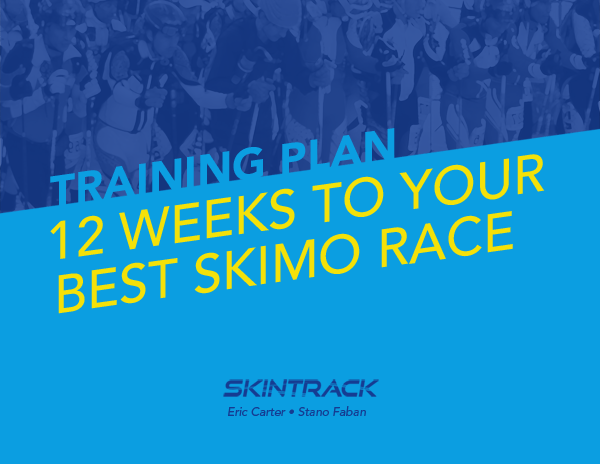
Today, after receiving much feedback and almost two years after releasing the Manual For Ski Mountaineering Racing e-book, we are proud to announce something we have been working on since summer – our first skimo racing specific training plan!
As its name suggests, we created this plan to be your daily training guide in the last couple of weeks leading up to your goal race.
skimo-training-plan-cover-600x464

Who can benefit the most from this plan?

It’s primarily designed for three athlete groups that we believe can reap the most benefits from such a training plan as well as those that want to take a more focused approach:

  1. Beginner and intermediate level skimo racers
  2. Time restricted athletes who need highly efficient training schedule
  3. And those that want daily guidance in their training

We considered usual time constraints and settled on 6 to 10 hours of weekly training volume based on a mix of  VO2max, tempo and lactate tolerance intervals, alternating with easy days and training races.
The plan was developed mainly with these goal races in mind – Grand Traverse, Mezzalama, Pierra Menta, The Power of Four, Wasatch Powder Keg, The Five Peaks – but will effectively prepare you for any ski mountaineering event.

More details

Without further due, just head over to this page to learn more about this training plan:
12 Weeks to Your Best Skimo Race
If you are also interested in the Manual For Ski Mountaineering Racing e-book then we created a “2-in-1 package” for you:
The Manual + this 12-Week Training Plan

Thank you for your continued support

We greatly appreciate all our readers and those that have supported us via purchasing our Manual in the past.
Thank you for keeping the SkinTrack going and keeping us motivated to always deliver the best content! It’s been 7th years in September 🙂
Stano & Eric
PS: Here’s a page from inside the training plan.
sample-skimo-training-plan

Filed Under: Skimo Racing, Training, Tricks & Tips Tagged With: skimo training

Is Your Skimo Helmet Legal for Racing? New ISMF Rule and the EN 12492, EN 1077 and UIAA 106 certifications

October 24, 2016 By Stano Faban 23 Comments

skimo-helmets-matchup
Several weeks ago, we hinted that some new ISMF rule changes will affect the gear skimo athletes will need to use at ISMF sanctioned races starting in the 2016/17 season. Since then one of the most debated topics among athletes revolves around helmets.
Here, we are taking a deeper look at:

  • the new ISMF helmet rule and how it will affect the use of your (and our) current helmets,
  • what the certifications/standards mean,
  • what you should pay attention to in a store,
  • which helmets currently on the market have both of these certifications.

* ISMF stands for International Ski Mountaineering Federation and is the world governing body for skimo racing.

The new ISMF rule and required helmet certifications

For years, ISMF required our skimo racing helmets to meet only the UIAA 106 or EN 12492 standards. Both are basically the same and saying a helmet has been certified for mountaineering.
However, with the beginning of the new racing season our helmets will also require the EN 1077 classB standard – effectively meaning, a helmet has been certified for alpine skiing.
This is the helmet rule to the letter as of last update in early October 2016:

A helmet conforming to:
– UIAA 106 (For season 2016-2017 : UIAA 106 and EN 1077 classB standards)
– or EN 12492 (For season 2016-2017 : or EN 12492 and EN 1077 classB standards).
Helmets must be used (chin-strap has to be fastened) during the whole race (from the start to the finish line). CE/UIAA: Yes.

What do these certifications and standards mean?

In a nutshell, this is the difference between the two certifications/standards:

  • UIAA 106 and EN 12492 standards test and approve helmets mainly for impact from above such as rockfall, hence, the standard was designed for climbing and mountaineering helmets.
  • EN 1077 standard tests and approves helmets for alpine skiing where a lot of impact is happening on collision or when a skier falls. Statistically, in such situations the impact is coming from the sides or the back of the head.
    This standard further divides into class A and class B, which essentially only differentiates the amount of head’s side and back areas covered up by the helmet. Class A helmets cover the head more while class B helmets less, however, both meet the same minimal impact force requirement protection from directions defined in the standard.

Do you really need a new helmet?

The answer is not black and white. First check your old helmet for certification tags to see whether or not it is compliant with both standards. Beyond this:

  • You will need a new helmet if you are planning on racing in World Cups, World Championships or any races that fully comply with ISMF rules.
  • You may not need a new helmet right away for racing in smaller events in the US, Canada and other countries depending whether their federations and organizers follow ISMF rules to the letter or are a bit more “accommodating” for the sake of growing the local skimo scene.

As for US and Canadian races, we received confirmation from both federations that they won’t be enforcing this rule in the current season, and will only start to do so from 2017/18. This is because many of the new helmets won’t even make it to North American market this year.

Buying your new certified skimo racing helmet

When buying your new lid you want to make absolutely sure that it has the above specified double-certification. Check for those little “EN” stickers or tags inside the helmet or on manufacturer’s website as not all store employees will know the correct answer.

Ventilation

We are curious to see how the new helmets will ventilate. While safety is a priority, in skimo we spend majority of time climbing, with the surface of our heads being one of the most important areas through which the body cools. On most ski-rated helmets, vents are conspicuously absent – likely because they are primarily designed for descending, and therefore warmth.
Road cycling also went through this “ventilation” debate but the speeds reached on a bicycle while climbing are much higher than while skinning and the helmets don’t need to meet the mountaineering standard; therefore, cooling is much easier. It will probably take a few years before a happy medium is found and a manufacturer can develop a new skim0-specific design.

Currently compliant helmets on the market under 500g

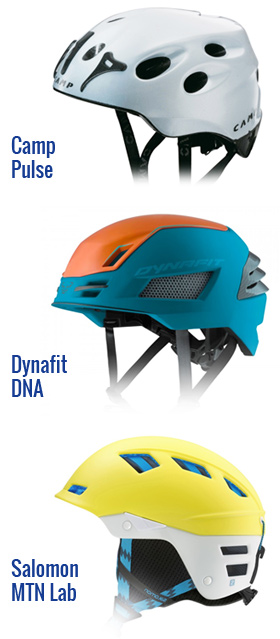
skimo-helmets-comply-ismfAccording to our own research (mainly based on manufacturers’ websites) here is a list of helmets that comply with the new ISMF rule and are currently on the market.
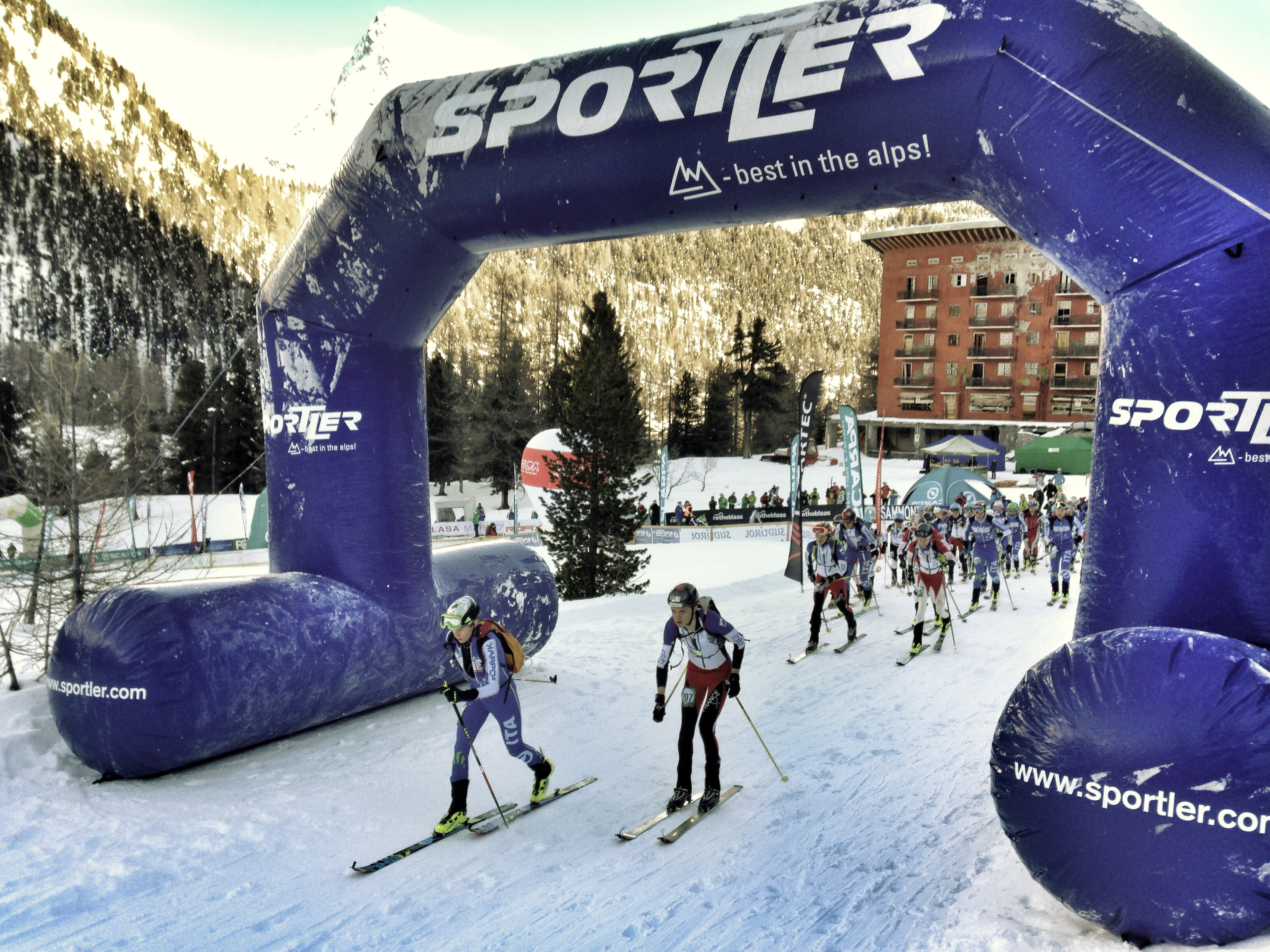
However,many of these won’t be available in North American stores just yet.
Alpina Snow Tour – 330g
Camp Pulse – around 360g (must be used with winter kit for double certification)
Cebe Trilogy – around 360g
Dynafit Daymaker – 320g
Dynafit DNA – 290g
Dynafit ST – 320g
Kong Kosmos – 390g (also certified for cycling)
Mammut Alpine Rider – 430g
Salewa Vert FSM – 400g
Salomon MTN Lab – 300g – Read our review!
Ski Trab Casco Gara/Race – 280g
Ski Trab Casco Maximo – 280g
Uvex P.8000 Tour – 310g

Non-compliant but popular “ski mountaineering” helmets

Note that some of these helmets might meet the EN 1077 standard for skiing in the future but they first need to be tested for it, thus, as of now they don’t comply:
Black Diamond Vapor
Black Diamond Vector
Camp Speed 2.0
Dynafit Radical
Edelrid Shield Lite
Kong Leef
La Sportiva Mulaz (same as Crazy Idea Crazy NRG)
La Sportiva RSR (same as Crazy Idea Crazy Carbon)
Petzl Scirocco
Petzl Meteor
Ski Trab Attivo (same helmet as Kong Leef)

Filed Under: Gear, Tech & Food, Skimo Racing Tagged With: Camp, Dynafit, ISMF, Mammut, Salomon, Ski Trab, skimo helmet

Useful Tips for Traveling: Skimo Racing and Ski Touring in Europe

October 16, 2016 By Stano Faban 1 Comment

Racing in Europe is awesome. Hopefully this post helps smooth out some of the bumps for a first time visitor!
For North Americans, skimo racing in Europe is not only a humbling and awesome sporting experience but also an adventure into different cultures, customs and rules. While most of that is very pleasant, there are times that the language barriers make it challenging to figure things out.
In this article, we are going to share some tips and our general observations to help you navigate the foreign waters. They are mostly based on Eric’s experience from racing most of the 2014/15 World Cup circuit while staying in Chamonix for few months, with Stano adding a couple of useful bits as well (after all he grew up in Europe).

Registering for races

Make sure to research sign-up opening and deadline at least 5-6 months ahead of the event as many races (specifically Pierra Menta, Mezzalama and Patrouille de Glaciers) tend to sell out in a matter of few weeks. In general, the registration fees (calculated per day) are comparable to North American events but obviously vary from race to race, and the value of services depends on the organizers but usually it’s pretty high. The current system uses a central registrations system through the Grande Course website which should be the first stop to investigate.
Make sure you have all your information sorted before reg including your National and ISMF license.
Another thing to keep in mind, when signing up, are potential requirements which don’t exist in North America. From special gear (rope, ice axe, etc) to doctor’s note proving you are healthy to race, make sure to study each race’s rules. Doctor’s notes are much easier to get in North America ahead of time than at the last minute in a foreign country. The French Alpine Federation FFME has a form that can be downloaded and filled out.
» Here’s the 2017 Skimo World Cup calendar

Cities to fly into for popular race locations

Given the travel distances to most European races and convenient flight connections from US and Canada we believe these are some of the best cities to fly into:
Geneva, Switzerland:
– very central location with Western Europe
– 1.5h to Chamonix
– 2h to Pierra Menta location
Milan, Italy:
– still quite central location
– 3-4h to 2017 World Champ venues
– 3-4h to most other races
Turin, Italy:
– more difficult with connections but it’s close to many cool races in France and Italy
Zurich and Bern, Switzerland:
– still in the center of things
Barcelona, Spain (Catalonia):
– close to Andorra and Pyrenees
– many cool races within 3-4h, including some 2017 World Cups
– great city to hang out in
Paris, France and Rome, Italy:
– a bit further from the mountains but easy to get connections to
– sightseeing at its best
Below is a Google map with the above cities and some most important/popular races. If you don’t see it then click here to display it on Google Maps.


Trains in Europe are rad and get you all over the place!

Transportation – Cars and Trains/Shuttles

For standard ski touring and climbing trips, depending on trains and shuttles is fine. For travelling to races a car is necessary as most are at out-of-the-way locations.
Many car rental companies require a deposit for twice the rental price of the car be put on your card so be sure you have enough of a limit to allow this. Also, most rental cars will have standard transmission unless you pay significantly extra for an automatic. There is nothing like learning to drive a stick in a rental car parking lot in a small town in France 🙂
Also, it is important to be explicit that you require winter tires as driving to some of the ski areas can be treacherous – tiny roads, lots of snow, steep hills. Tire chains can be purchased relatively cheap so better just to buy them rather than rent from the car company. Even if it feels like summer in the valley in which you rent, it may be VERY wintery up at the race venue!
Be prepared as tolls on major freeways in France, Italy, and elsewhere can be significant – it is definitely best to carpool if possible. If you are driving in Switzerland, Germany and other countries you will require an annual or multi-month toll pass sticker (buy it at any bigger gas station).
Places are closer than they are in North America but still require some planning and travel but it’s worth it. One of Eric’s favourite races of his “Euro” season was a last second decision to go to Poland for a teams race. Chamonix to Poland is 1500km (1000 miles) of driving!

The best places to stay have skiing right out the back door.

Housing and Accommodation

Staying long-term can be tricky if you don’t have a connection with a place to stay. The best chance to find an apartment is if you have a friend who can help.
When travelling to races, ask the race organizers where to stay – they usually have designated athletes lodging with board. This tends to be a simpler option if you are unfamiliar with the area and it allows you to focus on your goals.
Hotels can be expensive and in smaller towns and are a little different than what we expect from North American hotels – usually they are smaller and run fairly minimally, you won’t find a Holiday Inn at Transcavello.

Lifts are all over the place and go to amazing places. Mt. Gele, Switzerland.

Equipment

If you are going to Europe specifically to race, just bring skinny skis. Most of the time I was on-piste or in the high mountains on stable days. I never used my fat skis once in the four months I was in Europe – that being said, I was there to race and climb, not ski pow or the resorts.
Bring one pair of race skis and one pair of training skis. Mid-winter, the skinny skins were nice but when spring rolled around and things started to melt-freeze regularly, it was key to have wider ones.
Things can get boney so don’t be surprised if you break some equipment. Luckily, most of the equipment manufacturers are located in the Alps so if you break a boot or binding, they are usually pretty helpful. I had very good luck with both Plum and Gignoux promptly fixing broken equipment. The Plum factory in particular was a treat to visit as they refurbished my bindings free of charge on the spot.
Bring sufficient skins (or be prepared to purchase) as a season full of racing will seriously take life out of skins. Ski crampons are critical for spring touring as well.
Crevasses in the alps are serious, much more like the Rockies – actually pretty scary. We carried crevasse rescue equipment most of the time and I was happy to have it. Picking up a short glacier rope when you arrive is relatively cheap (Technique Extreme in Chamonix, View Au Campeur elsewhere in France). For climbing, we usually used a 60m half rope for easier routes and also had a 60m single for harder stuff. This really depends on trip goals (skiing vs. climbing).
I think an axe/tool hybrid like the Petzl Sum’tec is a good option. A light axe is nice for snow but it was handy to have the pick of a tool on the occasion that we encountered a bit of ice. We had tools as well for real climbing and that was worth it.
It’s usually pretty warm in central Europe. I had a down jacket that I used rarely and a thin synthetic puffy that I used ALL the time. A sleeveless shirt to wear under the skin suit was also invaluable in warm weather races.

Be prepared for the occasional off day. Guidebooks and maps can be easily found in most outdoor stores. The kindle was awesome to have.

Power

Check all your appliances and see if you need a power transformer or just a converter. Everything I brought with me required just a basic plug converter except for my boot dryer which I didn’t check because everything else worked fine. I plugged it in and it went into turbo drive and then started smoking… 🙂

Food

Gels, energy food, etc. are expensive in Europe so bring as much as you can from home. Stuff your ski boots with gels. Bring specialty foods (chia, hemp hearts,…) if you eat them as they are harder to a get hold of in many places.
Remember, grocery stores in Europe are smaller and operate in much more limited hours. Most small towns won’t have a superstore type grocery but just a small family run store. There is frequently a lunch/afternooon break when the store is closed and it can be almost impossible to find groceries in a small town on a Sunday. Plan ahead or be prepared to be eating bread and Nutella for dinner 🙂

Most resorts are pretty uphill friendly. Ask a local but it is much less restrictive than North America.

Training

European resorts are much more tolerant of uphill skiers on-piste than resorts in North America but still rules can be quite variable. Some resorts have specific off-piste access routes while others allow skinning anywhere on-piste at any time. For example, Grand Montets in Chamonix allows you to skin up the ski-out run outside of operating hours and has an off-piste access route for during hours.
In the spring however, the access route was melted out so we skinned up the run. Patrollers were rare but warned us that we were breaking the rules skinning during operating hours but never explicitly asked us to ski down. Verbier on the other hand was a free for all. The best strategy is probably to talk with a local racer or check in at the local touring store to find out the ideal place to train.

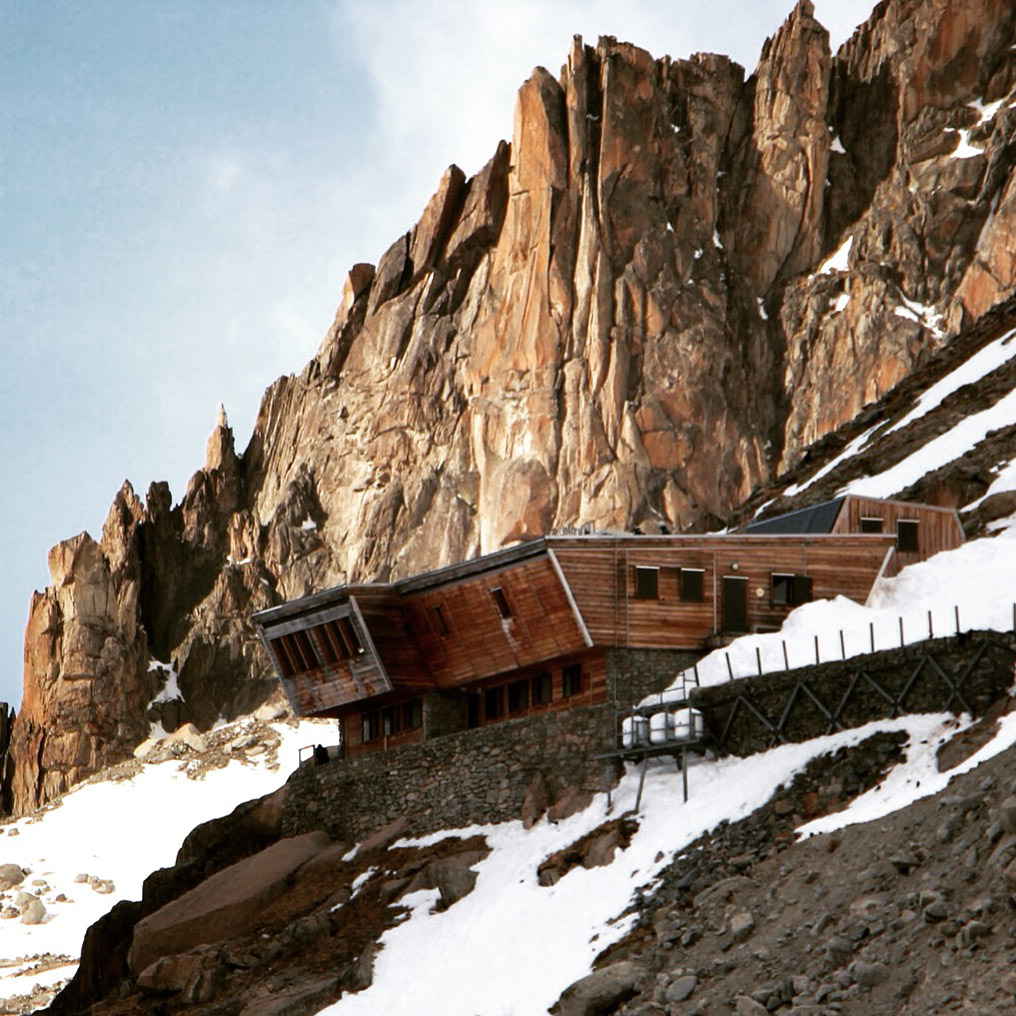
Huts are all over the place and much more well equipped! Argentiere, France.

Other useful tips

A data plan was super handy – finding hotels and race venues we used GPS and email a ton. It is easy to buy a cheap phone when you arrive and can be nice for in-country calls or emergencies but may not work everywhere. I’ll spend the extra money on a worldwide data plan next time. (Note: even a really good data plan may not work everywhere – ahem – Andorra…)
Wifi is much less reliable. Cafes frequently have wifi but expect to buy something and it’s pretty slow. Finding free, fast wifi to do work-related things was much more difficult than in North America. Uploading batches of photos was nearly impossible. Hotels frequently advertise wifi but only offer it in the lobby (and it is slow). McDonald’s was the most reliable.
Make sure you know the local emergency number. We were the first on scene of a climbing accident and were only able to call the rescue because I had randomly downloaded an app with their number on it to my phone. Without that, we would have had no idea who to call.
I joked that if I ever was to get injured, it should be while I was on this trip because it was the most well insured I’ve ever been in my life. I had travel insurance through my employer, accident/rescue insurance through the American Alpine Club, and because I was racing in Switzerland, I had to purchase rescue service/insurance from REGA. All of this was relatively painless with a bit of research.
Lift tickets work differently and usually better. If you are uploading only once to mid station, it is likely considerably less expensive than a day pass. Downloading only tickets are even less. It’s not like spending $120 just to think about riding a lift at a resort in North America.

What are your tips and observations?

Share your Euro tricks with us in the comments below so we can all have a smoother trip the next time we go 🙂
Thank you!

Filed Under: Skimo Racing, Training, Tricks & Tips Tagged With: Chamonix, Eric Carter, Europe, Travel, Verbier

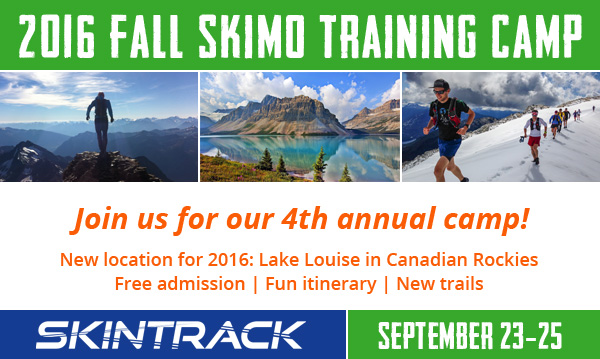
2016 Fall Skimo SkinTrack Training Camp

August 25, 2016 By Stano Faban Leave a Comment

skimo-camp-teaser-2016

The 4th edition of our training camp will be based around the beautiful small town of Lake Louise, in the heart of the Canadian Rockies and the Banff National Park!
As usual, the camp will partly serve as a fall training camp for some Canadian National Skimo Team athletes but it will be open to other fit skimo and mountain running enthusiasts as well.
IMPORTANT: To attend, you must fill out the sign-up form further down on this page and be fully ready to participate in all activities. (See bottom of this page for more hints on self-assessment if you have doubts based on the camp’s itinerary.)

Quick overview

  • Dates are September 23-25, 2016.
  • All training sessions will be based within 30 min drive from Lake Louise.
  • It will be mainly a trail & mountain running focused camp.
  • Admission is free and additional costs will be kept to minimum – we are fully volunteering our time as well.
  • This is not a “guided” training camp in the sense that there will be no official mountain or hiking guides present. We will make all safety decisions together as a group.

Itinerary

The camp will officially begin Friday at 5pm but we understand that work schedules may prevent some from joining us then. Feel free to join us later on Friday night or early on Saturday morning.
NOTE: This itinerary could change due to changing weather and mountain conditions, otherwise, we will most likely proceed as follows:
Friday – Sep 23:

  • 5-5.30pm – meet at the hostel
  • 5.30pm – easy run and stretching (1h altogether)
    – this is not a mandatory session but is good to loosen your legs after the drive
  • 6.30-8.30pm – dinner, introductions and discussing next day
    – see further below for more details about meals (section on Accommodation and meals)

Saturday – Sep 24:

  • 8am – depart and drive to trail-head (I will present 2 options to choose from on Friday)
  • 9am – start a long mountain run/hike & scramble which hopefully be a loop or A-to-B run
    – this will be a 5-6h session
  • 6-8pm – dinner and skimo related Q & A, discuss next day

Sunday – Sep 25:

  • 8am – bootcamp-style strength workout (1h)
  • 10am – depart and drive to trail-head
  • 10.30am – start a 2-4h trail/mountain run
  • 3-4pm – we can all start driving home

Accommodation and meals

  • Hi-Hostel at Lake Louise will be our ‘official’ accommodation and cooking place for the camp.
  • Every participant is responsible for their own accommodation (unless you are one of the people that I already booked it for).
  • Everyone is responsible for cooking or buying their own meals – the hostel has a great kitchen and a small restaurant as well.

Gear to bring

Here is a basic gear list we would like you to bring:

  • Mountain or trail running shoes in good condition (La Sportiva or Salomon have the best models many of which MEC or REI carries)
  • Training clothing – sweat wicking base layers, shorts, long sleeve and pants
  • Water proof clothing – jacket and pants
  • Cold weather clothing – bring a down jacket, hat and gloves for sure  as we could easily have snow during the camp
  • Headlamp
  • Survival emergency blanket (like this or similar)
  • Sandals and post workout clothing
  • Ski poles or running specific poles
  • Running vest or a suitable pack that can carry all your gear on Saturday (Ultimate Direction makes great running vests but your skimo race pack will do the trick as well)
  • Food and snacks for fuel during workouts
  • Helmet for protection against light rock fall
  • Personal first aid kit – to treat blisters and stop minor bleeding
  • Mountain or road bike (optional)

Registration and Updates sign-up form

Everyone that wishes to participate (although is still unsure) must fill out the form below. Thank you.
[contact-form-7 404 "Not Found"]

Can I handle the camp?

If you are unsure if you should attend based on the below then send us an email via the form above.
Three things to consider when deciding:

  1. If you are currently not able to complete 8-10h of trail and mountain running spread over 3 days then this camp might be too much for you at the moment.
  2. The runs on Saturday and Sunday will include about 20-30% of extended periods of hiking so they won’t be as intense as they may sound.
  3. We expect you to show up well rested, injury free and with a positive attitude to participate.

» Report from the 2015 training camp based around Whistler.
» Here is how the the first Canadian Team summer training camp in Squamish went two year’s ago.
» Here is how a Canadian Team summer training camp looked like in Revelstoke in 2012.
To improve your training in the meantime checkout these:

  • Our Skimo Racing Manual e-book
  •  Summer training tips for skimo racers from Adam Campbell (professional mountain runner)
  • “Bread and butter” summer training for rando racing…
  • Hiko-run: Skimo racer’s best summer friend

Filed Under: Events & Races

  • « Previous Page
  • Page 1
  • …
  • Page 4
  • Page 5
  • Page 6
  • Page 7
  • Page 8
  • …
  • Page 23
  • Next Page »

Primary Sidebar

  • Facebook
  • Instagram
  • YouTube
Our Facebook Page

skimo-manual-banner-300px
 

Recent Articles

  • Kilian Jornet Interview: About His New Foundation, His Own Environmental Impact, and How He Wants To Help Athletes and The Outdoor Industry To Protect Nature
  • How Fast Are Glaciers Really Melting? How Will This Affect Your Mountain Adventures? Interview with Pascal Egli
  • Book Review – Art of Freedom: The Life and Climbs of Voytek Kurtyka
  • Forest Skis: Innovative, Custom Build, For Backcountry Skiing and Freeride
  • Lighter and Completely Redesigned: New CAMP Ultralight Ski Mountaineering Ice Axes

Categories

  • Contests & Giveaways
  • Crazy Tracks
  • Events & Races
  • Gear, Tech & Food
  • General News & Articles
  • Industry Press Releases
  • Movies & Books
  • News Shorts
  • People (Interviews)
  • Racing 101
  • Reports & Results
  • Reviews
  • Skimo Racing
  • Training, Tricks & Tips
  • Trip Reports & Conditions

Footer

About SkinTrack

Travelling through snowy mountains on skis is like flying… and experiencing life at its core.

Gear reviews, interviews, adventures, contests, skills, skimo training, race reports – we connect you to all things related to self-propelled skiing.

SkinTrack.com, created by Stano Faban, was born out of passion for ski mountaineering and ski touring. Over the years, it has become one of the most popular ski mountaineering blogs in North America.

Recent Articles

  • Kilian Jornet Interview: About His New Foundation, His Own Environmental Impact, and How He Wants To Help Athletes and The Outdoor Industry To Protect Nature
  • How Fast Are Glaciers Really Melting? How Will This Affect Your Mountain Adventures? Interview with Pascal Egli
  • Book Review – Art of Freedom: The Life and Climbs of Voytek Kurtyka
  • Forest Skis: Innovative, Custom Build, For Backcountry Skiing and Freeride
  • Lighter and Completely Redesigned: New CAMP Ultralight Ski Mountaineering Ice Axes

Useful Links

Comparing the lightest: Skis | Boots | Bindings

Skimo Training: Training Plans | Videos

Stay in Touch

  • Facebook
  • Instagram
  • Twitter
  • YouTube

Copyright © 2025 SkinTrack.com. All rights reserved.