
• Skip to primary navigation
  • Skip to content
  • Skip to primary sidebar
  • Skip to footer

SkinTrack

  • Lightest Gear
    • Skis
    • Boots
    • Bindings
    • Skins
    • Packs
  • Skimo Training
    • Training Plans + Skimo Manual
    • Transitions Videos
  • Facebook
  • Instagram

Stano Faban

Dogtooth Dash 2010 race: Canadian National Ski Mountaineering Championships

April 1, 2010 By Stano Faban Leave a Comment

During the upcoming Easter weekend Kicking Horse Mountain Resort (near Golden) will host the final round of the Canadian Ski Mountaineering Cup with its second annual Dogtooth Dash event.
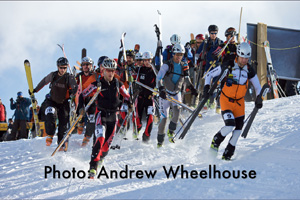
Crazy start of the Dogtooth Dash 2009 edition.
Starting gun will go off on April 3rd (Saturday) and once again the event will be coveted as Canadian Ski Mountaineering Championships.
The race is run in partnership with the Alpine Club of Canada, the Golden Ski Mountaineering Club and the Kicking Horse Mtn Safety team.
The course is one the most challenging ski mountaineering race courses in North America, utilizing all three alpine bowls and featuring: technical boot packs, descents on each ridge line and a unique Le-Mans start.
The Dogtooth Dash race course is set entirely within the ski area boundary and will challenge athletes with about 5000 vertical feet of climbing/descending on the competitive course, and 2600 ft of climbing/descending on the rec course.
» If Dogtooth Dash is going to be your first skimo race then make sure to check out an older article that gives tips and advice for your first ski mountaineering race.

Basic facts and wide range of prizing categories

  • Two race course options:
    • Competitive (full course) and Recreational (poker run)
  • Cash prizing for the fastest male and female racers of the day in the competitive course
  • Masters prizing classes for racers 40+ and 50+
  • The recreational class poker run with participants grabbing cards at transition stations and playing the best hand for first grabs at prizes at the Eagle’s Eye après
  • New junior class for youth 18 and under:
    • With free entry for the first 10 under 19 racers
    • In partnership with backcountrysafety.com
  • For more info and to register online see Golden Skimo blog
  • Included in the entry fee is the chance to win great door prizes, apres at the Eagles Eye, lift ticket for the whole day and dinner at the pre-race meeting.

Sponsors
More prizes this year from The North Face, Integral Designs, Suunto, Black Diamond, Dynafit, Kicking Horse Coffee, Rossignol and more.
Go, race and have fun!
Filed Under: Events & Races

Canucks in Andorra: Culture shocks, race engines tune ups, big traverse plans

February 25, 2010 By Stano Faban 6 Comments

First of all, I would like to thank all the people that are supporting me and other Canadian team members in our efforts to represent Canada at the world skimo racing scene this season. Without you it would be very close to impossible. Thank you very much.

Atop the highest peak on the race course, from left - Alex Wigley, James Minifie, Stano Faban.
On February 19th, five members of the Canadian National Skimo Team boarded a plane headed to Europe.
The journey’s primary objectives are the World Ski Mounatineering Championships in Andorra, and a four day stage race in France – Pierra Menta. And learning…
Three of the five – James Minifie, Alex Wigley and I – switched a plane in London to eventually land in Barcelona.
Julie Matteau and Jeff Colvin continued to attend a skimo training camp in Sicily (Italy) where they joined other team members.
The travels were tiring, however, I felt a certain privilege to “visit” three Olympic cities in less than 13 hours:

  1. We flew from Vancouver BC where the 2010 Winter Olympics are in a full swing.
  2. Switched planes in London that will host the next Summer Olympics in 2012.
  3. And landed in Barcelona where Canada captured 7 gold, 4 silver and 7 bronze medals during the 1992 Summer Olympics.

Culture shocks

Liking the culture, not so much the civilization.
Living in Canada for almost 9 years now, and going back to Europe only occasionally past few years, I caught myself being somewhat depressed by seeing that humans managed to leave their mark at every spot over the old continent by now.

James bombing up the kids terrain park Bode Miller style.
Endless webs of chairlifts, roads climbing the most exposed terrain features and people fighting for every square inch made me to be thankful for the Canadian wilderness.
And then there was James, who lives up at Yukon’s White Horse, getting awestruck by not being able to see backcountry past the last chairlift. Simply, more and more chairlifts followed.
But all three of us sure like the food, architecture and the spontaneity with which people great everyday here. And yesterday, all turned a corner when we went to check out the individuals race course :).

Race engines tune ups

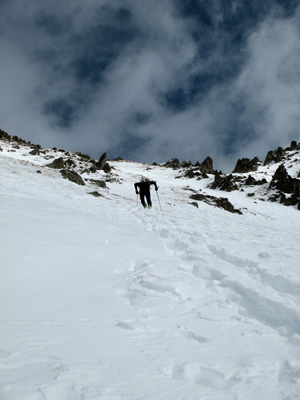
James heading up the boot pack that should be featured in the very last climb.
For the first two ski days we only attacked the ski runs right across the road from our hotel at Soldeu as jet lag and 9h time difference didn’t let us do any damage in the backcountry.
But yesterday, after a first full-night sleep, we caught a taxi ride up the valley to Grau Roig to check out the course for the World Championships’ individual race that will take place on Wednesday, March 3rd.
Once on skis, we were all shining with big smiles as we reached the real backcountry in just about 30min of skinning.
In the process we got passed by a couple of Spanish Team members that were practicing their furious stride frequency in Pierre Gignoux carbon boots.
However, they stopped for a moment to great us and once I recognized one of them (I met Manu Perez a couple of years ago at Whistler) they showed us the way and offered us to join them. Even though the offer was exciting we decided to stick to our acclimatization plans and let the fast deers run…and of course to break trail for us.
Few moments later we were treated to being past by Mireia Miro, top caliber female skimo racer, and one think became very clear – in Europe, even if you have carbon F1 boots you can look a like a tourist :).
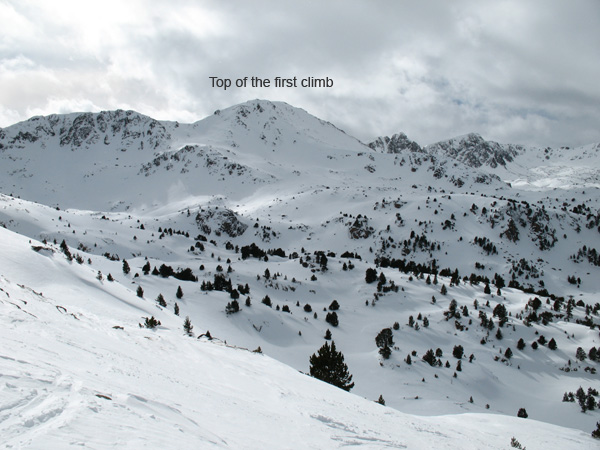
top-first-climb
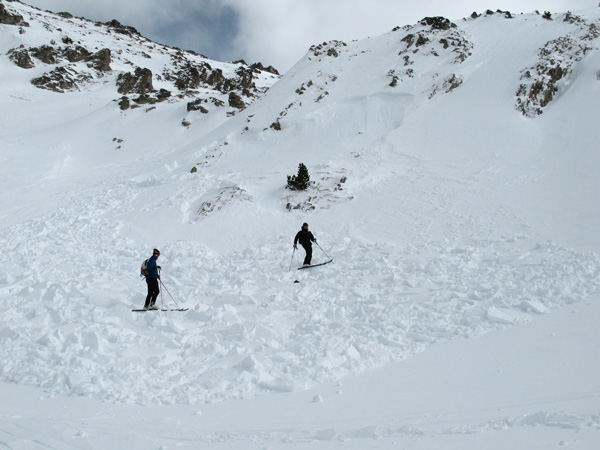
95% of the individual race course is in the backcountry with avalanche debris covering couple spots of race course. Based on what we saw, it will be an amazing venue for a skimo race with lots of technical sections whether on the uphills or downhills.
» You can see more pictures from this day and the course at Alex’ Ski Theory blog.

Big traverse plans

Since I have yet to meet a Canadian that would look at a topo map without connecting glaciers, cols and ridges for possible traverses all three of us studied the map of Andorra at some point since leaving Barcelona.

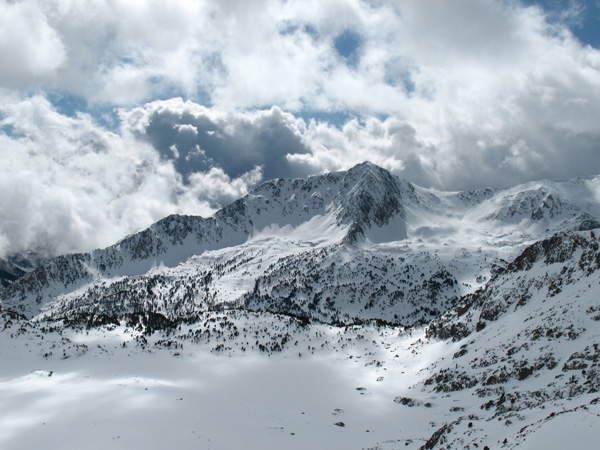
As long as you get away from lifts Andorran backcountry looks very nice. There is a nice hut by the lake - right bottom part of the photo.
As long as you get away from lifts Andorran backcountry looks very nice. There is a nice hut by the lake - right bottom part of the photo - which we should be skiing around during the race.
One traverse specifically made us excited but will most likely be left for an attempt later in the future – a circumnavigation of the whole country!
Based on the map we have it looks very possible to gain ridges (about 2300m) above the Andorran capital Andorra la Vella (1300m) via summer hiking trails.
Then in a clockwise direction follow the ridges and high plateaus (between 2000-2900m) that create a natural border between Andorra and its neighbors – Spain and France.
And the coolest thing about this traverse is that the whole Andorra state fits easily on a 90×90 cm map in 1:40 000 resolution.

Plans for next few days

Plans for the immediate future involve good rest, some race gear shopping (which can be endless in Andorra – a tax free zone and plenty of gear to choose from) and reconnoitering the team’s race course tomorrow.
Besides that, we will try to meet as many fellow racers as we can, learn from them and once home share it all with you.

Boys checking out a fresh debris on the last descent of the race course.

Filed Under: Trip Reports & Conditions

Pierre Gignoux 444: Behind the scene of the lightest ski boot in the World

February 25, 2010 By Stano Faban 12 Comments

Sharing a look behind the scene of manufacturing the world’s lightest ski boot (Pierre Gignoux 444 model) through the eyes of Michael Silitch, an internationally certified mountain guide living his dream in Chamonix.

rando-girls
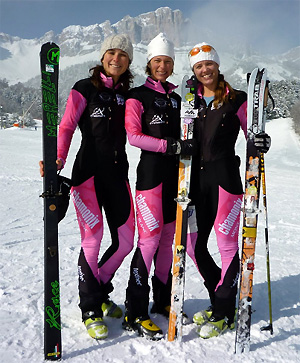
Nina with her team mates from the Chamonix Ski Alpinisme Club.
Michael is the founder and the main guide of High Alpine Mountain Guides, and a husband to one of America’s top female skimo racers Nina Silitch – NinaSilitch.com.
Both of them ski the PG boots on regular basis while Nina is also putting them through rigorous testing on the skimo World Cup circuit.
On behalf of all SkinTrack readers I want to thank Michael for sharing his experience from a visit to Pierre Gignoux’ workshop.
Michael supplied the text and photos, so please contact him via his website if you wish to reuse any of it.
Also, judging based on Pierre’s accomplishments as a ski mountaineer, and couple of reports like Micheal’s, Pierre is an absolute representation of someone extremely dedicated to deliver nothing less than the best to the sport he loves so much.
For a comparison of the lightest ski boots, currently available on the market, make sure to read also check these two articles and great discussions in the comments sections below them:

  • Introducing the lightest ski mountaineering boots
  • New carbon ski boot: LaSportiva Stratos

Look behind the scene – Michael Silitch words

Nina just loves her Pierre Gignoux all carbon fiber ski boots. She loves how light they feel climbing (less than 10% heavier than a Salomon World Cup nordic skate boot) and also how stiff they feel while descending, delivering precise edge to edge control.
Basically they are lighter and stiffer than almost all touring boots out there, from the big touring boots to the race specific light boots.

Nina Silitch in the Pila World Cup sprint race in Italy, December 2009 with her Pierre Gignoux boots.
Just after [the December 2009 Pila World Cup] race, I had the opportunity to visit Pierre Gignoux at his workshop outside of Grenoble, France.
It’s a small workshop in his basement where he and 5 other employees hand-mold and assemble the lightweight masterpieces.
Pierre raced for 12 years at the highest level and [besides other wins] he won the Pierra Menta stage race.
He also holds the ski record for Mont Blanc. With Stephan Brosse, he skied up and down Mont Blanc in 5 hours 15 minutes – the start and finish line was the church in downtown Chamonix!
Stano’s note: This is little more than 3800m of climbing, then skiing it down. Pierre and Stephan reached the summit in 4 hours. The record attempt also involved a small crevasse rescue.
After all Pierre’s racing at altitude and using his degree as a biomechanical engineer he started working to create the lightest and highest performing ski boot possible. Used in skis, sail boats and F1 technology, carbon fiber was the material of choice.
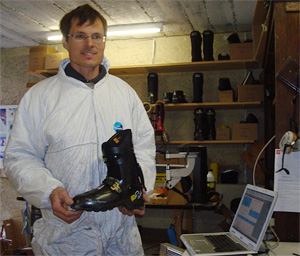
Pierre, in his workshop, proudly showing off his latest masterpiece, the XP 444.
After a few years of testing, the XP 500 was made available to the public in 2006.
At the time it weighed 650g per boot and was nearly half the weight of the Scarpa F1 (1200g).
My 2008 XP 500 were down to 520 g per boot without liner in size 27.5.
This year, the new XP 444 shell weighs a cool 444 grams in 27.5 and comes with many other improvements as well.
The shape, especially around the ankle, is lower profile and more streamlined resulting in an even more precise fit, and less ankle bumping which can rip your race suit to shreds.
The distinctive yellow fiberglass tongue has been replaced with a lighter more sturdy carbon fiber tongue. Besides the weight savings, the upper cuff is 30% stiffer and the locking lever more ergonomic.
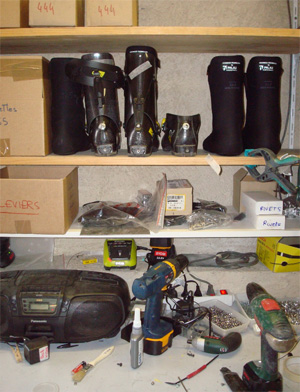
The hardware assembly area of the workshop.
Speaking of the unique, one motion, locking lever (by just lifting the locking lever you go directly into touring mode without needing any further ankle buckle adjustments), Pierre told me he invented it and Scarpa copied it.
Poorly I might add, as the F1 Race locking lever is a real knuckle basher – Scarpa did fix that for the F1 Carbon.
Similarly, the new Dynafit and LaSportiva race boots have both developed one movement locking levers.
Pierre also makes a Mountain version with a protective rubber rand and a full Vibram sole – all that with just 56 extra grams.
The XP Mountain is a true lightweight touring boot. There is a rubber rand around the welt of the boot to protect the carbon fiber while scrambling around in the rocks.
And a full Vibram sole will give you the best grip and wear. All that for only an additional 56 grams still makes it an exceptionally light boot for extended tours.
One thing you may note of all these pictures is that there are not many boots in his workshop. That’s because they fly off the shelves.
Pierre and his crew produce about 300 pairs a year and currently there is a 6 month waiting list. So order now to get a pair for next season! They are well worth it.
A Mountain version of Pierre's boots with a protective rubber rand and a full Vibram sole.

Questions? Experience?

Feel free to ask any questions about these boots in the comments section below.
If you have a personal PG boots experience you are welcome to answer these questions and share your experience.

Filed Under: Gear, Tech & Food, Skimo Racing

Are these the same skis? Dynafit DNA Race vs. Crazy Idea DNA Race

February 17, 2010 By Stano Faban 13 Comments

Update: After confirmations from various sources these two skis are in fact the same.
For a longer time now I have been suspecting a little “marketing scam” that might be being played with the ski mountaineering racing community. Two companies with well known names might be presenting the same ski but covered in two different top design sheets.
Dynafit is the Name in ski mountaineering (and ski touring) manufacturing industry, whereas, Crazy Idea is more known for its niche market approach in the sport of skimo racing. Both companies present skimo racing skis in their repertoire, however, I wonder how genuine these skis really are.

Some facts to compare

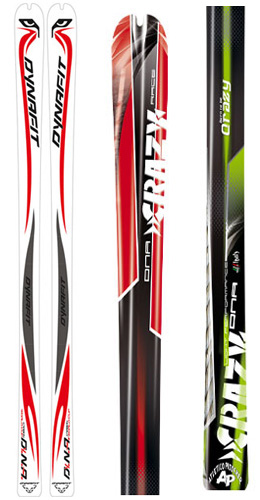
dynafit-vs-crazy-ideaWithout even comparing the model names (DNA Race and DNA Race) the similarities are pretty obvious.

Dynafit DNA Race:
Length: 161 cm
Side cut: 96-65-78
Radius: 24.5 m
Weight: 710 g
» See the ski here – Dynafit website
Crazy Idea DNA Race:
Length: 161 cm
Side cut: 95-64-78
Radius: 24.5 m
Weight: 710 g
» See the ski here – PDF doc
Except the side cut all other parameters match exactly. And even with the side cuts, I wouldn’t be surprised if they actually were identical.
But for “marketing purposes” companies (or one of them) decided to skew the numbers by a millimeter to create an impression that we are choosing between two different models. Who knows?
Also, after inspecting the specs (Dynafit website and the above PDF) the structure or the materials used in the built of both skis appear to be at least similar if not the same. But again, the specs can be written in so many ways and angles that “if you don’t really know you will never know”.

“Conspiracy theory” assumptions

Based on what I know, Crazy Idea had its skis out on the market first, now for about 2 or 3 years. And I don’t think they changed them significantly since then.
On their website, Crazy Idea, offers to customize the design of your skis for 30.00 Euros if you buy a pair. Therefore, they must be able to print out a different top sheet quite easily.
This leads me to quite a “serious discovery” because while inspecting my friend’s almost brand new Dynafit DNAs skis last Saturday he pointed out that the the top sheet is easily scratched on the top edges (rounded sides) of the skis.
After a closer look I could clearly see that the top sheet is only a vinyl-like layer that, with some patience, you would be able to peel off from the place where the ski was scratched. (I will ask for detailed photos of the scratches.)

Some questions to ask

Is Dynafit just printing a different design sheet over Crazy Idea skis? Or is it the other way around?
Has anyone been a little suspicious about these two skis like me?
What is your opinion on these striking similarities?
Most likely both companies will stand the ground that each ski was genuinely developed after years of testing, and I hope they are.
But if the ski industry is following the (outdoor) clothing industry example then I wouldn’t be surprised if there is even an absolutely different original manufacturer for these skis, and big companies are only slapping their designs over a pair of light sticks. Who knows?
The images and the PDF file were downloaded from the Dynafit and Crazy Idea websites.

Filed Under: Gear, Tech & Food, Skimo Racing

Future of avalanche beacons: old standards and new ideas – ARVA Link and Ortovox 3+

February 12, 2010 By Stano Faban 7 Comments

Every two or three years manufacturers release improved and more innovative features for their avalanche beacons. Some of these are revolutionary and some are just small enhancements, however, they are constantly moving forward.

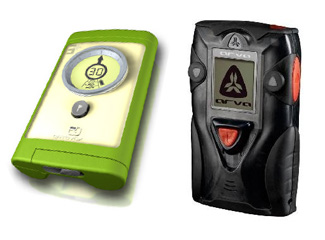
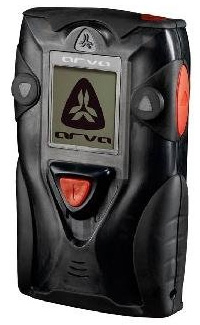
Ortovox 3+ (left) and ARVA Link will introduce new features to improve avalanche rescues.
In the past couple of weeks I had a chance to talk to two representatives about new products of their respective brands – ARVA and Ortovox.
Both discussions opened my eyes to some new thinking about avalanche rescue search but also somewhat confirmed my opinion that we might be stuck with some old standards.

Old standards

Technology and standards that are used for current avalanche beacons were established (agreed upon by manufacturers) about two decades ago.
Of course, there were some refinements since then but pretty much it appears that we are stuck with the antennas and the frequency they transmit (457 KHz). Therefore, being stuck also with the way we can search for avalanche victims.
I am no engineer, so during a meeting with ARVA representative from France I asked these questions:

  • Isn’t the current technology quite limiting for significant improvements for faster searching?
  • If it is then why something new isn’t being invented?
  • What about some other technologies (like GPS)?

The answers were both upsetting and encouraging:
On one hand, yes, we are a bit stuck with the very core technology beacons are using now. On the other hand, there are great plans underway to improve what we currently have.
Bad news
The current technology obviously affects the basic functionality of the avalanche beacon and the ways manufacturers can improve its performance.
Also, even with a technology like GPS it would be very tough, at least for now, since users (searcher and victim) would depend on one more piece of device (satellites) than just a transmitting and a receiving beacon. This would make the rescue activity quite vulnerable due to terrain obstacles (steep valley) and satellites available for precisely locating a victim.
Pretty much the bottom line is, according to ARVA representative, that avalanche safety is such a small market to invest big sums of money in to invent, or research, something completely new. Besides, manufacturers don’t have such budgets anyways as they are not selling to huge markets such as electronics consumers.
They could possibly work on this together but then there must be a significant will to share information. In a commercial world we live in, this seems too “utopia like” to consider that. However, there is already a small change on this front which is discussed later in this article.
Good news
The good news is that engineers found some new ways how to improve avalanche beacon search while using the same old standards. To me these are brilliant ideas and I am looking forward to see them work and hopefully to be implemented by more than just few brands.

New ideas: out of the box thinking

Two new avalanche beacons will (should) hit the stores next season – ARVA Link and Ortovox 3+, and they will represent new ideas and developments from inside their companies.

ARVA Link avalanche beacon

ARVA is a French avalanche safety equipment manufacturer that is quite popular in Europe, yet not known at all on the North American market.
w-link-logoRecently, ARVA purchased or is licensing W-Link broadcast technology from Mammut which uses a second frequency (W-Link frequency: 868 / 915 MHz) for additional data transfer between Mammut Pulse beacons.
Mammut uses this frequency to transmit victim’s life data and there is a bit of debate within the industry whether it is good or not to make such information available to those who search.
However, ARVA is not thinking to use this frequency to send such data but rather to use it for communication among all the beacons in a reachable range.
This is how it should work – rescue scenario:
arva-linkParty of five gets caught and three persons are buried under the snow, the other two starts searching. As searcher “A” flags (marks) a found victim searcher’s “B” beacon receives this info and flags it too. So now both searchers know there is only two more to be found.
Or if the searchers run in different directions and searcher “A” picks up a signal that is too far for “B” to see, it will notify the “B” beacon that it already picked up a signal.
This signal separation would be possible because the other W-link frequency through which the buried beacon is sending its unique ID (maybe a serial number).
Therefore, there is no way a beacon could be flagged but really not located in case of signal overlap by the transmitting beacons which happens sometimes with currently available models.
Taking it a step further:
Lets say another party comes to help and is also equipped with ARVA Link (or other beacon that would support this technology in the future). As they start searching too their beacons will be notified of the already found victims by the searchers “A” and “B” beacons.
You can definitely see how this can be very helpful in multiple burial scenarios. However, as you also noticed, no one started digging yet. 🙂

Ortovox 3+ avalanche beacon

Ortovox is a well known leader in the avalanche safety industry and once again they are readying to release a beacon that will do something no other beacon did before.
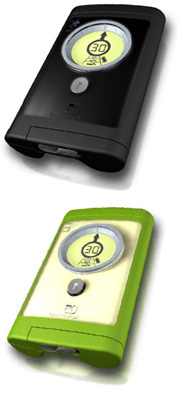
ortovox-3+Apart from a very nice design and a use of only one AA battery, which makes the beacon very small and light, Ortovox 3+ will introduce a feature that helps others to search for itself!
This avalanche beacon will have the ability to automatically switch between two antennas through which the transmitting signal will be send when buried.
Ortovox 3+ will have three antennas in total but the third will be used only for enhancing it searching capability, not transmitting.
How this works – Ortovox 3+ vs today’s beacons:

When any currently available beacon is buried in a “wrong” way its main antenna will be transmitting mostly in vertical directions – to the sky and to the ground.
If an avalanche manages to bury you the “right” way then you have a better chance of being found as your antenna is transmitting more horizontally (or more leveled to the surface), therefore, providing the searching beacons with a bigger range to pick up your signal.
What Ortovox 3+ will bring to the table is its ability to figure out which one of its two main antennas is positioned more horizontally, then switch transmitting to it.
This means that no matter how this beacon is buried it will always be transmitting on the best plain for the searching beacons to pick up its signal from.
This feature seems quite revolutionary since the buried beacon will actively help the searching beacons to find it. Therefore, improving searching capability of any beacon, even those with a smaller search range.

More details about ARVA Link and Ortovox 3+

Currently, there are not all details available about these two units, thus not everything can be explained right now. However, based on what is known so far the features that will be used in these two beacons are a big step towards future improvements of avalanche beacon search functionality.
Both beacons will be available on the North American market once they are officially released and the purchase prices should be in a range of $350-$420, not too much for such cool features.

Filed Under: Gear, Tech & Food

Sunshine 5000 race report: great battles, long course…little rocky

February 7, 2010 By Stano Faban 5 Comments

Sunshine 5000 is the oldest race on the Canadian ski mountaineering racing calendar and its 6th going was held last Saturday (Feb 6th, 2010) at the Sunshine Village ski resort near Banff, AB.

Start line - calm before the storm.
Sunny skies are nothing new to this event yet the course was a hybrid version of previous years. Long low angle climbs were spiced up by a couple of “no-wipe-out-recommended” downhills and one of the longest boot packs ever.
It also should be mentioned that one of the organizing pioneers of this race at the very beginning was Greg Hill, arguably one of Canada’s most famous ski mountaineers.
Greg himself raced couple of events over the years but now is pursuing more adventurous goals like climbing and skiing 2 million feet in a single year.
But the long standing pair that grind the event each and every year for all of us is David Dornian and Ryan Johnston. They keep the tradition rolling and improving.
» Original information about the event can be found in this article – Sunshine 5000 skimo race: Saturday, Feb 6th, 2010.

How the Sunshine 5000 was won – great battles

Stairs that led racers down to a little col to start the descent of the "feared" Delirium Dive.
There were three main favorites for the top prize in the main racing category at the start line – Reiner Thoni and Brandon French in men’s category and Melanie Bernier in the women’s category.
Behind these three there were about 3-4 men and 2-3 women hungry for the rest of the honors.
Men’s race
Top tier men’s duo, Reiner and Brandon, formed early on and pretty much never looked back. Occasionally switching the lead they were watching each other, always staying closely together.
In the final descent, they shared some tumbles thanks to a very rocky section that wrecked couple of skis on the day.
At the end, Brandon crossed the line first just  handful of seconds in front of Reiner, however, he lost a skin on the course and received a time penalty which moved him to second.
Always present, always competitive Steve Sellers (currently at 4th) leading Stano Faban, Ian Gale and Andrew McNab over the first climb.
Always present, always competitive Steve Sellers (here at 4th place) leading Stano Faban, Ian Gale and Andrew McNab over the first climb.
These two guys look quite hot for the upcoming World Ski Mountaineering Championships and it will be very interesting to see how high they can reach among the best.
Delirium Dive line that was skied in the race.
The battle for third can be described in great detail as I was one of the protagonists but here is a shorter version to keep you reading onto the girls race.
During the first (long low angle) climb James Minifie settled at 3rd with a steady pace. About 50sec back a trio consisting of Steve Sellers, Ian Gale and myself (Stano Faban) chased him. During the third climb and before the big descent I opened a gap on Ian and Steve while steadily bridging to James.
The last two ascents James and I kept hurting each other until I was able to establish a little gap just before the long boot pack.
Then in the final descent both of us, just like Reiner and Brandon, hit some rocky fields on multiple occasions. And as James was trying to catch me for third he hit them hard also with his body but thankfully survived without any serious injury. Couple of badly cut fingers though.
5th and 6th place went to Ian Gale and Andrew McNab. To read Ian Gale’s race report visit this page – Sunshine 5000 race report.
Women’s race
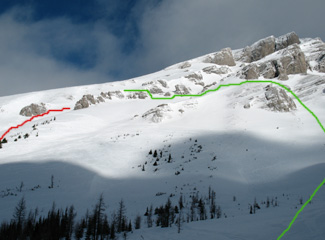
Green shows parts of the last climb and red a little bit of the last decent.
Green shows parts of the last climb and red a little bit of the last descent.
The women’s race was dominated from start to finish by this season’s Canadian fast girl Melanie Bernier.
After a slightly disappointing previous season Mel is racing with great determination this year, and even giving us men some serious schooling on how to climb quick.
Behind her, the battle had a more interesting going where failing skins, perhaps due to big changes of temperature between sunny and in the shade transitions, played a role.
At the end, Billie Velisek took second in front of Julie Matteau who is trying hard to find her last year’s strong legs before she heads to Andorra for the World Championships.

Results

Complete final results will be added as soon as they are available to me (2-3 days) in electronic format.

Big thanks to organizers and volunteers

On behalf of all racers I would like thank the organizers for preparing a very challenging course (last decent a little rocky for me though) and also express a great appreciation to all the volunteers for their hard work, especially for doing it out of pure joy to help out a crowd of crazy racers to get a chance to compare themselves. Thank you all.

Share your experience form Sunshine 5000

Whether a competitor, organizer or a volunteer you are welcome to share your experience from this event in the comments below.

Filed Under: Reports & Results

Sunshine 5000 skimo race: Saturday, Feb 6th, 2010

February 2, 2010 By Stano Faban 8 Comments

Updated with current photos from critical parts of the race course. See at the bottom of the article under “Photo updates”.
This Saturday, Sunshine Village ski resort (16km west of Banff, AB) will be the venue for a second round of the Canadian skimo racing series.
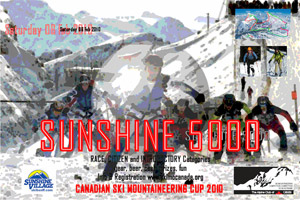
sunshine_5000There are two courses ready for you – one shorter less challenging and one long that also includes a descent of Delirium Dive run.
Sunshine 5000 quick facts:

  • date – Feb 6th, 2010
  • two courses
  • three categories – Race, Citizen and Introductory
  • bring also beacon, shovel, probe, helmet
  • everyone is welcome – skimo gear, tele, split-boards, snowshoes

Sunshine 5000 itinerary:

Race course
Race course is a serious challenge for experienced ski mountaineers. It will feature a total ascent of about 1400-1500 vertical metres over a distance of about 18km. Delirium Dive, the steepest line in the resort, is planned also for this course.
The course will feature 5-6 ascents and 4-5 downhill sections. One or two climbs will include a boot pack section were your skis need to be strapped to your ski pack.
Citizens course
A great challenge for novice ski mountaineering racers and for those that don’t feel fit enough for the goods of the race course.
This course will feature 4 climbs and 3 downhills while gaining about 700 vertical metres over 6-7 km.
» As a novice to ski mountaineering racing you may find useful this article – 6 tips to get you ready for your first skimo race.

Sunshine 5000 schedule:

  • Last minute registration (7-8pm) and a mandatory pre-race meeting (8-9pm) on Feb 5th in the Heritage Room at the Alpine Club of Canada Clubhouse in Canmore
  • Feb 6th, 2010 at 7:30 am
    Loading a gondola at Sunshine Gondola Base
  • Feb 6th, 2010 at 9:00 am
    Race begins for both categories and race courses from Sunshine Day Lodge start area
  • Feb 6th, 2010 at 3:00 pm
    Awards ceremony and draw prizes at Skier Services, Sunshine Gondola Base

More info and registration:

For more detailed information, race maps and registration information visit this page on the Alpine Club of Canada website – http://www.alpineclubofcanada.ca/ccc/ismc/index.html

Photo updates

I took the below photos on Wed, Feb 3, 2010. During the previous night about 10cm of fresh powder fell and covered an older harder surface. Good skiing overall, didn’t hit any rocks.

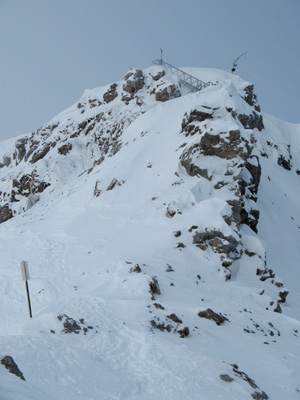
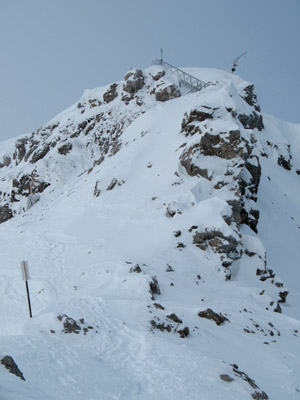
Racers should be coming down these stairs and making bootpack traverse to where I am.
Racers should be accessing the Delirium Dive down these stairs and making a bootpack traverse to where I am. Skiing is to lookers right.
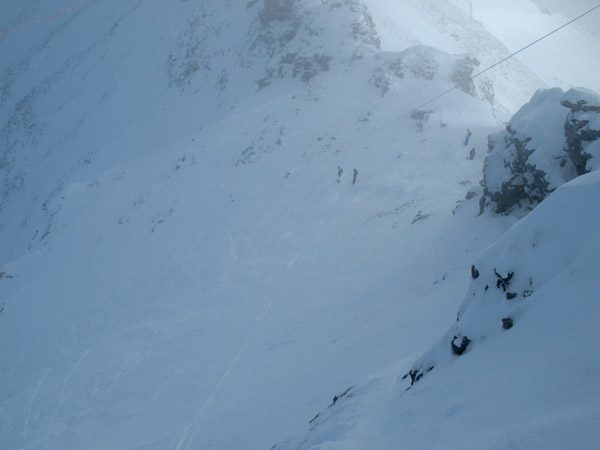
People standing at the entrance to Delirium Dive.
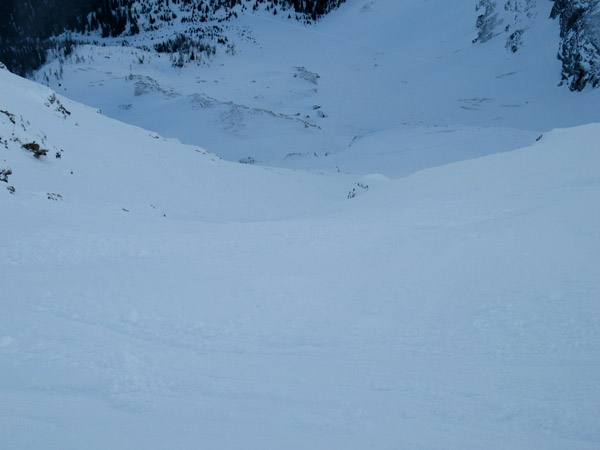
Looking down from where the people were standing.
Looking down from where the people were standing. Snow coverage looks good.
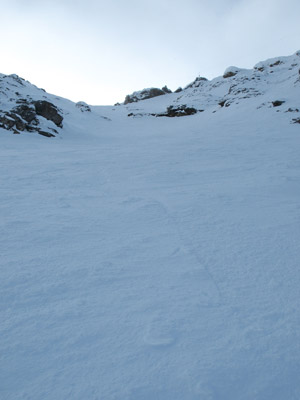
Looking up after about 130m vertical of skiing.
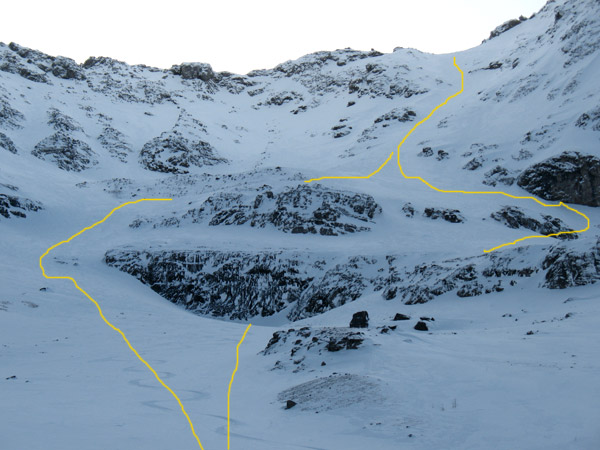
To me, these seem like the possible lines for the race course down the Delirium Dive.
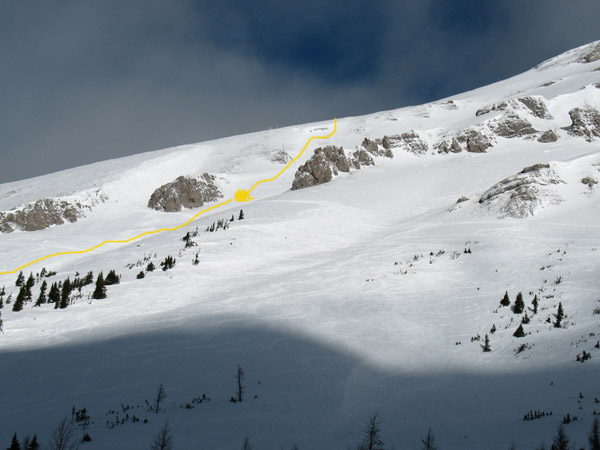
Last year, we skinned up to the yellow dot then boot packed the rest. On Saturday, we should be reaching the boot pack from my position. Or there might be a slightly different line for a boot pack.

Filed Under: Events & Races

Whitefish Whiteout ski mountaineering race: big checks, fast times, wicked course

January 24, 2010 By Stano Faban 8 Comments

Another round of the US skimo racing series was hosted on Saturday, January 23, 2010 at Whitefish ski resort. According to organizers, for the first time in the events history the weather didn’t stay true to its name. It was clear skies with a bit of cool temperatures but just enough to make for great racing conditions.

How it all went down

Canadians seeded the field with almost a full national team against two very strong home boys that are also members of the US national skimo team.

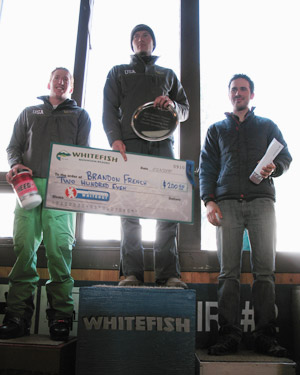
From left - second Ben Parsons, first Brandon French, third Reiner Thoni.
The whole race featured about 1425m of vertical gain, according to my watch, and the times set by all the racers were quite inspiring.
The race started fast since there was a $50 bonus for the fastest guy up the first hill.
The climb was 640m vertical, according to my watch, and Reiner Thoni from the Great White North took the prize with super speedy time of 26min 59sec.
Local racer, Brandon French, was right on his heels (27min 4sec) but could not answer the well timed attack.
In the process, Reiner set a new record for this climb which was previously held by Ben Parsons and was around 29min – an improvement of around two full minutes!
To cover 640 vertical metres in 27min translates into a vertical speed of 23.70 metres/minute or 1422 metres/hour! This is an amazing speed which is way greater than the speeds achieved at the Tiki Torch vertical race in earlier December 2009. And never mind that this was just a first climb of the race.
Both racers used two different but very light setups: Brandon – all new complete Dynafit DyNA setup, Reiner – Ski Trab WC skis with Scarpa F1 carbon boots.
The overall winner of the women’s race category, Canadian Melanie Bernier, was also the first girl to the top of the first climb with a very fast time of 33min 1sec which means a speed of 19.40 m/m or 1164 m/h. Like Brandon, Melanie also races the full DyNA setup.
On the second climb, Reiner had some skin problems and was passed by Brandon and another local Ben Parsons. This is also how they rounded the top three.
From start to finish, 4th placed was occupied by a Canadian team member James Minifie who was racing in a no mans land. He was always about 3-7min behind the top three and about 2-3min in front of a pair of another Canadians – Ian Gale and myself (finished 5th and 6th). Ian and I weren’t making up or loosing any ground on James after the first climb but we were consistently pulling away from a group of about 5 racers.

Wicked race course

The race course deserves two thumbs up as it was a true ski mountaineering course yet still managed within boundaries. This is a testament to the ski area’s great terrain.
I found the course very much to my liking with lots of technical skinning and skiing, and I mean there was lots of it.
The boot pack section was very nicely setup with good supportive steps and a very straightforward line between two rocks.
As for the marking, I was a bit afraid of what to expect based on hearing stories from the previous year. But the organizers really stepped up and I don’t think anyone had a slightest problem to follow the route.

Results and big checks

Inspired by golf tournaments the prize money were handed out on big cardboard checks that made the awards ceremony quite special to the non-involved public at the ski area’s base restaurant.
Below are just a brief results re-typed from the official ones I got from the race organizers. As soon as they appear in full length on the USSMA website I will link to them.
Men’s race AT:
1. Brandon French – 1:27:34
2. Ben Parsons – 1:29:39
3. Reiner Thoni – 1:30:48
Women’s race AT:
1. Melanie Bernier – 1:47:18
2. Billie Velisek – 2:10:43
3. Kylee Ohler – 2:17:00
Men’s race Tele:
1. Clint Muhlfeld – 1:50:00
Women’s race Tele:
1. Anne Walton – 3:19:05
Then there were also other categories and a race on a shorter course for those that wanted to try our sport for the first time and I would have to believe they got a great introduction on a great course while getting a light sun tan.
Thanks to everyone for racing and big thanks to organizers for putting together such a great event.

Filed Under: Reports & Results

The Heathen Challenge – Sunlight COSMIC Race Report + US Team

January 20, 2010 By Stano Faban 5 Comments

Last Saturday, January 16th, Sunlight Mountain in Colorado hosted another round of the US ski mountaineering racing series and the event was the last chance for three more racers to make the US National Team. The race was also included in Colorado’s own COSMIC series.
The following words and photos were submitted by Bryan Wickenhauser who raced in the event himself and is one of the elite North American skimo racers. Thanks Bryan for sharing and congrats on making the US Team.

Race report from Bryan

Travis Scheefer and Ben Parsons discussing the race at the finish.
All the chips were on the table, as those skiers still looking to clinch a spot on the US Ski Mountaineering Team made the effort for the first stop on the COSMIC Series.
The first three racers, who hadn’t already qualified from a previous qualifier at Jackson Hole last Spring or Grand Targhee the prior week, would be awarded spots on this year’s team.
The Race venue was at Sunlight Ski Resort outside of Glenwood, CO. The resort has hosted a stop on the COMIC Series the prior three winters, so the course is not an unknown to most athletes.
Unfortunately, this winter started out with some descent early snow and then the tap got turned off for the last 5-6 weeks, making for some sugary, unconsolidated snow on the climbs when in the trees, and firm & fast on the descents, over all some technical conditions.
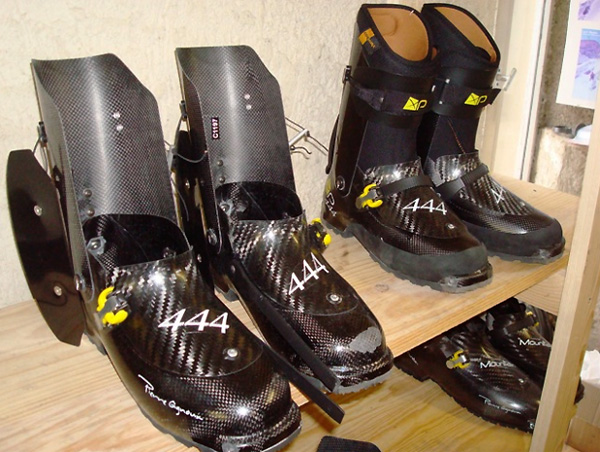
Pierre Gignoux carbon boots and Ski Trab carbon skis. Who's are they?
On the start line were a number of new carbon boots (SCARPA F1 Carbon, Dynafit DyNA, and even a pair of Pierre Gignoux 444) and skis.
Under clear skies, racers took off flying up the first 1740 foot climb, with skins ripping and snapping at the first transition. The first descent was down a bumped out, steep and bony run called The Heathen, the racers would get to know well.
The second climb was a repeat of the first climb, followed by another descent down The Heathen and then continuing on down another 250 vertical feet to the last uphill transition. At this point athletes were starting to spread out and solidify positions for the home stretch.
The last uphill consisted of a complete off-piste trail, switch backing through unconsolidated snow for ~600 vertical feet to the boot pack section. Here racers had to strap skis to packs for an additional ~400 vertical feet…. at least the steps weren’t too sugary for this section!
After putting the skis back on after the boot pack, racers still had to negotiate another ~700 feet to the top for the last skin rip and descent down The Heathen to the finish line at the base area.
At the finish, after nearly 5223 feet of climbing, it was Chris Kroger taking first by one second over Max Tam in just around 1hour 55minutes, followed closely by Pete Swenson. Bryan Wickenhauser came in 4th and Ben Parsons rounded out the top five.
In the women’s category it was Monique Merrill 1st followed by Jari Kirkland and Sue King 3rd rounding out the top three.
» Full results can be found at USSMA website.

The US National Team finalized (from Bryan)

Men:
Brandon French (Kalispell, MT)
Chris Kroger (Jackson Hole, WY)
Ben Parsons (Kalispell, MT)
Pete Swenson (Breckenridge, CO)
Carry Smith (Jackson Hole, WY)
Travis Scheefer (Crested Butte, CO)
Max Tam (Aspen, CO)
Bryan Wickenhauser (Gunnison, CO)
Women:
Sue King (Carbondale, CO)
Jari Kirkland (Crested Butte, CO
Monique Merrill (Breckenridge, CO)
Lyndsay Meyer (Chamonix, Fr)
Nina Cook Silitch (Chamonix, Fr)
Amy Smith (Jackson Hole, WY)

Filed Under: Reports & Results

Needle Peak (Coquihalla) and Rogers Pass conditions

January 19, 2010 By Stano Faban 1 Comment

Here is a brief report on conditions from Needle Peak (Coquihalla area) and Rogers Pass.
On my way to Canmore I planned two stops – a quick ski at Coquihalla area and a full ski day at Rogers Pass.
Forecasted avalanche conditions were quite different for the two locations and indeed the weather at both locations was quite different as well.

Needle Peak – Coquihalla (Jan 16, 2010)

Approaching Needle Peak.
Looking back at Needle Peak.
Weather conditions can be defined in two words – blue bird. But what surprised me was absolute absence of winds – even “calm” would be too strong of a word.
Snow within the treeline was quite deep and fairly dry. Once on the ridge and getting out of the trees the top layers were wind affected but it really depended on the spot how much the wind played its role as it changed quite a bit.
Skiing experience was pretty good, especially in the tree line. On the ridge not so pleasant, due to breakable wind slab, but definitely skiable.
Avalanches – I observed only one debris from a small slab that was about 8m wide and run for only about 15m. Might have been about 20-30cm deep. It was on NE aspect on a wind loaded slope above tree line.

Rogers Pass (Jan 17, 2010)

No surprises. Deep track setting at Rogers Pass.
Due to high avalanche danger rating at tree line and above we opted to head for Ursus Trees and then gain a ridge on the right side of the basin and ski laps there.
Weather was typical for Selkirks – high overcast with occasional breaks chased by small flurries.
However, the temperatures felt quite warm (about -2 C) even at 2000m. The winds were calm where we were.
In the trees we skied and pretty much anywhere in the tree line the snow was…super deep and…very good. 🙂 Hard work setting a skin track though as the penetration on skis was about 30cm and more.
Skiing was Rogers Pass average, in one word – fantastic. We had the whole treed slope for ourselves, so we skied a brand new run every time.
We observed debris at couple of locations from avalanches from the previous days but nothing on that day.
Neither anything was going on a surface hoar layer in the trees we were skiing. However, these trees get skied a lot, therefore, the surface hoar might got destroyed before any snow fell on top of it.

More photos those two trips

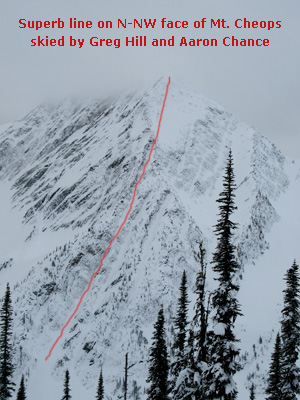
I took this photo to show you one of the coolest lines skied at Rogers Pass. Greg and Aaron did two rappels over ice falls to accomplish this first decent.
I took this photo to show you one of the coolest lines skied at Rogers Pass. Greg and Aaron did two rappels over ice falls to accomplish this first descent. I believe they did it in the 2008/2009 season.
Looking west from the top of Needle Peak.
Skiing trees in deep snow at Coquihalla.

Filed Under: Trip Reports & Conditions Tagged With: Coquihalla, Greg Hill, Rogers Pass

  • « Previous Page
  • Page 1
  • …
  • Page 38
  • Page 39
  • Page 40
  • Page 41
  • Page 42
  • …
  • Page 45
  • Next Page »

Primary Sidebar

  • Facebook
  • Instagram
  • YouTube
Our Facebook Page

skimo-manual-banner-300px
 

Recent Articles

  • Kilian Jornet Interview: About His New Foundation, His Own Environmental Impact, and How He Wants To Help Athletes and The Outdoor Industry To Protect Nature
  • How Fast Are Glaciers Really Melting? How Will This Affect Your Mountain Adventures? Interview with Pascal Egli
  • Book Review – Art of Freedom: The Life and Climbs of Voytek Kurtyka
  • Forest Skis: Innovative, Custom Build, For Backcountry Skiing and Freeride
  • Lighter and Completely Redesigned: New CAMP Ultralight Ski Mountaineering Ice Axes

Categories

  • Contests & Giveaways
  • Crazy Tracks
  • Events & Races
  • Gear, Tech & Food
  • General News & Articles
  • Industry Press Releases
  • Movies & Books
  • News Shorts
  • People (Interviews)
  • Racing 101
  • Reports & Results
  • Reviews
  • Skimo Racing
  • Training, Tricks & Tips
  • Trip Reports & Conditions

Footer

About SkinTrack

Travelling through snowy mountains on skis is like flying… and experiencing life at its core.

Gear reviews, interviews, adventures, contests, skills, skimo training, race reports – we connect you to all things related to self-propelled skiing.

SkinTrack.com, created by Stano Faban, was born out of passion for ski mountaineering and ski touring. Over the years, it has become one of the most popular ski mountaineering blogs in North America.

Recent Articles

  • Kilian Jornet Interview: About His New Foundation, His Own Environmental Impact, and How He Wants To Help Athletes and The Outdoor Industry To Protect Nature
  • How Fast Are Glaciers Really Melting? How Will This Affect Your Mountain Adventures? Interview with Pascal Egli
  • Book Review – Art of Freedom: The Life and Climbs of Voytek Kurtyka
  • Forest Skis: Innovative, Custom Build, For Backcountry Skiing and Freeride
  • Lighter and Completely Redesigned: New CAMP Ultralight Ski Mountaineering Ice Axes

Useful Links

Comparing the lightest: Skis | Boots | Bindings

Skimo Training: Training Plans | Videos

Stay in Touch

  • Facebook
  • Instagram
  • Twitter
  • YouTube

Copyright © 2026 SkinTrack.com. All rights reserved.